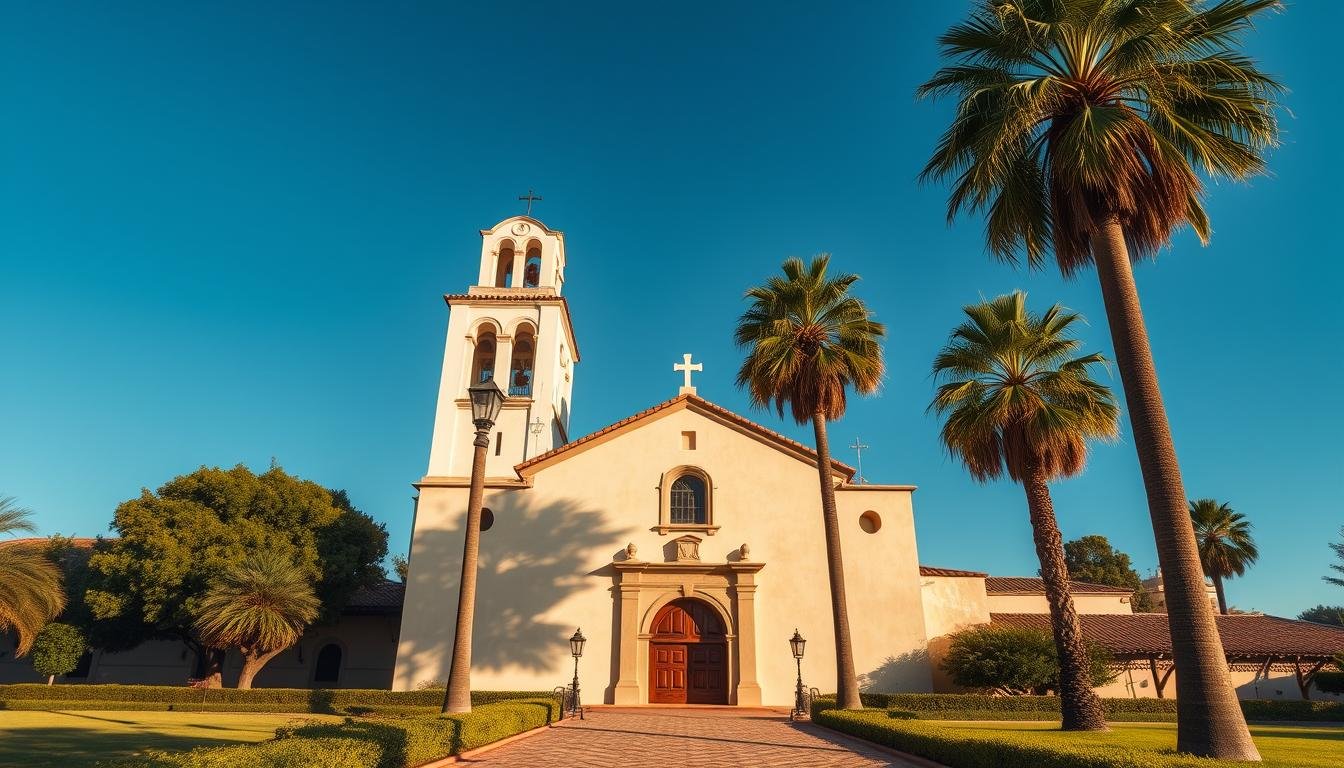
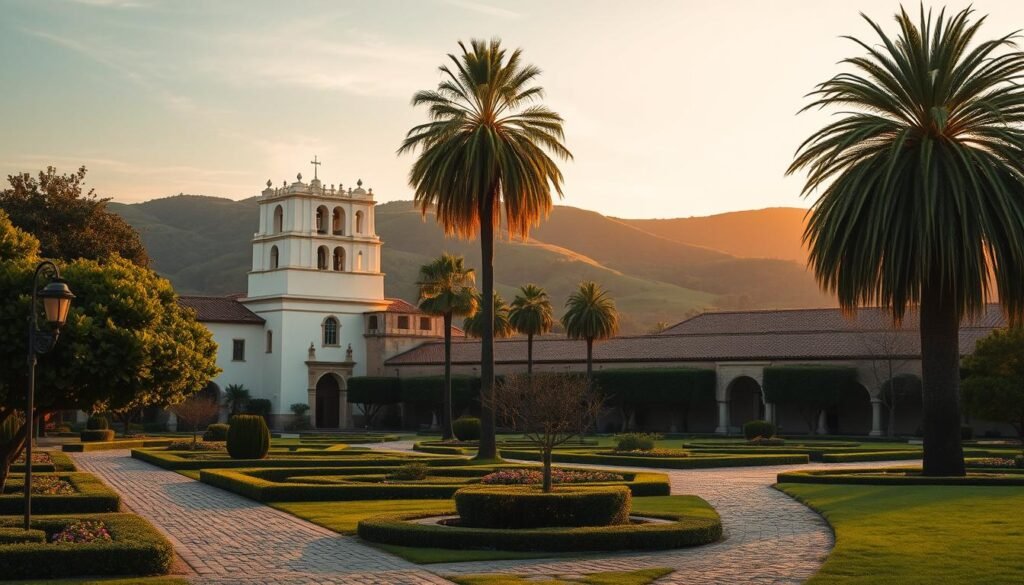
Mission Santa Barbara is known as the “Queen of the Missions” in California. It was founded in 1786. This place tells a story of early European settlers and Native American interactions.
In Santa Barbara, this mission is more than a building. It shows California’s rich culture through stunning architecture. It keeps centuries of history alive, drawing visitors from everywhere.
The Mission Santa Barbara started on December 4, 1786, by Father Fermín Lasuén. It’s in a coastal area, where Spanish colonists and Chumash people met.
Kids will find it amazing how this mission survived tough times. Earthquakes, government changes, and cultural shifts didn’t stop it. Its beauty and strength make it a key part of California’s history, sparking curiosity and dreams.
The Story Behind California’s Most Beautiful Mission
Mission Santa Barbara is a stunning landmark in California’s history. It’s a beautiful example of Spanish colonial architecture, set between the Pacific Ocean and Santa Ynez Mountains. Founded in 1786, it marks an important part of santa barbara mission history.
Why It’s Called the Queen of Missions
Many call Mission Santa Barbara the “Queen of Missions” for good reasons:
Exceptional architectural preservation
Stunning geographical location
Continuous operational status from its founding
Remarkable cultural significance
The Mission’s Location and Setting
The mission is in Santa Barbara, California, on a stunning landscape. It was chosen to strengthen Spanish claims in Alta California.
Important Dates to Remember
Here are some key moments in the mission’s history:
1786: Official founding by Spanish missionaries
1812: Completed main church construction
1834: Secularization under Mexican government
1865: Returned to Catholic Church ownership
The mission’s lasting beauty and history inspire many. It’s a true treasure in santa barbara mission history.
Are you ready for some cool facts about Mission Santa Barbara? This place is like a time machine that takes you back to California’s early days. It’s the tenth mission in Alta California and has amazing stories to share.
Here are some awesome mission details:
Founded in 1786 by Spanish missionaries
Nicknamed the “Queen of Missions” because of its stunning beauty
Home to the Chumash-Barbareño people for thousands of years
The mission is in a beautiful spot that will amaze you. It’s between mountains and ocean, like a postcard. Kids love learning about the kid-friendly mission information that shows how people lived long ago.
Mission Quick Facts
Cool Details
Established
December 4, 1786
Location
Santa Barbara, California
Native Tribe
Chumash-Barbareño
Mission Number
10th in California
Did you know this mission has survived earthquakes, storms, and hundreds of years of history? It’s incredibly resilient! The Chumash people played a big role in building and keeping the mission, creating a unique community.
The Founding of Mission Santa Barbara in 1786
In the summer of 1786, Mission Santa Barbara was born. It was a key moment in California’s history. Father Fermín Lasuén was key in starting this mission.
Father Fermín Lasuén’s Vision
Father Fermín Lasuén had a big dream. He wanted to create a place of faith and culture in California. His goals were:
Spread Christianity among Native American communities
Establish a permanent Spanish settlement
Create an agricultural and educational center
The First Buildings and Construction
Building Mission Santa Barbara was tough. They used local materials and Native American help. The design mixed Spanish styles with local building methods.
Construction Element
Materials Used
Significance
Walls
Adobe bricks
Provided insulation and durability
Roof
Wooden beams and clay tiles
Protected from weather
Foundation
Stone and compacted earth
Ensured structural stability
Early Mission Life
The early days of Mission Santa Barbara were full of learning. Native Chumash people worked alongside Spanish missionaries. They learned new farming skills and joined in daily tasks.
Father Fermín Lasuén led the mission to success. It became a place where faith and practical skills like farming and craftsmanship thrived.
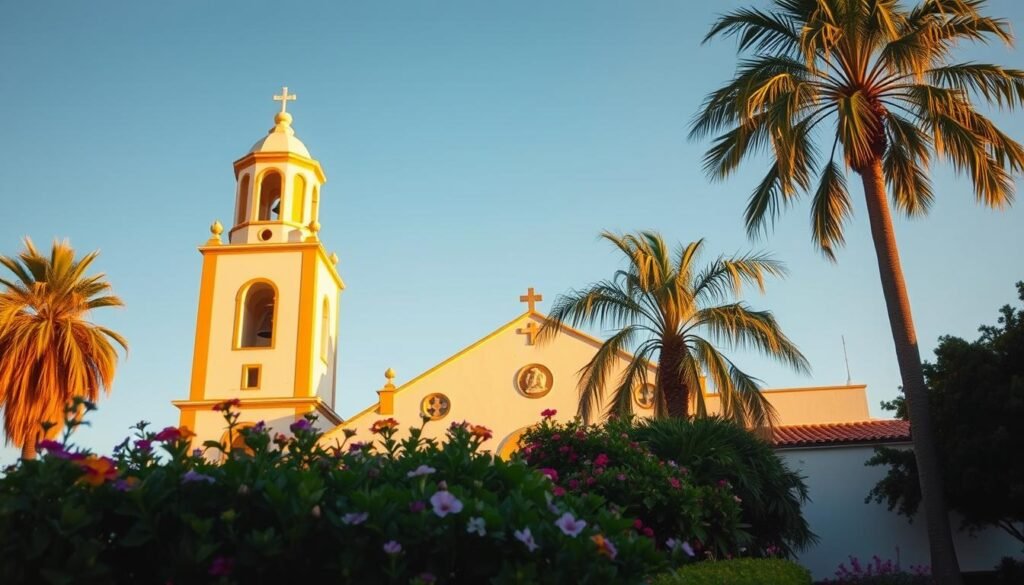
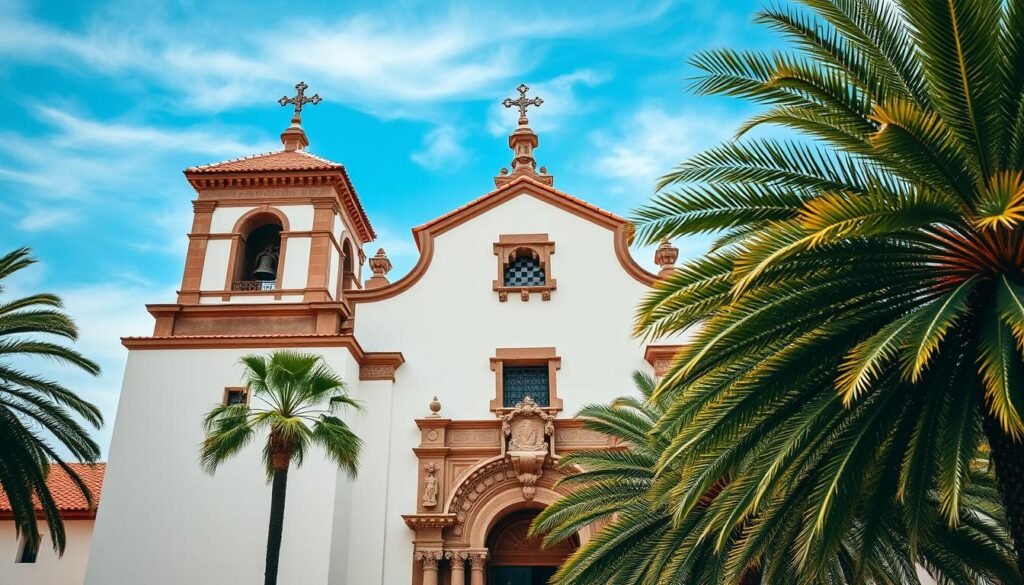
The Santa Barbara Mission’s architecture is famous for its twin bell towers. These towers stand tall above the main building, creating a stunning view against the California sky.
Mission bell towers were more than just buildings. They played a key role in mission life. They helped spread time and important messages to everyone.
The towers feature six remarkable bells
Each bell is dedicated to a different saint
The bells were cast in different years
Visitors to Mission Santa Barbara can see the detailed work of these bell towers. The towers’ symmetrical design shows the skill of the builders. They built a structure that has lasted for centuries.
Bell Number
Saint Dedication
Year Cast
1
Saint Barbara
1789
2
Saint Francis
1795
3
Saint Clare
1802
4
Saint Joseph
1807
5
Saint John
1812
6
Saint Mary
1820
The Santa Barbara Mission’s architecture is known for its detailed bell towers. Their beauty continues to attract visitors and historians. They are a key part of California’s cultural heritage.
The Chumash People and Mission Life
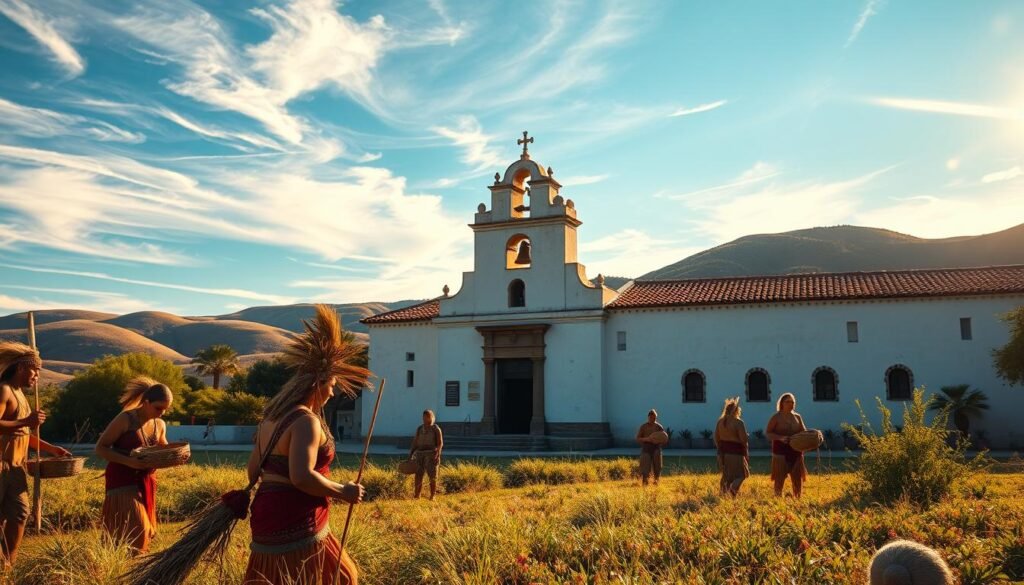
The Chumash tribe was key in Mission Santa Barbara’s history. They were the first people in California’s coastal areas, with a deep culture before Europeans came. Their time with Spanish missionaries was a turning point in California’s early days.
Daily Activities at the Mission
Chumash people were essential to the mission’s daily tasks. They helped in many important ways:
Agricultural cultivation of crops
Animal husbandry and livestock management
Construction and maintenance of mission buildings
Crafting tools and essential equipment
Traditional Chumash Culture
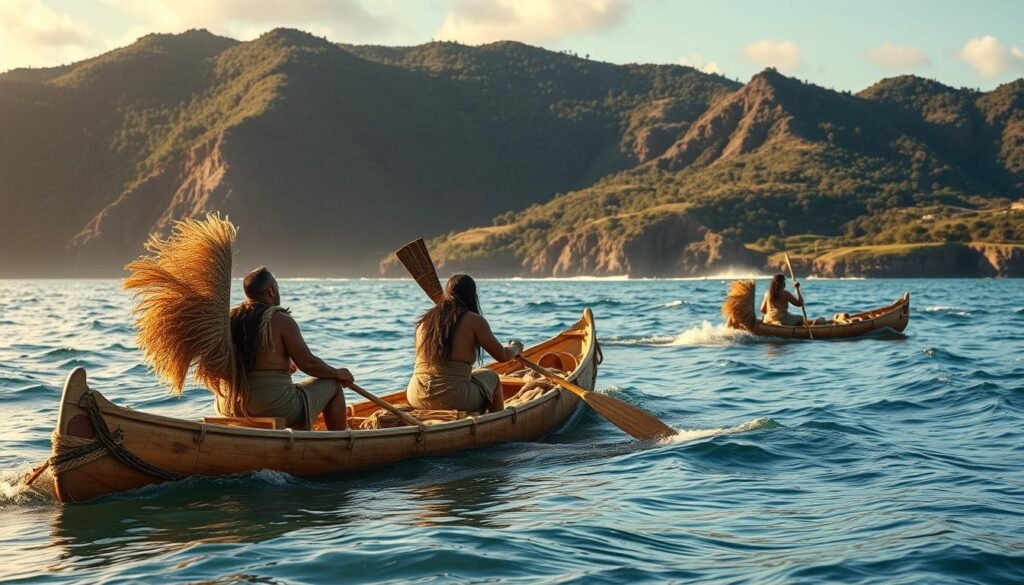
Before the mission, the Chumash had a rich society. Skilled maritime people, they were known for their boat-building and basket weaving. Their social structure and connection to nature made them stand out among California’s tribes.
Working and Living Together
The relationship between Chumash and missionaries was complex. The mission system changed their lives, but they also shared knowledge. The Chumash taught new farming skills and shared their survival expertise.
Mission Santa Barbara’s history shows a key moment of cultural exchange. It highlights the Chumash’s strength and ability to adapt during a big change.
Gardens and Water Systems
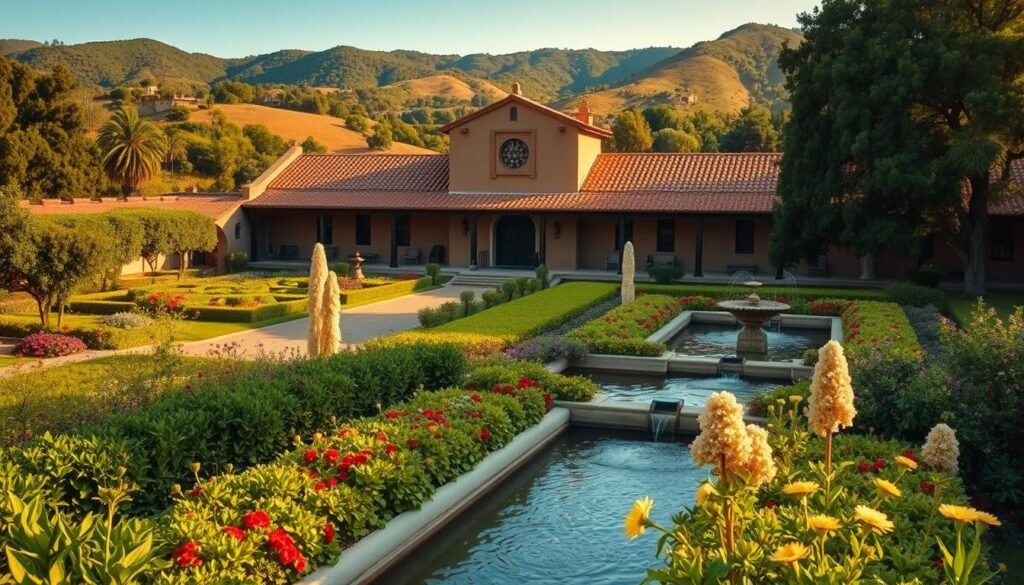
The mission santa barbara gardens were more than just beautiful spaces. They were key to the mission community’s survival. These gardens showed the colonists’ advanced skills in agriculture and water management.
The colonial water systems at Mission Santa Barbara were an engineering marvel. Settlers created complex systems to capture, store, and distribute water. They built:
Complex aqueduct networks
Strategically placed reservoirs
Innovative filtration techniques
Gravity-driven water distribution
Franciscan missionaries changed the landscape with European farming methods. They mixed Chumash plant knowledge with Spanish techniques. This created gardens with crops like:
Wheat
Corn
Vegetables
Fruit trees
Water management was vital in dry California. The mission’s systems made farming possible. They diverted streams and built underground channels for water.
The mission santa barbara gardens show human adaptability and resourcefulness. Today, visitors can see parts of these amazing systems that helped the community survive.
Amazing Architecture Features
Mission Santa Barbara is a stunning example of colonial architecture. It shows a mix of Spanish and Native American building styles. This blend has amazed visitors for many years.
The mission’s architecture is known for its unique features. Builders used special techniques to make a beautiful and strong building. This building could stand up to California’s tough weather.
Unique Architectural Design
Symmetrical facade with graceful proportions
Twin bell towers that define the mission’s skyline
Romanesque Revival architectural style
Intricate stone and adobe wall construction
Colonial Building Materials
Building materials from the colonial era were key in the mission’s creation. The builders showed great skill by using local resources.
Material
Purpose
Origin
Stone
Primary structural material
Local quarries
Adobe
Wall construction
Native clay and straw mixture
Limestone
Decorative elements
Regional stone deposits
After 1812, stone became the main building material. The mission was restored after the 1925 earthquake. This kept its original look and historical value.
The mission’s design was ahead of its time. Detailed stone masonry and precise structural planning made it strong and beautiful.
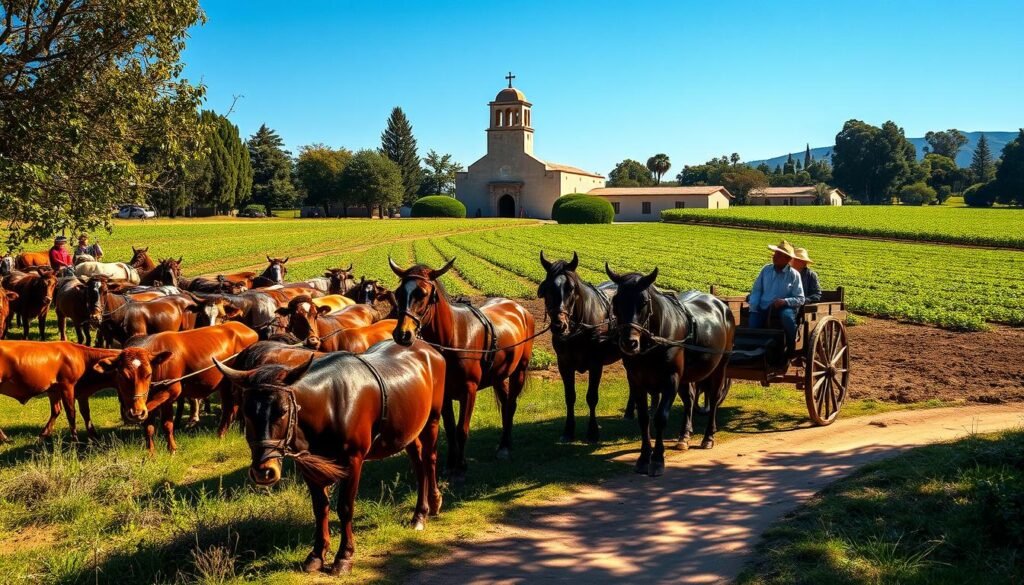
The Mission Santa Barbara farm was a key part of early California’s colonial agriculture. Franciscan missionaries created a thriving agricultural system. This system changed the landscape and supported the community’s life.
The mission’s farming was truly impressive. Between 1806 and 1810, they kept an average of 14,000 animals. These included:
Cattle
Sheep
Horses
Goats
Chumash Native Americans were vital in the mission’s farming. They worked with missionaries to develop advanced farming and animal care techniques.
Animal Type
Estimated Population
Primary Use
Cattle
8,000
Meat, Leather, Milk
Sheep
4,500
Wool, Meat
Horses
1,200
Transportation, Labor
Goats
300
Milk, Meat
The mission grew crops like wheat, barley, corn, and vegetables. These farming successes helped shape California’s farming future.
The Mission’s Role in Education
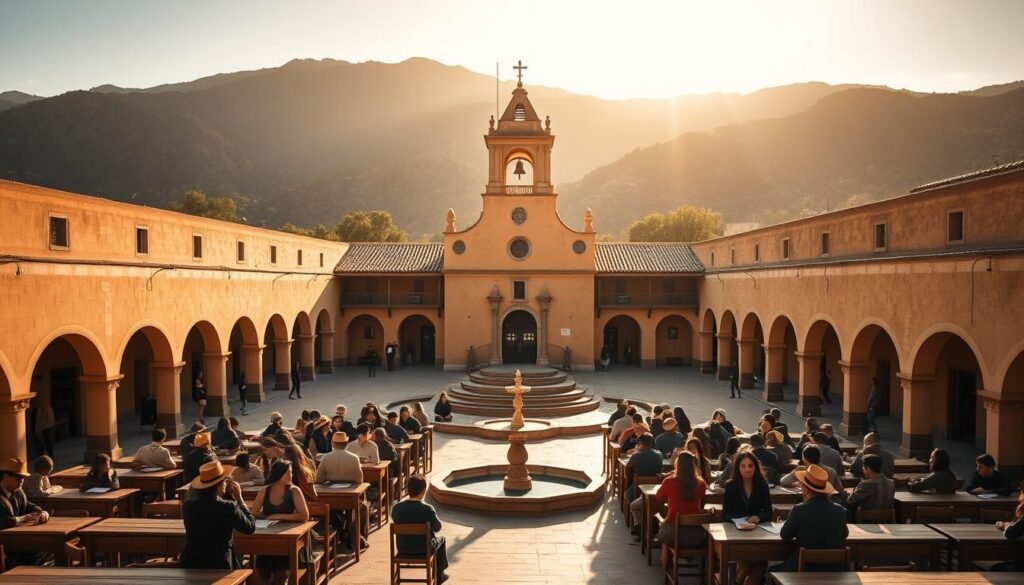
Mission Santa Barbara was key in shaping education in colonial California. It became a major learning center, changing education in the Santa Barbara area.
The mission started with new teaching methods. Students learned a lot, mixing cultural knowledge with practical skills.
First School in Santa Barbara
The mission’s school was the first in the area. It brought structured learning to local communities. Some key achievements were:
Teaching indigenous children to read and write
Teaching skills like farming and crafts
Teaching about religion
Helping students speak multiple languages
Teaching and Learning Programs
The mission’s programs were ahead of their time. Students learned by doing, getting ready for life in colonial times.
Vocational Training: Students learned carpentry, farming, and crafts
Cultural Exchange: They learned languages and cultures from both sides
Spiritual Education: They learned about religion and practical skills together
Mission Santa Barbara’s focus on education helped start a tradition of learning in Santa Barbara. It left a legacy of knowledge and cultural understanding.
Natural Disasters and Rebuilding
Mission Santa Barbara has faced many challenges, like the mission santa barbara earthquakes. It shows its strength by bouncing back from big natural disasters.
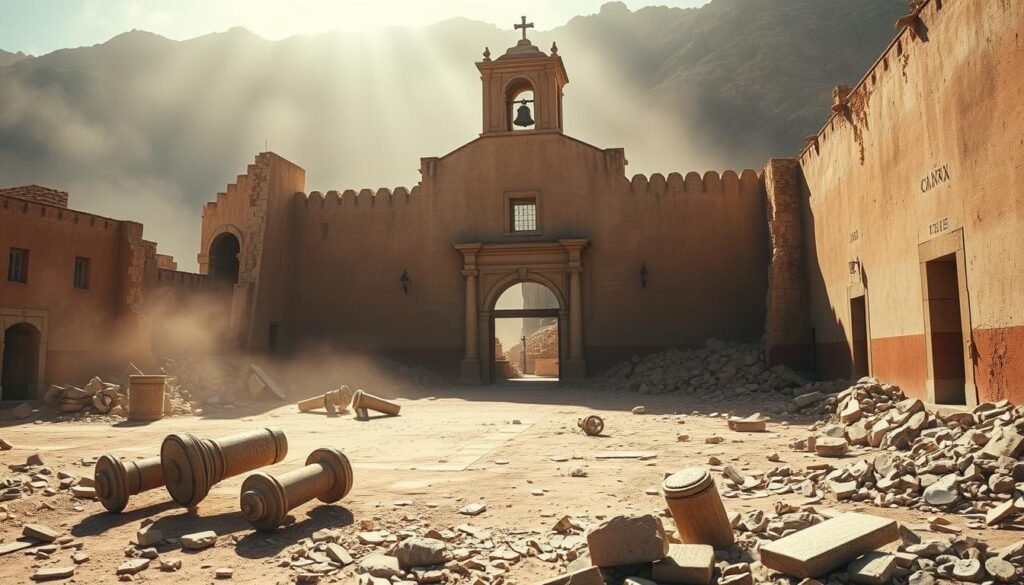
In 1812, a huge earthquake hit the California coast. It hit the mission hard. Workers started fixing the damage right away.
The earthquake made big cracks in the stone walls. It also damaged several important buildings.
1812 Earthquake damage assessment:
Extensive structural damage to stone walls
Partial collapse of original mission buildings
Disruption of daily mission activities
Then, in 1925, another earthquake tested the mission’s strength. The community worked hard to rebuild it. Skilled craftsmen fixed the damaged parts, keeping the mission’s look.
The mission’s survival through these earthquakes is amazing. Each time it was fixed, it kept a piece of California’s history alive.
Key restoration techniques:
Careful stone replacement
Reinforcement of original structures
Preservation of historical architectural details
Today, visitors can see the signs of these earthquakes. They remind us of the mission’s long journey and its strength.
The Mission’s Sacred Art Collection
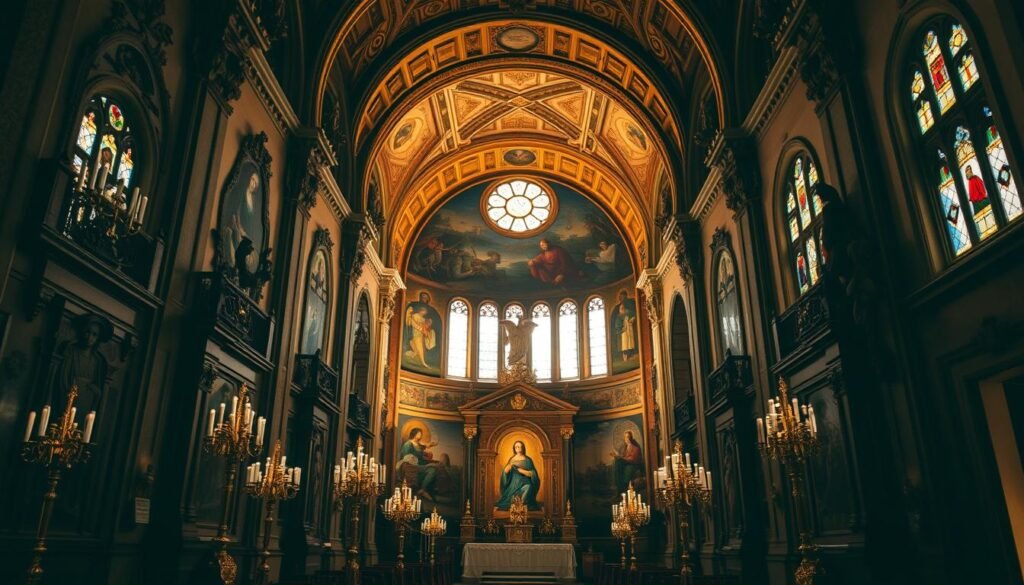
Mission Santa Barbara art shows a world of colonial religious artifacts. These pieces tell stories of faith and creativity. The mission’s art collection is a testament to the artistic traditions brought by Franciscan missionaries in the late 18th century.
The sacred art collection includes stunning elements that capture visitors’ imaginations:
Ornate statues carefully transported from Mexico
Intricate colonial Franciscan music manuscripts
Handcrafted religious paintings depicting biblical scenes
Delicate wooden crucifixes with detailed carvings
Visitors can explore mission santa barbara art that blends European and indigenous artistic influences. The statues above the altar show exceptional craftsmanship. Each piece silently tells a story of spiritual devotion.
Colonial religious artifacts in the collection show remarkable preservation. Franciscan missionaries protected these treasures for future generations. They ensured we could appreciate their historical and cultural significance.
The art collection offers a glimpse into the spiritual and artistic world of early California missions. It lets visitors connect with a rich cultural heritage that shaped the region’s history.
Modern Day Mission Activities
Mission Santa Barbara is a key cultural spot in California today. It shows off its great preservation and importance to the community. Visitors can see many interesting places that make history come alive.
The mission plays a big role in today’s world:
Operational Franciscan Friary housing religious community members
Educational museum displaying historical artifacts
Comprehensive research center with extensive archives
Popular tourist destination attracting thousands annually
The Santa Barbara Mission-Archive Library is a treasure for researchers and history lovers. It has collections that give a deep look into California’s cultural past. It keeps documents and materials from the mission’s start to now.
Visitors can enjoy mission santa barbara today through many activities:
Guided historical tours
Gift shop featuring unique mission-related merchandise
Retreat house with spaces for spiritual contemplation
Educational programs for schools and community groups
The mission is a living link to California’s rich history. It connects old traditions with today’s cultural experiences.
Fun Facts About Mission Santa Barbara
Ready to dive into some mind-blowing mission santa barbara trivia? Get set for an exciting journey through interesting mission facts that will make your history-loving brain buzz!
The mission holds the incredible record of being the only California Mission that was never abandoned
It’s nicknamed the “Queen of the Missions” for its stunning architectural beauty
Mission Santa Barbara boasts the oldest unbroken tradition of choral singing among all California Missions
Did you know this mission has some seriously cool unique status? It serves as a pro-cathedral, which means it’s an important administrative church for the local diocese.
Mission Santa Barbara Trivia
Fascinating Details
Founding Year
1786
Architectural Style
Spanish Colonial Revival
Current Use
Active Catholic Church and Historic Museum
The mission’s twin bell towers are not just pretty – they’re a historic landmark that has survived multiple earthquakes and reconstructions. These towers have witnessed over 200 years of California’s rich history!
The mission’s original adobe walls are up to 5 feet thick
It has preserved over 75% of its original structures
The mission’s museum contains artifacts dating back to the Spanish colonial period
Visitors can explore this living piece of history and discover why Mission Santa Barbara continues to captivate history buffs and curious explorers alike.
Visiting the Mission Today
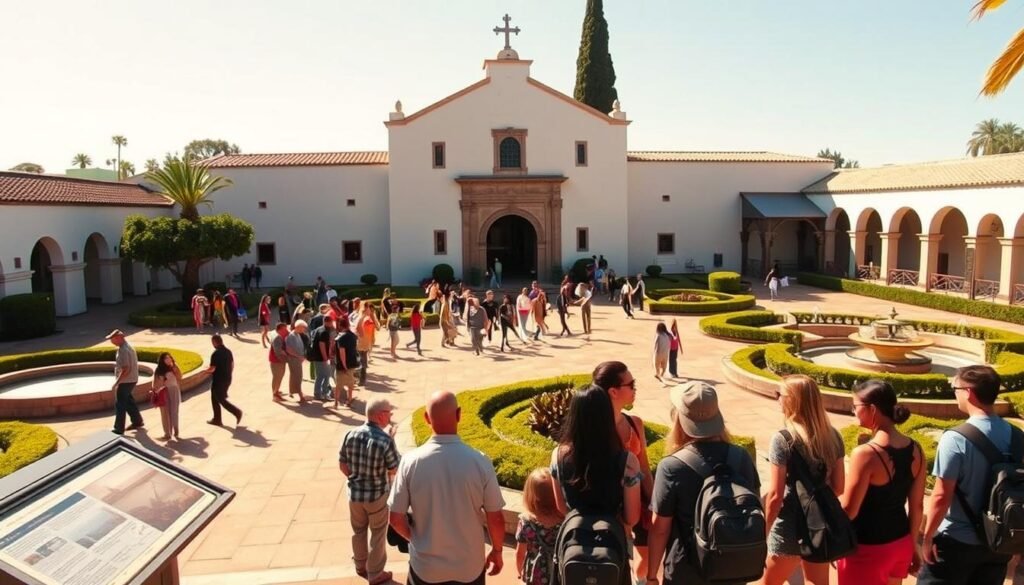
Mission Santa Barbara is a great place for families and history lovers. It offers guided tours that show California’s rich culture. Kids can see the historic grounds and learn about the mission’s history through fun tours.
It’s easy to plan your visit. The mission is open six days a week. It has activities for kids that make learning fun. You can see preserved rooms, beautiful gardens, and artifacts that tell the story of early California.
The area around the mission is also worth exploring. There are public parks and museums nearby. You can walk, take photos, and learn about the Chumash people. The mission also has special programs and events for families.
Admission is affordable, with discounts for students and groups. You can take photos in most areas. Check the official website for hours, exhibits, and seasonal events to make your visit even better.