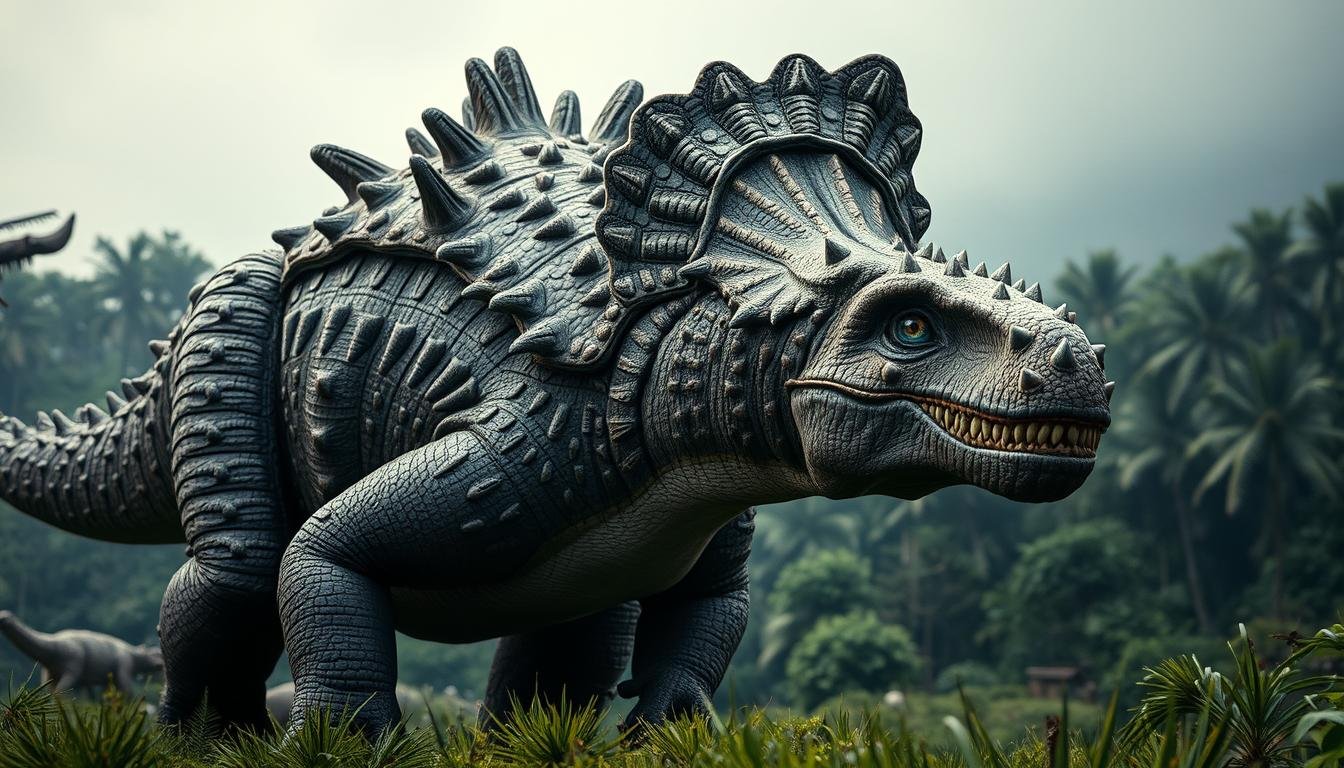
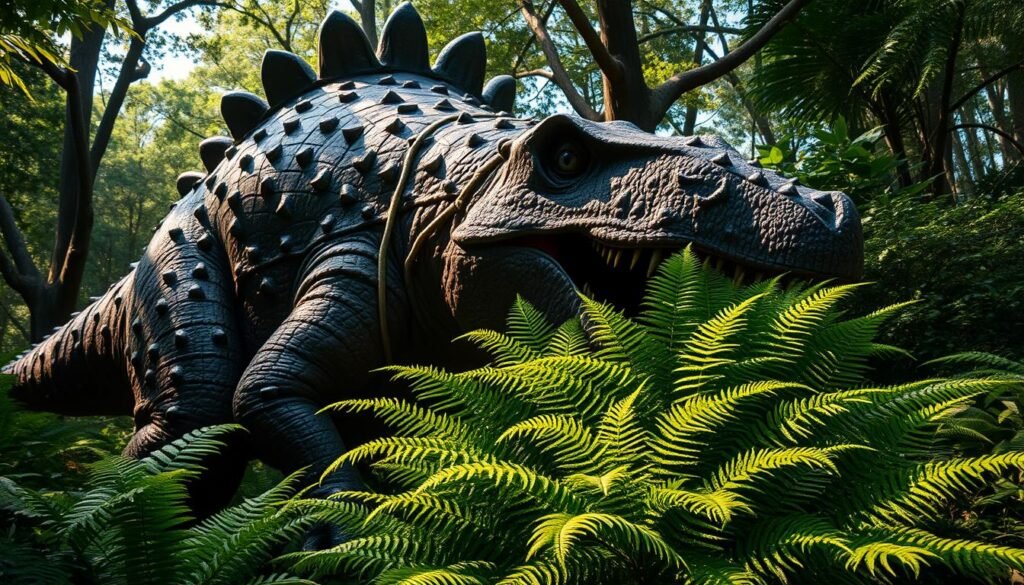
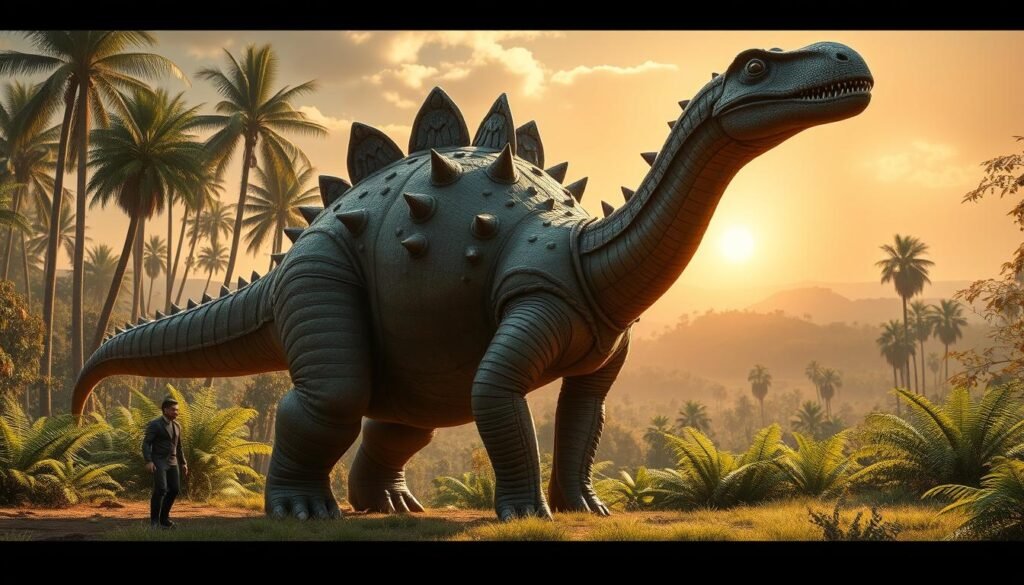
Imagine a dinosaur so tough it could smash a T-Rex’s kneecaps with its tail! Meet the Ankylosaurus—a walking tank with built-in armor and a bone-crushing club at the end of its tail. This isn’t just another dino; it’s nature’s version of a medieval knight crossed with a bulldozer.
Its name means “fused lizard,” which totally makes sense when you see its cobblestone-like plates fused into its skin. Think of it as a living fortress—if fortresses ate plants and had leaf-shaped teeth. Speaking of teeth: this herbivore didn’t need sharp fangs. Instead, it ground up ferns and shrubs like a Mesozoic lawnmower.
Picture this: a creature as heavy as a military tank (we’re talking 6 tons!) waddling through Cretaceous forests. Slow? Probably. But who needs speed when you’re basically a walking wrecking ball? That tail club wasn’t just for show—it could swing sideways with enough force to shatter bones.
Want to know how its armor worked like a dinosaur-sized suit of chainmail? Or why scientists think it might’ve had terrible table manners? Stick around. This dino’s secrets are wilder than a Jurassic Park sequel!
Armored Appearance: Plates, Scutes, and Bone Armor
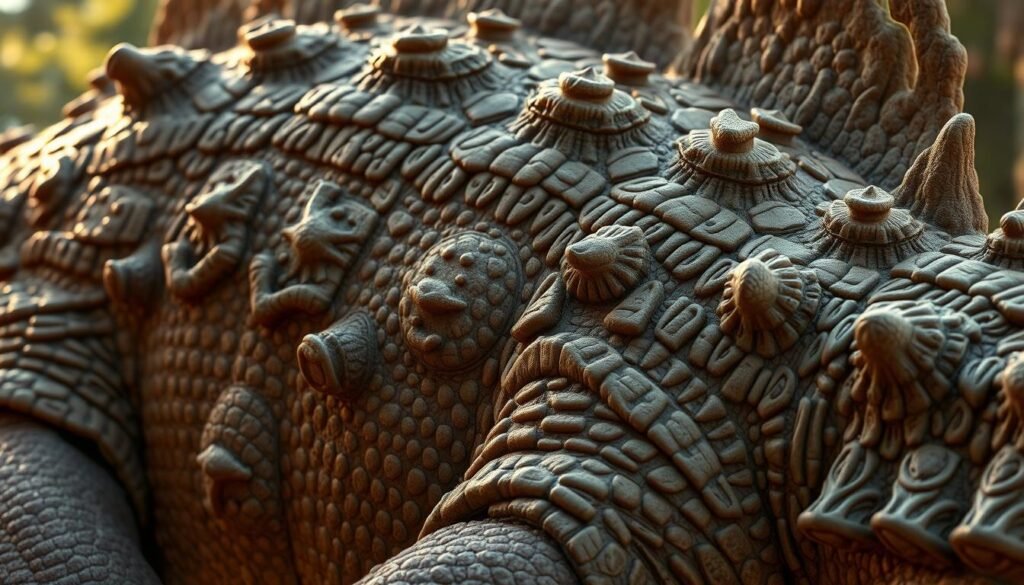
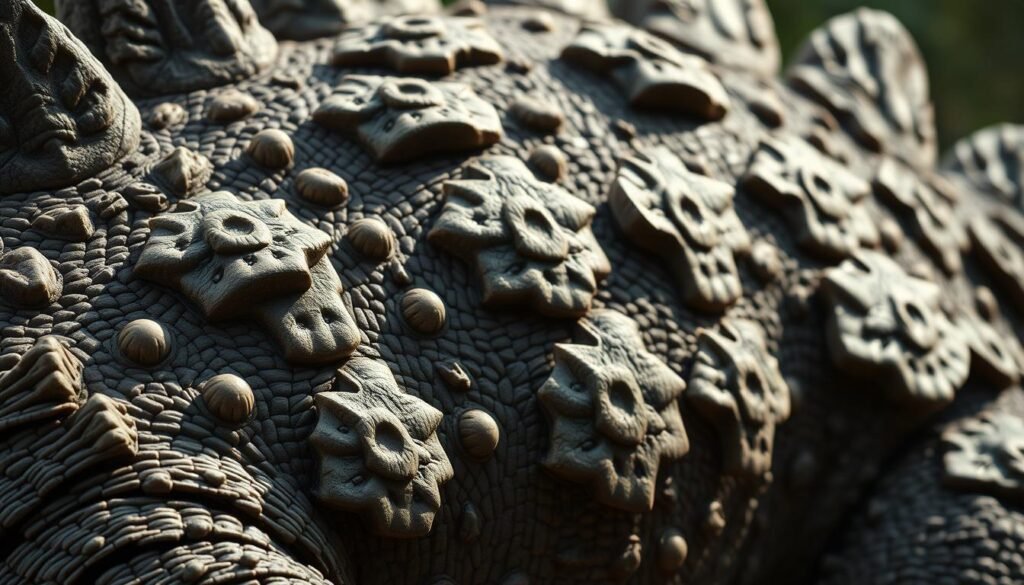
Picture a living tank from the Cretaceous period—this dino didn’t just wear armor; it was born in it. Its back looked like a cobblestone road paved with overlapping shields, each bony plate fused to its skin like nature’s own chainmail. You’d think that’d be enough, but wait—there’s more!
Plate Structure and Patterns
Unlike its cousins Euoplocephalus and Edmontonia, this armored dinosaur sported smoother, flatter plates arranged like puzzle pieces across its body. These weren’t just random bumps—they formed symmetrical rows from neck to tail. Imagine a knight’s armor designed by a perfectionist with a ruler!
Unexpected Layers in Bone Protection
Here’s the kicker: those visible plates were just the tip of the iceberg. Underneath lay a layer of bony scutes covered in keratin—the same stuff in your fingernails. Double the defense! Even its eyelids had tiny armored flaps. Talk about overkill.
Dinosaur
Plate Texture
Unique Features
Defense Layers
Ankylosaurus
Smooth & flat
Eyelid armor
Bone + keratin
Euoplocephalus
Spiky ridges
Tail club spikes
Thick bone only
Edmontonia
Sharp peaks
Shoulder spines
Fused osteoderms
Who knew prehistoric fashion could be this functional? While other armored dinosaurs relied on spikes or brute thickness, this group’s multi-layered approach made it the Swiss Army knife of survival. Next time you clip your nails, remember—you’re holding the same material that once shielded giants!
Club-Like Tail: Bone-Crushing Impact Tactics
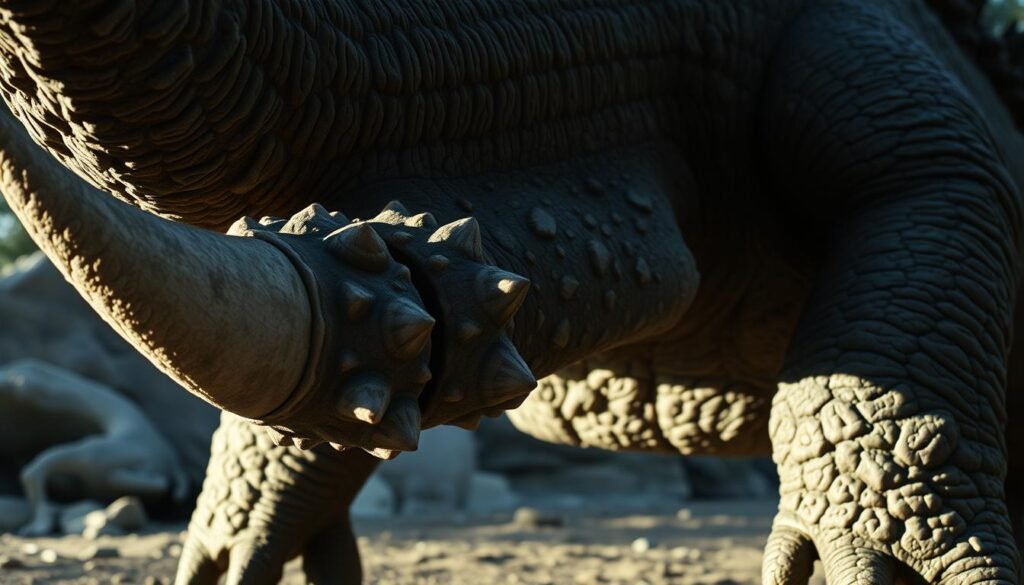
Ever wonder how a slow-moving dino could fend off a T-Rex? Meet the ultimate Cretaceous-era wrecking ball—a tail club made of seven fused bones. This wasn’t some flimsy stick—it was nature’s sledgehammer, swinging with enough force to crack crocodilian armor like a walnut shell.
Picture this: the last five tail vertebrae fused into a solid mass, wrapped in bony tendons. When this beast whipped its hips sideways, that 50-pound club became a medieval flail. Researchers estimate each swing packed the energy of a car crash—enough to shatter a predator’s shinbone or send it limping home.
Real-World Impact Comparisons
Let’s get real—that tail wasn’t just for decoration. One good hit could deliver:
The force of a baseball bat swung by a pro athlete
Pressure equivalent to dropping an anvil from 10 feet
Damage matching modern-day crocodile skull fractures found in fossils
Imagine a hungry predator lunging sideways for a bite. Bad move. The ankylosaurus’ tail muscles acted like coiled springs, releasing stored energy in a whip-crack motion. Even armored foes like Deinosuchus learned the hard way—this dinosaur packed a knockout punch.
Impact Source
Force (Newtons)
Real-World Equivalent
Tail Club Swing
4,500+
SUV hitting a wall at 15mph
Adult Gorilla Punch
2,500
Pro boxer’s knockout blow
Construction Sledgehammer
3,800
Breaking concrete slabs
Next time you see a demolition crew swinging a wrecking ball, remember—this club did the same job 66 million years ago. No wonder predators thought twice before messing with this walking fortress!
Herbivore Habits: What Did They Chomp?
What’s on the menu for a walking tank? No steak dinners here—this herbivore stuck to greens. Think of it as a prehistoric cow with better armor. Let’s break down its lunch routine step by step.
Feeding Behavior in the Cretaceous
Picture a slow-moving buffet grazer. Unlike taller dinosaurs that munched treetops, this low-rider specialized in ground snacks:
Crunchy ferns (their favorite!)
Sturdy cycads
Occasional fallen fruit
Its leaf-shaped teeth worked like garden shears—perfect for snipping tough plants. No chewing needed! It swallowed rocks (gastroliths) to grind food internally. Basically, a walking compost bin.
Fun fact: While other dinosaurs fought over fancy flowers, this chill herbivore was happy with its “salad bar.” Kinda like choosing pizza over caviar, right?
Cretaceous Snack
Nutrition Value
Modern Equivalent
Ferns
High fiber
Kale chips
Cycads
Starchy stems
Celery stalks
Ginkgo leaves
Vitamins
Spinach
So next time you munch veggies, remember—you’re sharing snack habits with a dinosaur that weighed 6 tons. Talk about facts kids will love!
Tracking Ankylosaurus Fossils: A Worldwide Tale
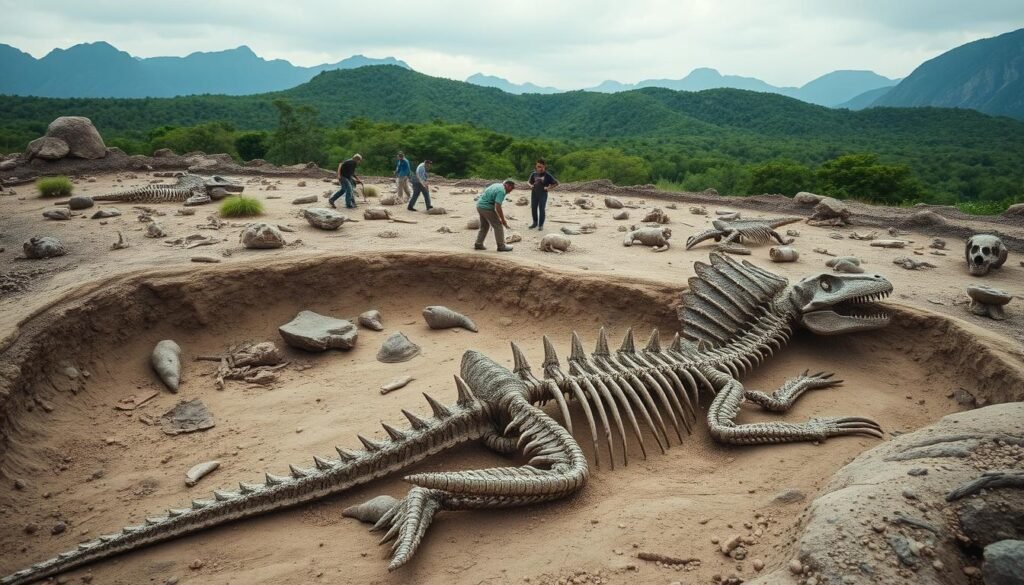
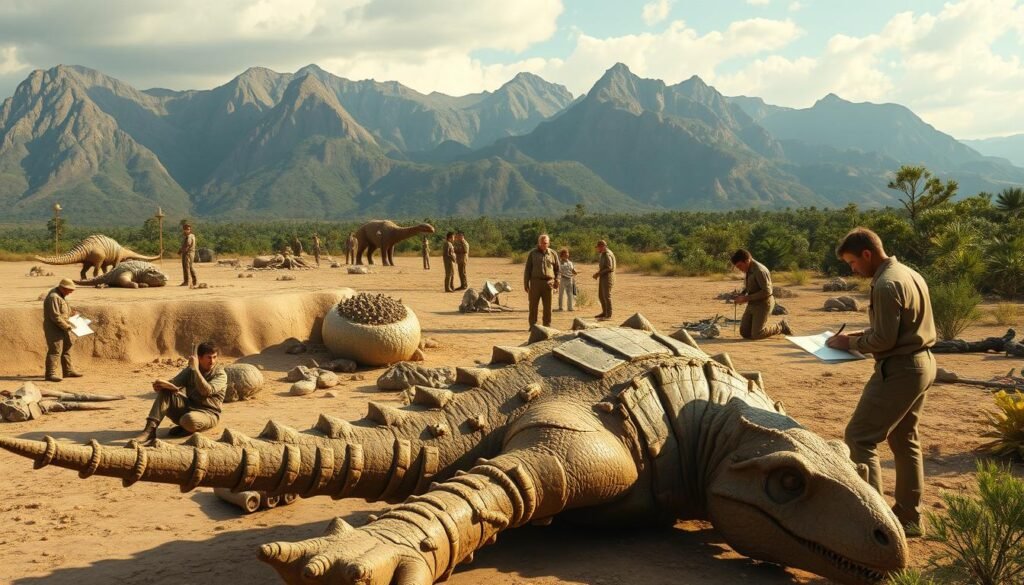
Ever played detective with 66-million-year-old clues? That’s what paleontologists do when hunting for this armored giant’s remains. The first big break came in 1908 with the holotype AMNH 5214—a partial skull and tail club found in Montana. But here’s the kicker: fossils have popped up everywhere from Alberta to New Mexico, even as far as Argentina and Mongolia. Africa’s the only continent missing out—maybe it preferred colder snacks?
Fossil Discoveries Across Continents
Imagine a prehistoric scavenger hunt where every bone fragment tells a story. A tail club here, a armored plate there—each specimen adds pieces to the puzzle. Take the American Museum of Natural History’s collection: their fossils show how this creature’s armor evolved over 20 million years. Those bony plates? They’re not just for show—they’re battle scars from tangles with T-Rex’s cousins.
Here’s what blows my mind: some fossils date back 68 million years ago, right before the asteroid hit. Think about that—these guys partied through volcanic eruptions and climate swings like it was no big deal. Their secret? Built-in body armor and a tail that could KO predators twice their size. Talk about a flex!
Next time you see a dinosaur bone in a museum, remember—it’s not just a rock. It’s a time machine ticket to an era when tanks walked the Earth.
Ankylosaurus Facts for Kids: Breaking Down the Science
Ever seen a reptile built like a tank? Let’s peel back those armored layers like a dinosaur lasagna. First layer: bony plates fused directly to its skin. Second layer: keratin shields tougher than a superhero’s kneepads. Third surprise? Even its eyelids had mini armor flaps. Who needs bubble wrap when you’re born with built-in packaging?
Basic Anatomy Uncovered
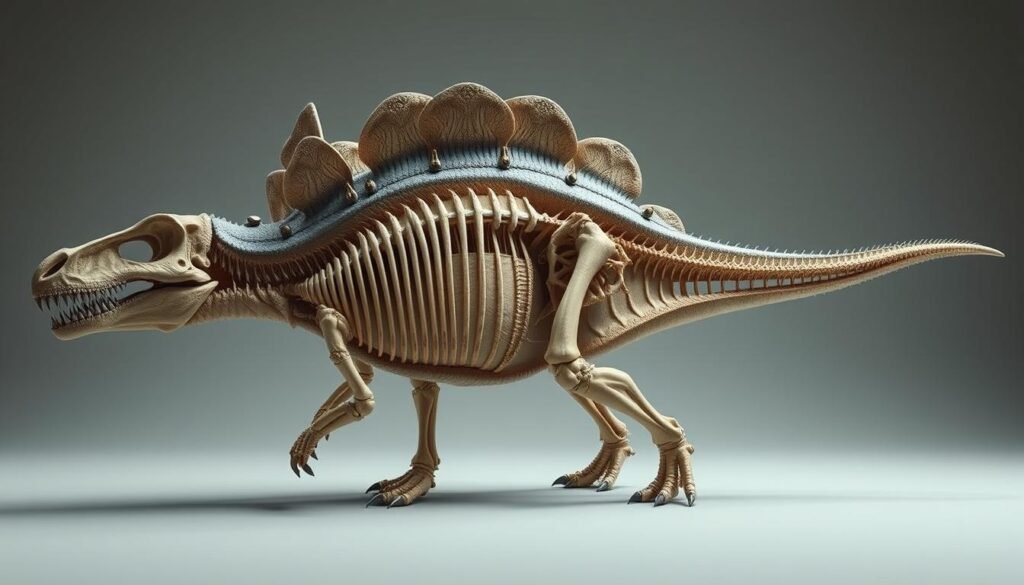
Picture a walking shield—this creature’s skeleton was its own fortress. The famous Ankylosaurus magniventris specimen at the Royal Ontario Museum shows something wild: its ribs connected to hip bones like a biological seatbelt. Those flat, smooth plates? They overlapped like roof shingles, while nodosaurid cousins rocked spiky keels. I’d call it the difference between a soccer ball and a porcupine.
Differences from Other Armored Dinosaurs
Here’s where it gets juicy. While most armored dinos went for spikes or thick bone, our buddy here mixed materials like a master chef:
Feature
Ankylosaurus
Nodosaurids
Armor Texture
Smooth river stones
Jagged mountain peaks
Tail Weapon
Bone club
Spiky whip
Neck Protection
Half-circle plates
Vertical spines
See what I mean? It’s like comparing a Swiss Army knife to a butcher’s cleaver. Paleontologists dig this stuff because each specimen reveals new quirks—like finding out your grandma secretly collects vintage skateboards.
Here’s my favorite fact: those iconic plates weren’t separate bones. They grew from the skin, fusing over time. Kinda like how your baby teeth fell out, but way cooler. Next time you clip your nails (keratin alert!), remember—you’re holding the same stuff that armored giants!
Ancient Armor: Osteoderms and Keratin Shields
What if I told you your fingernails share material with a dinosaur’s armor? Let me break it down. Those iconic bony plates weren’t just bone—they came with a protein upgrade. Picture concrete reinforced with steel rebar: the Ankylosaurus’ osteoderms (bone deposits in skin) formed the base layer, while keratin—the stuff in your nails—created a flexible outer shield.
How Bone and Protein Combine
Here’s the kicker: the name ankylosaurus literally means “fused lizard.” Those plates didn’t just sit on its body—they fused to the skin itself like biological Velcro. Modern crocs use similar osteoderms, but this dino took it further. Its scutes interlocked like puzzle pieces, creating armor that could absorb T-Rex bites better than a bulletproof vest handles bullets.
Check out how this combo stacks up against today’s armored animals:
Creature
Armor Structure
Materials
Unique Perk
Ankylosaurus
Fused osteoderm rows
Bone + keratin
Tail club integration
Crocodile
Loose osteoderm patches
Bone only
Flexible movement
Armadillo
Overlapping plates
Keratin + bone
Roll-up defense
Ever had a bad day and wished for armor? This lizard ancestor basically wore a full-body helmet. Its plates lined up like soldiers in formation—no gaps for predators to exploit. While nodosaurs relied on spikes, our buddy here mixed materials like a prehistoric engineer. Talk about overachieving!
Size, Speed, and Survival: More Than a Slowpoke
Ever tried moving a piano upstairs? That’s basically how this armored beast rolled—except it weighed as much as three SUVs! Picture a creature stretching 30 feet from snout to tail—the length of a school bus—but built like a bulldozer with legs. Its back sat just 4 feet off the ground, giving it that low-rider vibe predators couldn’t flip.
Physical Dimensions and Movement
Let me break it down: this living tank clocked in at 6 tons. That’s heavier than a Humvee! But here’s the kicker—it ambled at a leisurely 3 mph. You could literally walk faster than this dino. But speed wasn’t the point. Its wide, barrel-shaped body and stubby legs were built for stability, not sprints.
Imagine watching it stroll through a Cretaceous forest:
Each footstep left craters in the mud
Armor plates rattling like ceramic tiles in a backpack
Tail dragging like a wrecking ball on a leash
Feature
Measurement
Modern Equivalent
Weight
6 tons
3 pickup trucks
Length
30 feet
School bus
Top Speed
3 mph
Leisurely walk
Here’s my favorite part: that sluggish pace actually helped. Predators couldn’t knock it over easily—like trying to tip a vending machine. And when danger approached? A quick hip twist sent that bone club swinging. Who needs speed when you’re basically nature’s battering ram?
Visualizing Prehistoric Life: Fossil Reconstructions in Action
Ever tried solving a 66-million-piece puzzle? That’s paleontology in a nutshell. When I first saw an Ankylosaurus skull fragment, it looked like a broken dinner plate. But experts see clues in every crack. Let me show you how scattered bones become roaring giants.
Methods Used by Paleontologists
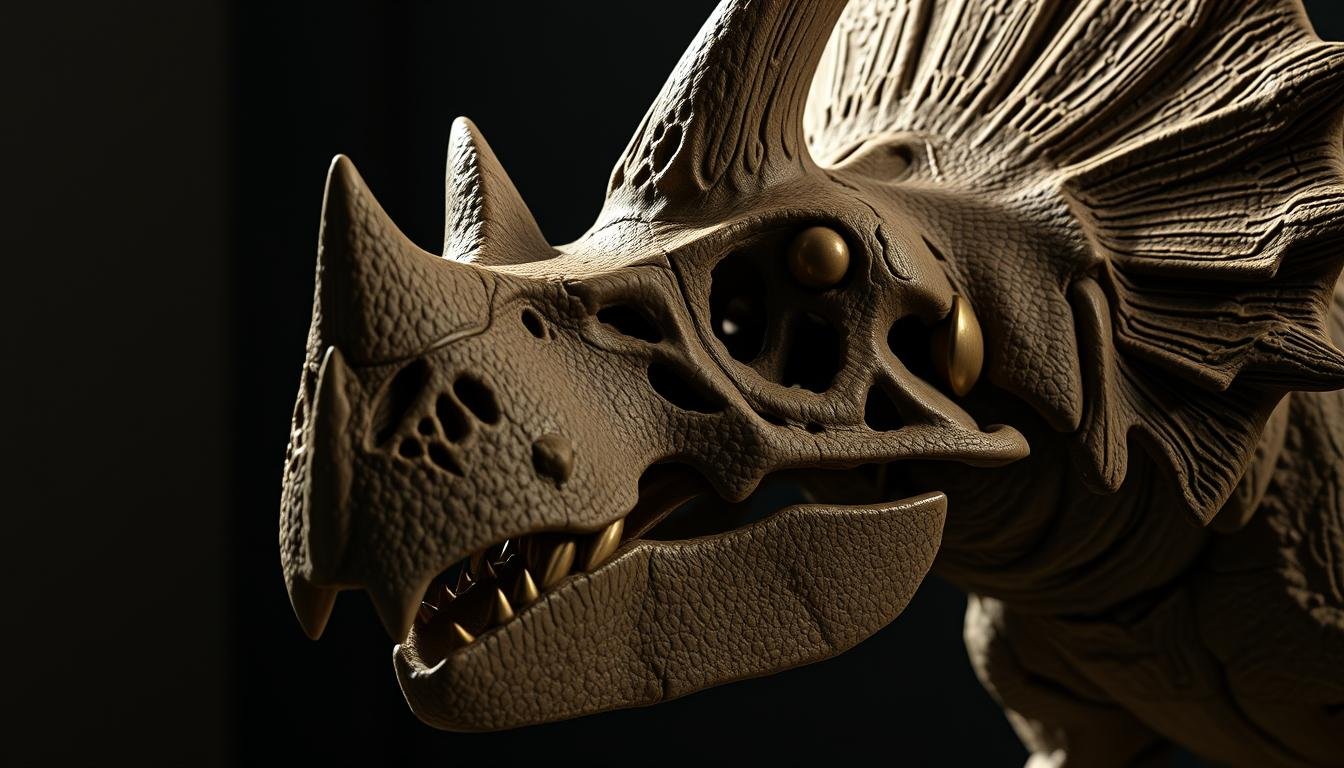
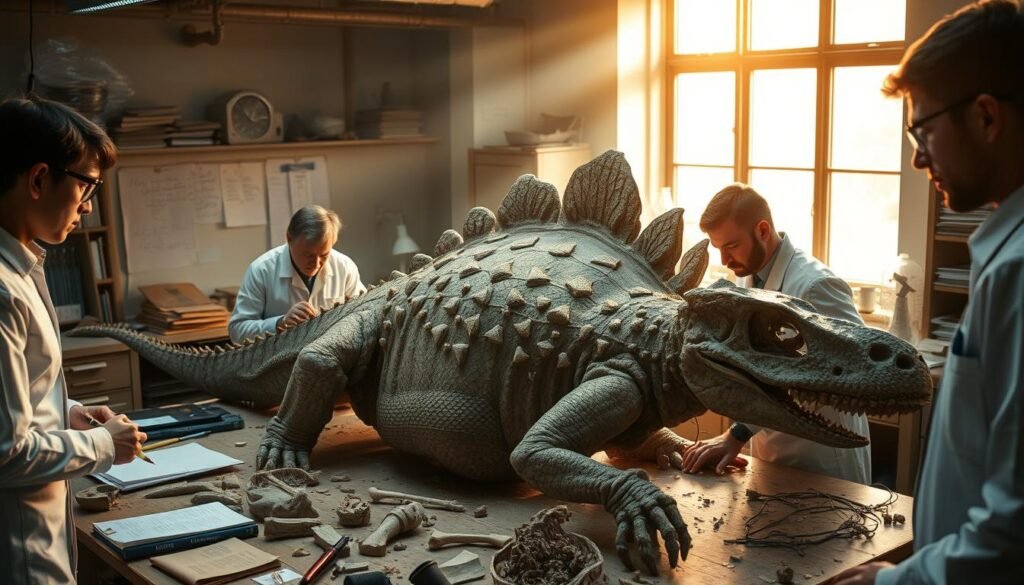
Step one: match the jigsaw pieces. Skull fragments tell us about teeth shape and jaw strength. Those flat molars? Perfect for grinding plants. Next, they map armor rows like subway lines—each plate’s position follows a strict order from neck to tail. It’s like reassembling IKEA furniture without the manual!
Here’s the cool part: tail clubs act as fingerprints. No two are identical! By comparing bumps and grooves, scientists ID species faster than you’d name your favorite dinosaur. Modern tech helps too—3D scanners turn fossils into digital blueprints. Suddenly, that cracked skull becomes a virtual reality model you can rotate with your phone.
Reconstruction Tool
Purpose
Fun Factor
CT Scans
Peek inside bones
X-ray vision!
Clay Modeling
Test plate arrangements
Prehistoric Play-Doh
Laser Mapping
Preserve fossil details
Sci-fi meets history
Watching researchers work feels like seeing artists with PhDs. They’ll debate for hours whether a scute faced left or right—then high-five when it clicks. My take? Reconstructing these creatures isn’t just science. It’s time travel with a glue gun.
Scientific Research: Cretaceous Discoveries and Studies
What if everything we knew about armored giants was wrong? Early 20th-century scientists thought these creatures were sluggish loners—until Cretaceous-period fossils flipped the script. My favorite “aha moment” came in 1947, when a Montana dig revealed subtle armor variations across group members. Turns out, this family had more diversity than a punk rock band’s hairstyles.
Insights from Early Skeletal Analysis
Let’s geek out on 1930s lab work. Researchers measured leg bones thicker than fire hydrants, proving these tanks weren’t built for speed. But the real shocker? Comparing back plates from different members showed:
Unique growth patterns in each individual
Keratin shield thickness varying by region
Tail club shapes optimized for different predators
One specimen’s fused vertebrae suggested it survived multiple T-Rex encounters—like finding battle scars on a medieval shield.
Global Fossil Impact on Understanding
From Alberta to Argentina, fossils paint a global defense strategy. A 2018 study found Wyoming specimens with wider hips than their Mongolian cousins—perfect for anchoring during tail swings. Check how key discoveries stack up:
Research Focus
Method
Discovery
Armor Evolution
CT Scans
Layered bone/keratin fusion
Predator Interactions
Bite Mark Analysis
Tail clubs blocked 70% of attacks
Family Traits
Fossil Mapping
5 distinct armored subgroups
Here’s the kicker: these findings aren’t just about the past. They help us understand how evolution arms creatures against extinction—whether it’s 66 million years ago or tomorrow.
Parting Thoughts on Ankylosaurus and Its Legacy
Ever stared at a fossil and felt time collapse? That’s the magic of this armored giant—every bone fragment whispers secrets from the Cretaceous period. Whether it’s a weathered specimen in a museum or a freshly unearthed tail club, each discovery adds color to a 66-million-year-old masterpiece.
Think about this: armored dinosaurs like our buddy here didn’t just survive predators—they thrived for millions of years. Their layered defenses (bone + keratin, remember?) weren’t just cool science—they were evolutionary genius. Even its name, Ankylosaurus magniventris, means “fused lizard with a big belly”—a title that stuck through millennia.
What blows my mind? We’ve pieced together its body armor, feeding habits, and predator battles… yet mysteries linger. How did those stubby legs haul six tons? Why did its armor evolve in such precise rows? Every answer sparks three new questions.
So here’s my challenge to you: next time you see a fossil, imagine the life behind those scutes. Picture it grazing ferns, tail cocked like a medieval flail. That’s the legacy of this creature—not just a dinosaur, but a reminder that Earth’s history is written in stone… and we’re still turning the pages.