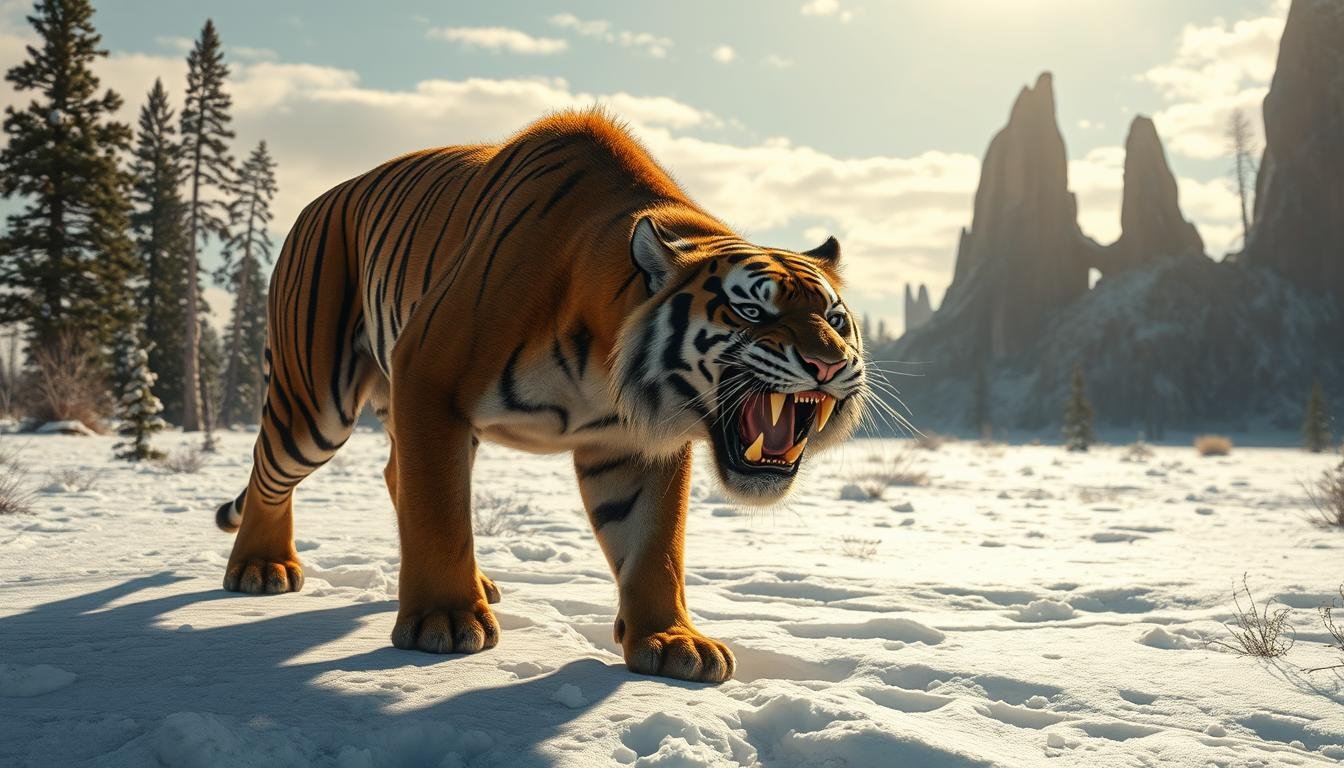
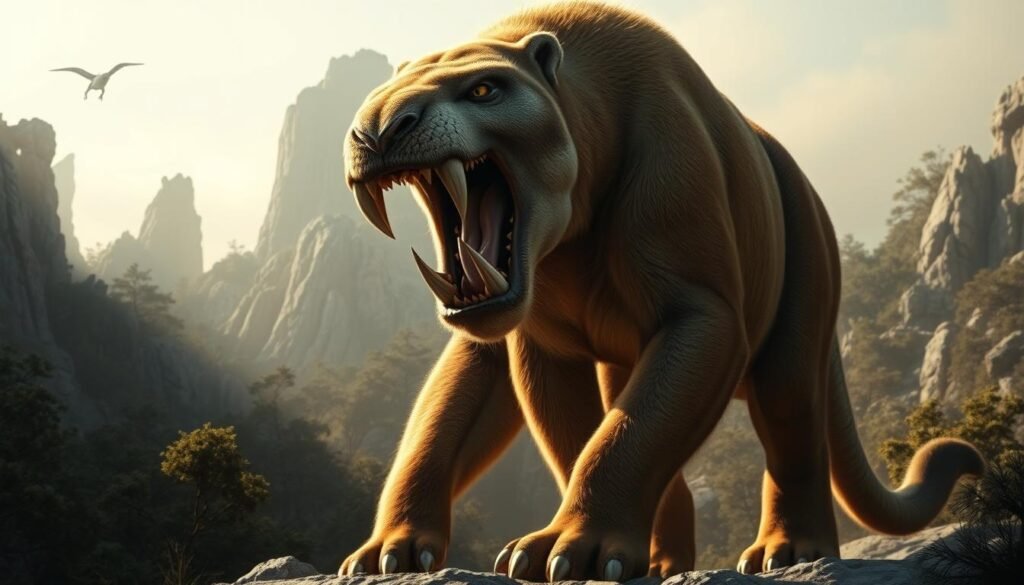
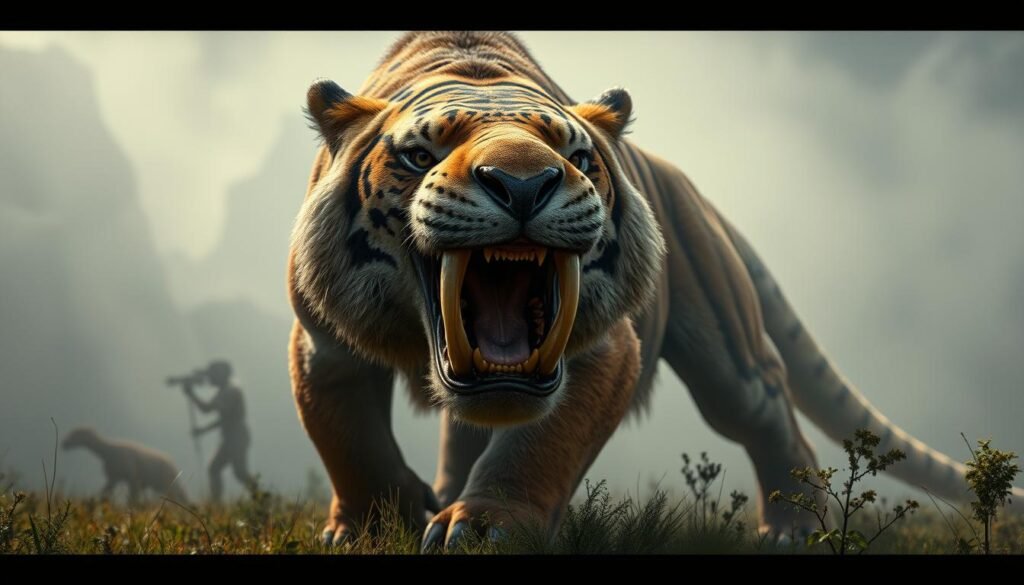
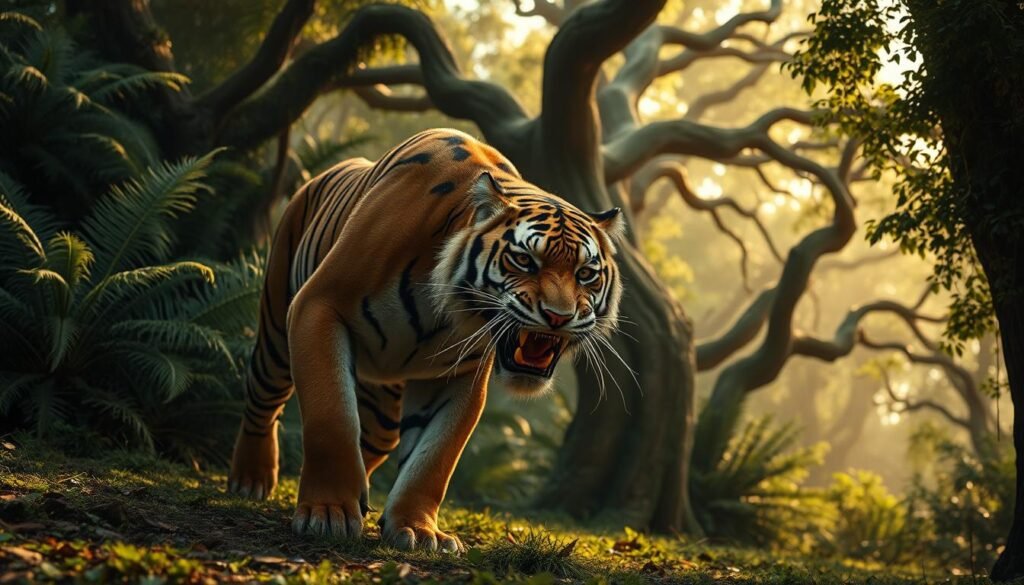
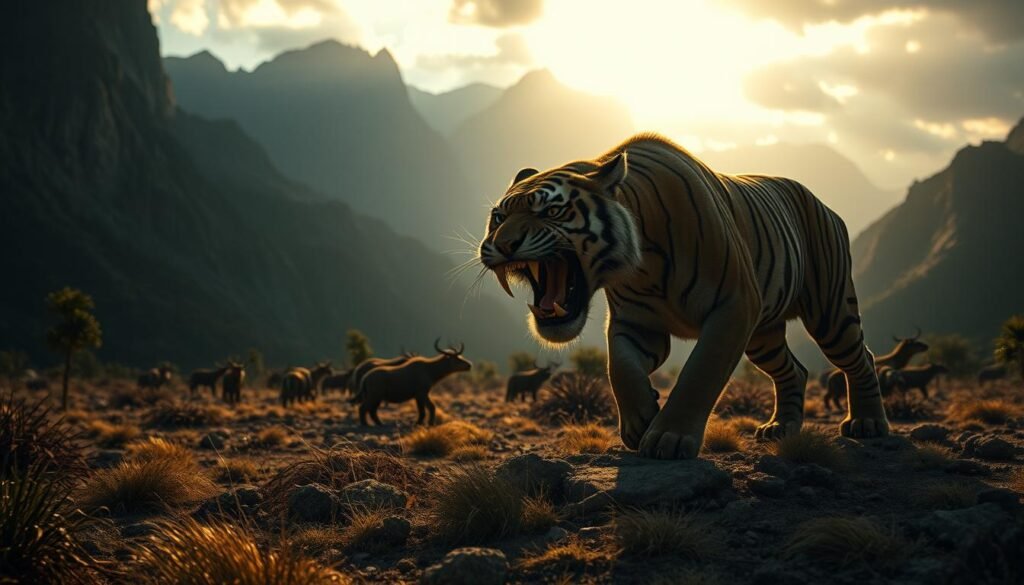
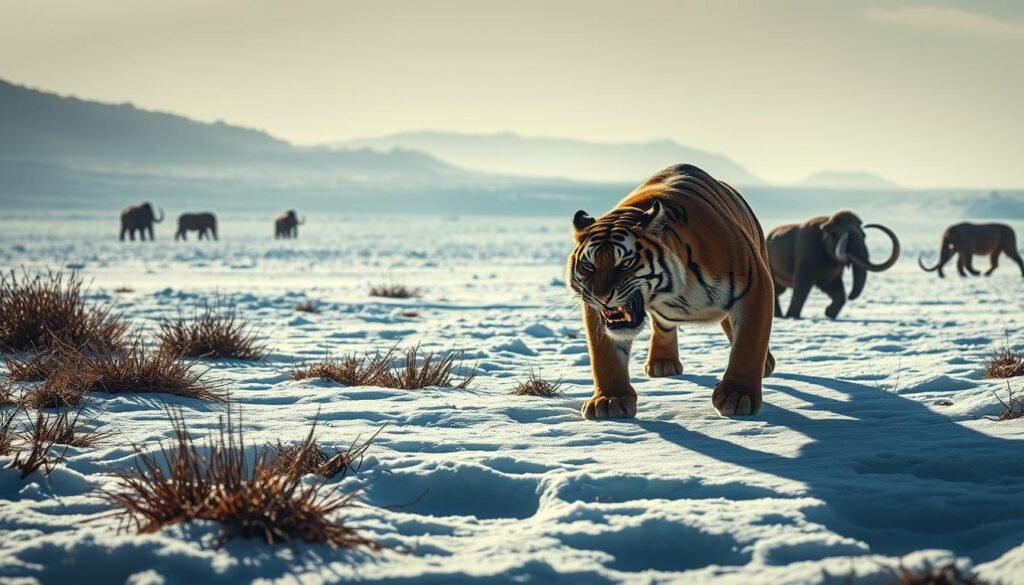
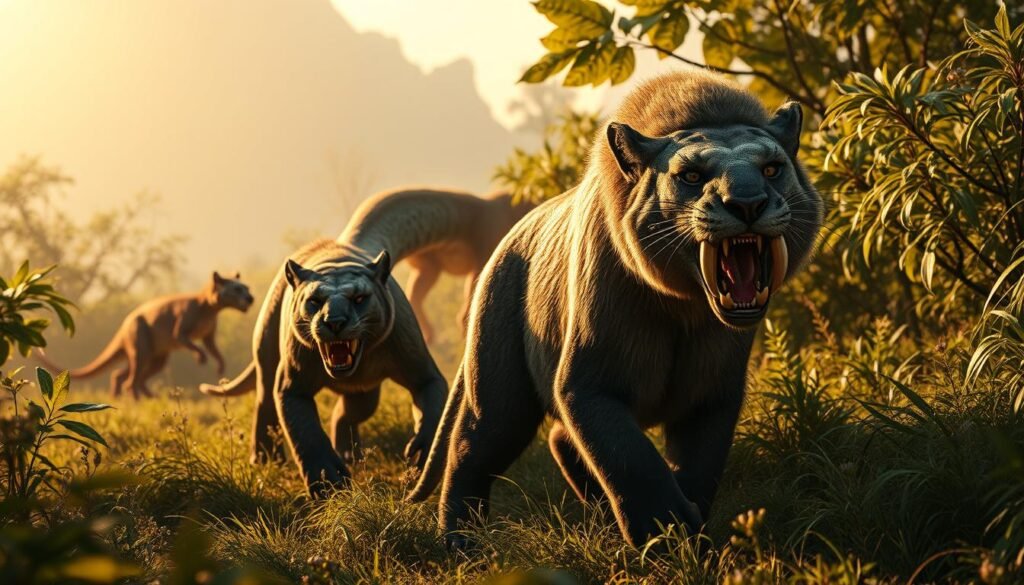
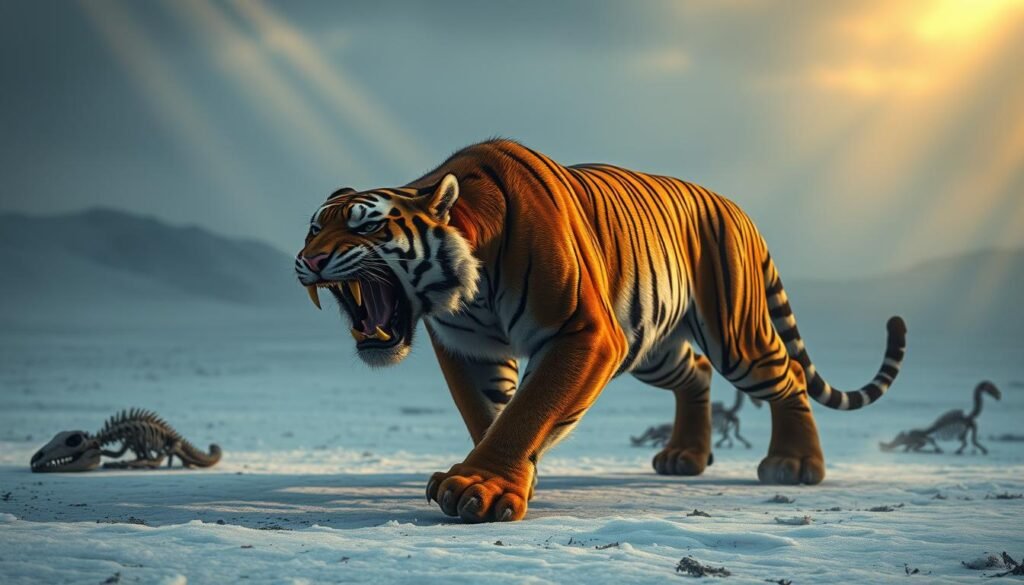
Saber-toothed tigers were the stars of the Ice Age. They ruled with their huge fangs. These cats had teeth so sharp, they could cut through prey easily.
Picture a creature whose smile could scare you. Saber tooth tiger facts show they were fierce beasts. Their teeth were almost 18 centimeters long, longer than a ruler.
These cats weren’t like your average house cat. They lived in North and South America, hunting big prey. Their huge fangs were perfect for hunting tough Ice Age mammals.
Let’s explore the world of these amazing prehistoric hunters. They had incredible survival skills and adaptations that will amaze you!
Meet the Ancient Beast: What Was a Saber-Toothed Tiger?
Imagine a prehistoric predator that would make today’s big cats look like house cats! The Smilodon, known as the saber-toothed tiger, was a fearsome Ice Age hunter. These cats weren’t tigers, but they were incredible hunters that amazed scientists and kids.
These magnificent creatures were part of a unique group of prehistoric mammals. They dominated the prehistoric landscape. Unlike modern big cats, Smilodons had distinctive characteristics that made them stand out.
Physical Characteristics and Size
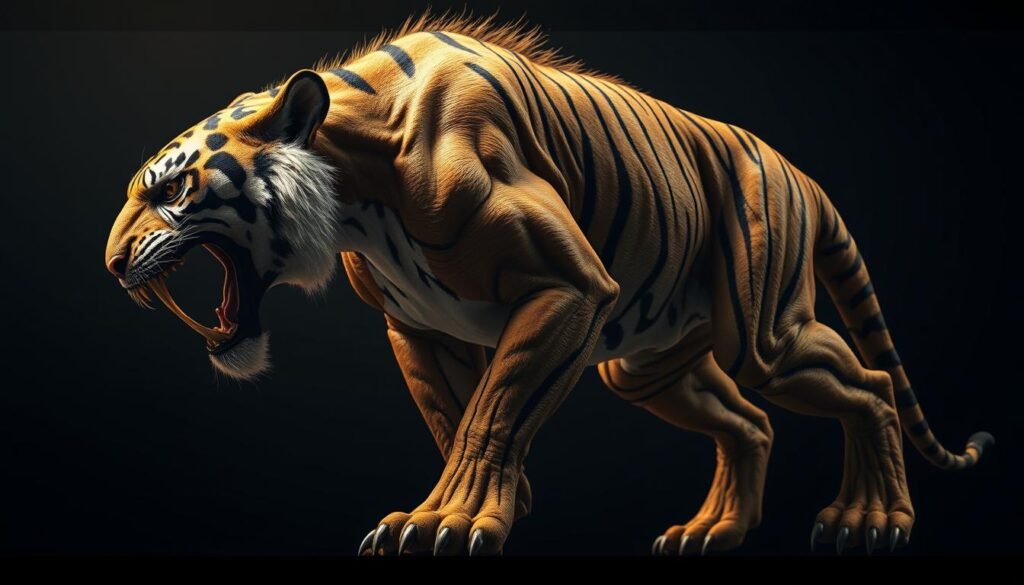
Saber-toothed tigers were muscular and compact, like modern-day lions. They were about:
Body length: 6-8 feet
Weight: 500-620 pounds
Shoulder height: 3-4 feet
Their most striking feature was their massive canine teeth. These teeth could grow up to 7 inches long – longer than a human hand!
Where They Lived
These Ice Age predators didn’t live in just one place. Smilodon fossils were found across vast territories, including:
North America
South America
Parts of Western Europe
When They Existed
Saber-toothed tigers lived during the Pleistocene epoch. This time span was from about 2.5 million to 11,700 years ago. They were part of a fascinating prehistoric ecosystem filled with remarkable creatures.
Those Famous Fangs: The Most Impressive Teeth in History
Saber teeth are a remarkable example of evolution. These teeth were unlike any in today’s animal kingdom. Saber-toothed cats had canines up to 7 inches long, making them giants of the past.
Let’s dive into what made these teeth so special:
Length ranged from 4-7 inches
Flat and blade-like in shape
Surprisingly fragile compared to modern predator teeth
Designed for precise killing strikes
Many think saber teeth were indestructible. But, they were actually quite delicate. They needed precise hunting to work well. These teeth were more like surgical tools than strong weapons.
Tooth Characteristic
Saber-Toothed Cat
Modern Big Cats
Canine Length
Up to 7 inches
1-2 inches
Tooth Strength
Fragile and thin
Robust and thick
Hunting Technique
Precision strike
Crushing bite
The design of saber teeth let these predators target weak spots on their prey. They didn’t fight for long because it could hurt their teeth. Instead, they hunted with precision, using their teeth to deadly effect.
A Powerful Hunter’s Body Built for Success
The saber tooth tiger’s body was a marvel of evolution. It was built for hunting, making it the top predator of its time. Its anatomy was a key to its success.
The saber tooth tiger’s body was a masterpiece of evolution. Its muscles gave it incredible hunting skills. This made it stand out among other ancient predators.
Muscular Structure
Saber tooth tiger hunting strategies were based on their strong muscles. They had:
Extremely powerful front limbs for grappling prey
Robust shoulder muscles for delivering devastating attacks
Compact, muscular body optimized for close-range hunting
Hunting Abilities
Their anatomy was designed for hunting large prey. They could:
Immobilize prey with powerful front limbs
Use signature long canine teeth for fatal strikes
Execute precise and lethal hunting techniques
Speed and Agility
Saber tooth tigers weren’t built for long chases. Their hunting strategy emphasized ambush and powerful short-distance attacks. They used strength over speed to catch prey.
Saber Tooth Tiger Facts for Kids: Everything You Need to Know
Get ready to learn some cool saber tooth tiger trivia. It’s going to make you the star of your science class! These prehistoric cat facts will amaze your friends and teachers.
Did you know saber-toothed tigers weren’t actually tigers? They were unique prehistoric predators that roamed Earth for 40 million years. These fierce hunters lived during the Ice Age and were part of a special group called prehistoric cats.
Saber-toothed cats existed between 42 million and 11,000 years ago
They were about the size of modern-day lions
Their massive canine teeth could grow up to 7 inches long
They lived across North and South America
Prehistoric cat facts show these animals were incredible hunters. Their powerful bodies and unique teeth made them top predators. Unlike modern big cats, saber-toothed cats had special hunting techniques for their time.
Some interesting saber tooth tiger trivia is about their social behaviors. Scientists think they might have hunted in groups, like modern wolves. This helped them take down large prey like mammoths and ancient bison.
Weighed between 500-620 pounds
Had muscles designed for powerful attacks
Could likely take down prey much larger than themselves
These incredible prehistoric predators continue to fascinate scientists and kids. They offer a glimpse into the extraordinary world of ancient mammals.
Daily Life of a Saber-Toothed Tiger
Step back in time to see how saber-toothed tigers lived. These amazing cats faced many challenges and had clever hunting ways.
Saber-toothed tigers were social animals. They probably lived in groups like modern lion prides. This helped them hunt better and protect their territory.
Sunrise meant active hunting periods
Midday involved resting in shaded areas
Evening hours were prime time for tracking prey
These hunters spent most of their day trying to survive. Hunting large mammals required tremendous energy. They used their strong bodies and sharp fangs to rule their ecosystem.
A typical day for a saber-toothed tiger included:
Searching for prey
Stalking animals
Coordinating group hunting
Defending their territory
Caring for young pack members
Learning about their daily life shows us how amazing these prehistoric cats were. Their complex social structures are truly fascinating.
Saber tooth tigers were incredible prehistoric predators. They had unique hunting methods that made them stand out. These ancient hunters developed smart strategies to catch prey in tough Ice Age environments.
Saber tooth tiger hunting methods were both strategic and powerful. They used several key techniques to become formidable prehistoric predators.
Hunting Techniques
The saber tooth tiger used special hunting strategies. These strategies helped them catch prey successfully:
Ambush hunting from dense vegetation
Using muscular limbs to grapple large prey
Delivering precise fatal bites with massive canine teeth
Targeting vulnerable areas like neck and belly
Favorite Prey Animals
These prehistoric predators targeted specific animals for food:
Large herbivores like mammoths
Ground sloths
Bison
Young or weakened woodland animals
Group Hunting Behavior
Many think saber tooth tigers hunted alone. But, evidence shows they might have hunted together. Cooperative hunting helped them take down bigger prey more efficiently.
Their hunting techniques showed remarkable intelligence. This made them one of the most successful hunters in their prehistoric world.
The Ice Age World: Their Natural Habitat
The Ice Age world was both fascinating and tough. Saber-toothed tigers roamed vast, open lands. The Pleistocene epoch’s landscapes were unlike today’s, with big grasslands, scattered forests, and harsh weather.
Saber-toothed tigers lived in different places across North and South America. They adapted to various environments, from cold tundra to temperate grasslands.
Typical landscapes included open plains
Scattered woodland areas
Regions with mixed vegetation
Areas near water sources
The Ice Age had a wide range of big animals. These massive creatures lived alongside saber-toothed tigers, making a complex ecosystem.
Animal Type
Habitat Preference
Interaction with Saber-Toothed Tigers
Mammoths
Grasslands and Tundra
Potential Prey
Giant Ground Sloths
Woodland Edges
Occasional Hunting Target
Prehistoric Horses
Open Plains
Common Prey
The climate was key in shaping these ancient ecosystems. It was much colder, with huge glaciers in North America. This environment required top survival skills from predators like saber-toothed tigers.
The world of saber tooth cat species was much more varied than many think. These ancient felines belonged to different groups, each with its own special traits. They were top predators in their time, thanks to their unique hunting skills.
Scientists have found many types of saber-toothed predators. Each one shows how these ancient hunters evolved. Not all were related, adding to their fascinating story.
Smilodon Species
Smilodon is the most well-known saber tooth cat. There were three main types:
Smilodon fatalis: Common in North and South America
Smilodon populator: The biggest, weighing up to 880 pounds
Smilodon gracilis: The smallest and oldest Smilodon
Other Saber-Toothed Relatives
There were other interesting saber-toothed cats too:
Nimravids: Like cats but with similar teeth
Barbourofelids: Smaller, found in Europe and Asia
Hoplophoneus: An early type from North America
These different saber-toothed cats show how adaptable ancient predators were. Each had its own way of hunting and physical features to thrive in tough environments.
Why Did Saber-Toothed Tigers Go Extinct?
The mystery of saber tooth tiger extinction is captivating. These amazing predators disappeared about 11,000 years ago. This was during a time of big changes in the environment.
Scientists have found several reasons why saber-toothed cats went extinct:
Dramatic climate shifts at the end of the Ice Age
Rapid reduction of large prey populations
Competition with emerging predator species
Limited genetic diversity
The big changes in the environment were tough for saber-toothed tigers. Massive ecosystem disruptions made it hard for them to hunt and survive.
Research shows their hunting skills didn’t work as well anymore. The prey they hunted became rare, making it hard for them to find food.
Studies also show that saber-toothed tigers had low genetic diversity. This made them more likely to fail when the environment changed. They couldn’t adapt fast enough to survive.
These incredible animals remind us of the impact of environmental changes. Even the most successful predators can disappear when the world around them changes too much.
Amazing Fossil Discoveries
Prehistoric cat remains tell a fascinating story of ancient predators. Saber tooth tiger fossils give scientists incredible insights into these creatures. They reveal secrets hidden for millennia.
Paleontologists have found remarkable saber tooth tiger fossils worldwide. These prehistoric cat remains give us a peek into their lives and environments.
Remarkable Fossil Sites
La Brea Tar Pits (Los Angeles, California)
Rancho La Brea Fossil Site
South American archaeological sites
North American Pleistocene deposits
Groundbreaking Discoveries
The most significant discoveries of saber tooth tiger fossils have given us a deep understanding. Researchers have learned about their physical traits, hunting habits, and how they interacted with their environment.
Fossil Site
Key Discoveries
Significance
La Brea Tar Pits
Over 2,500 Smilodon fossils
Most extensive collection worldwide
South American Sites
Multiple species variations
Genetic diversity evidence
North American Deposits
Skeletal structure details
Hunting technique insights
By studying saber tooth tiger fossils, scientists can piece together the world of these prehistoric predators. Each fossil tells a story of survival, adaptation, and the incredible diversity of prehistoric life.
How Scientists Study These Ancient Cats
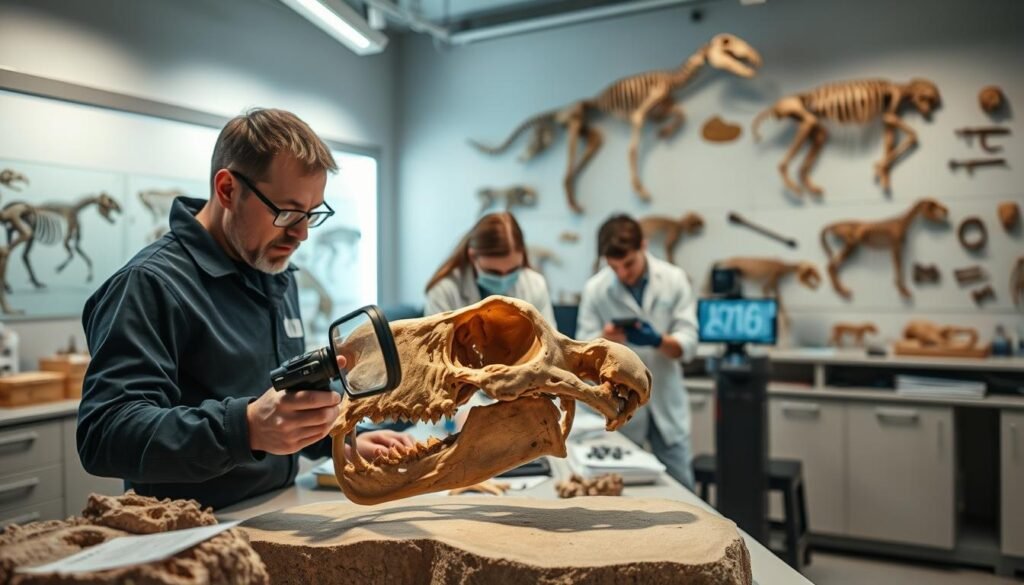
Scientists are like detectives trying to solve the mystery of saber-toothed tigers. They use many interesting methods to learn about these ancient animals.
Here are some ways researchers study these prehistoric cats:
Fossil Analysis: Scientists look closely at bone structures and remains
Computer Simulations: Digital models show how they might have moved and hunted
Comparative Anatomy: They compare saber-toothed tiger fossils with modern big cats
But it’s not just about digging. Scientists use cutting-edge technology like 3D scanning and CT imaging. These tools help them see details that are hard to spot by eye. They can see muscle attachments, bone density, and how these cats might have moved.
By making digital reconstructions, scientists can imagine how saber-toothed tigers lived and hunted. They mix fossil evidence with computer models. This way, they can show us what these ancient animals were like in a new way.
Genetic analysis and isotope studies also give clues about their diet, habitat, and social life. Each fossil is like a clue for scientists to solve. They are like detectives uncovering the secrets of these amazing prehistoric predators.
Comparing Modern Big Cats to Saber-Toothed Tigers
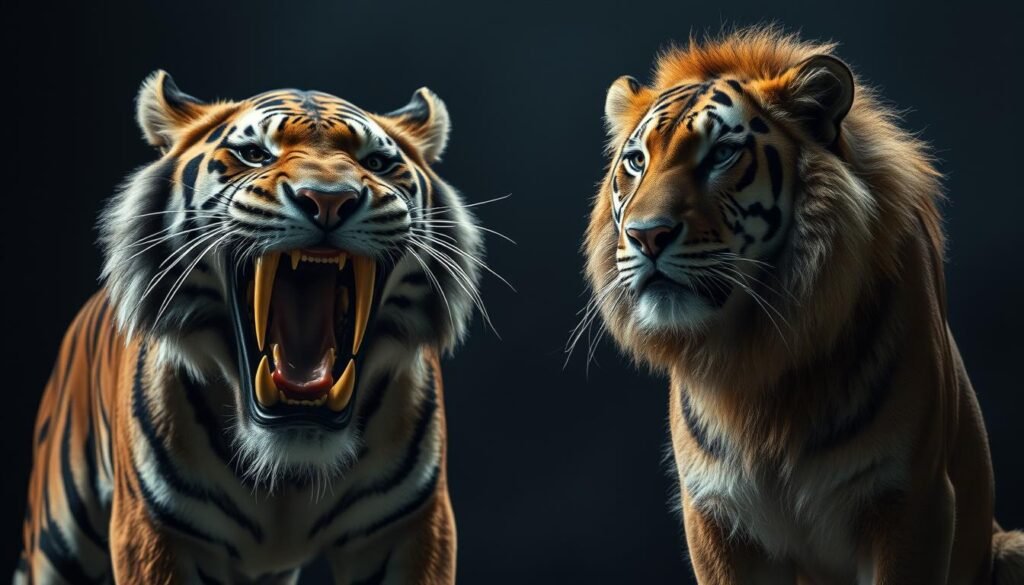
The world of feline evolution is full of surprises. Saber-toothed tigers and today’s big cats are quite different. They share some traits, but their unique features make them stand out.
Looking at the differences between ancient and modern cats shows how much they’ve changed:
Bite Force: Saber-toothed tigers had special hunting ways unlike today’s big cats
Body Structure: They were stronger and more muscular than today’s cats
Tooth Configuration: They had huge canine teeth that were unique to them
Scientists have found out how these ancient predators were different from today’s cats. Saber-toothed tigers couldn’t use the throat-crushing bite modern big cats employ. This changed how they hunted.
Feature
Saber-Toothed Tigers
Modern Big Cats
Hunting Technique
Ambush predator with powerful upper body
Stalking and quick pursuit
Tooth Structure
Long, blade-like canines
Shorter, robust canines
Habitat Adaptation
Ice Age environments
Diverse global ecosystems
Nature’s ability to adapt is amazing. Saber-toothed tigers are gone, but their cousins are thriving. This shows how cats have survived and thrived in different places over time.
Fun Facts About These Prehistoric Predators
Get ready for some amazing saber tooth tiger trivia that will amaze you! These prehistoric cats are more fascinating than you think. They weren’t actually tigers, but had some wild features that would make modern lions seem small.
Here are some incredible facts about these prehistoric hunters:
Their canine teeth could grow up to 7 inches long – that’s longer than a human hand!
Some saber-toothed cats weighed up to 600 pounds – talk about a heavyweight champion!
They lived during multiple prehistoric periods, not just the Ice Age
More saber tooth tiger trivia reveals they weren’t alone. Scientists found they hunted in groups. Imagine a pack of these massive cats taking down huge prehistoric prey together!
Saber-Toothed Cat Fact
Incredible Detail
Bite Force
Estimated at 1,000 pounds per square inch
Hunting Strategy
Ambush predators with powerful neck muscles
Geographical Range
Across North and South America
These prehistoric cat curiosities show nature’s design can be both scary and amazing. The saber-toothed cats were more than just big teeth. They were complex, intelligent hunters that ruled their world with skill.
Myths and Misconceptions About Saber-Toothed Tigers
Many myths surround saber-toothed tigers, capturing the public’s interest. People often think they were just big versions of today’s lions or tigers. But, science tells a more detailed story about these ancient animals.
One myth says their huge fangs were for stabbing prey. But, scientists found these canines were mainly for showing off and setting social order. They were fragile and could break during fights.
Media often shows saber-toothed tigers as lone hunters in icy lands. But, new finds suggest they might have lived in groups with complex ways of communicating and hunting. These myths ignore the social lives that helped them survive tough times.
To truly understand saber-toothed tigers, we need to look beyond myths. Science keeps revealing new facts about these hunters. It challenges old stories and gives us a deeper look into their lives.