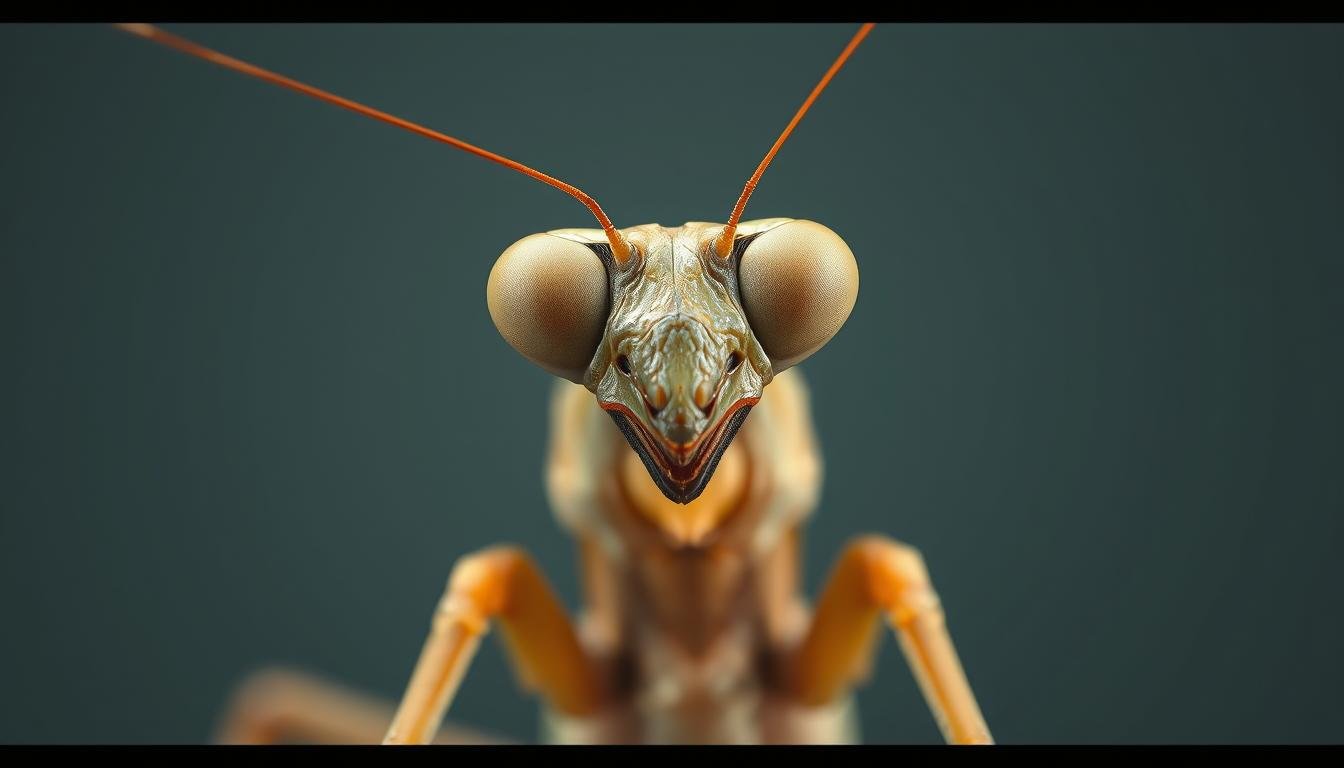
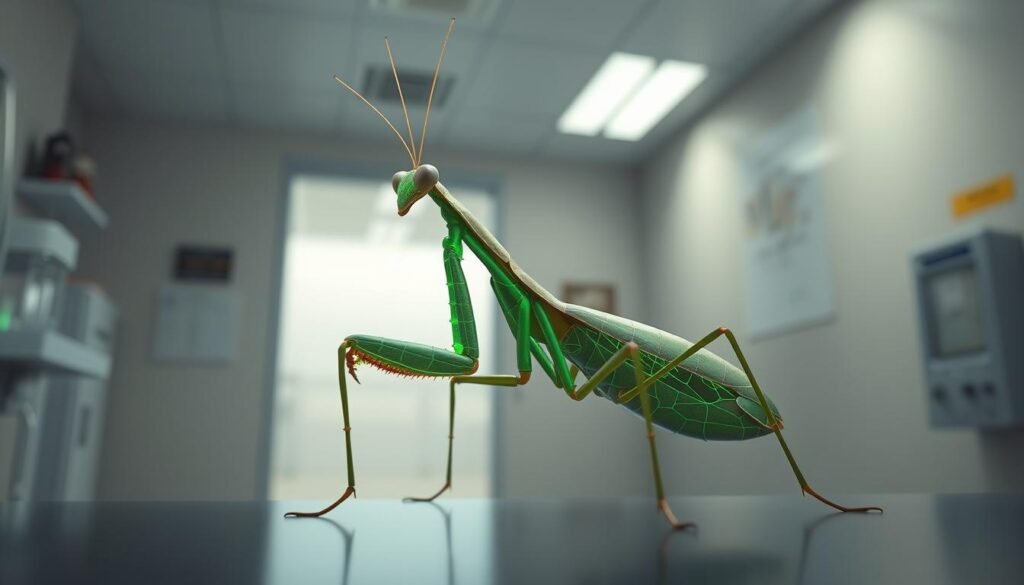
Want to meet an insect that’s part ninja, part alien, and 100% cool? The praying mantis can spin its head like an owl, spot you with five eyes, and snatch flies midair. Seriously, this critter’s resume puts most superheroes to shame.
Let’s break it down. Their necks rotate 180 degrees—try doing that during math class. Those spiky arms? They strike faster than you can say “gotcha!” And don’t get me started on the Orchid Mantis. It disguises itself as a flower petal, then BAM—dinner’s served. Nature’s ultimate trickster.
Here’s the deal: I’ll show you how these insects hunt, hide, and freak out your little sister. We’ll cover why they’re not just “bugs,” but precision hunters with killer instincts. Ready to dive into their wild world? Grab a magnifying glass. Things are about to get weird.
Amazing Vision: 3D Sight and 5-Eye Design
Let me show you something wild: mantises see the world like living 3D goggles. Their vision system makes ours look basic. Imagine having superhero specs that let you judge distances perfectly—every jump, every strike, every snack grab.
Compound Eyes and Ocelli Explained
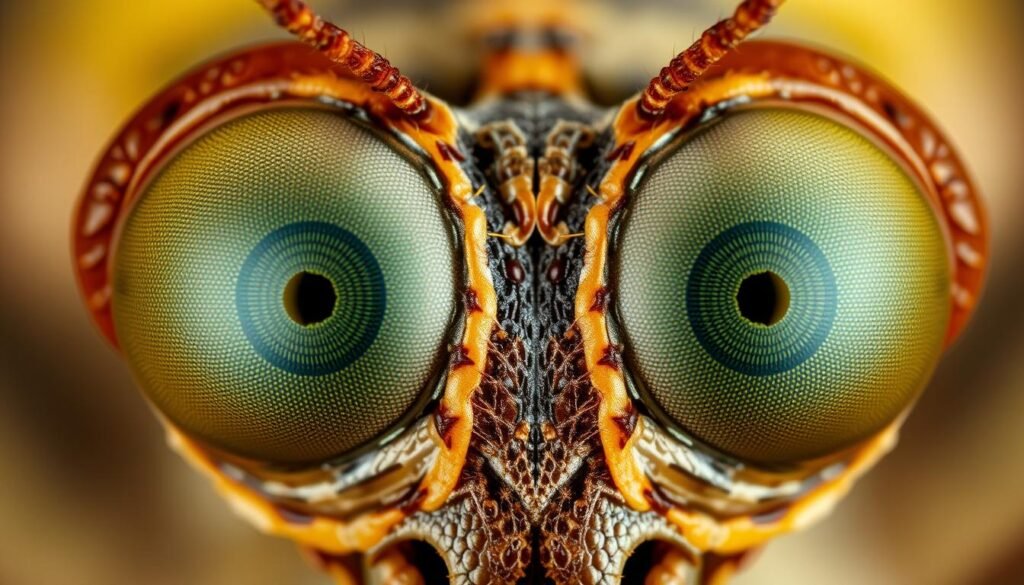
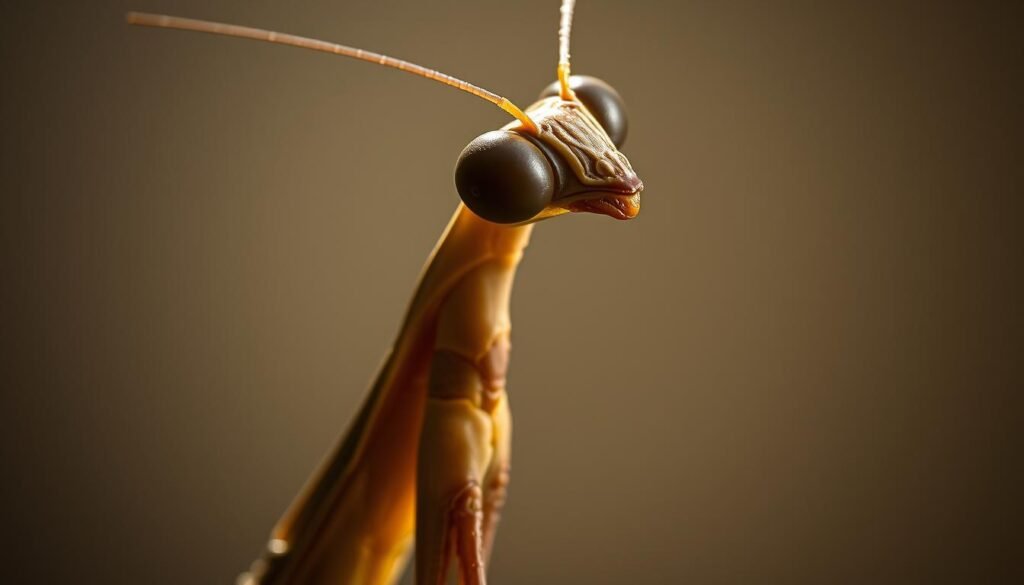
Those big bug eyes? They’re actually two compound eyes made of thousands of tiny lenses called ommatidia. Each lens captures a pixel of their surroundings, creating a mosaic view. But wait—there’s more! Three tiny ocelli sit in a triangle on their forehead. These “simple eyes” detect light changes, like nature’s sunrise alarm clock.
Understanding Binocular Depth Perception
Here’s the kicker: mantises have stereo vision. Each eye sees a slightly different angle, just like your eyes do. Their brain overlaps these images to calculate distance. Picture watching a 3D movie where the popcorn flies at you—except for mantises, everything pops in 3D. This lets them strike prey with laser accuracy.
I’ll let you in on a secret: their field vision overlaps more than ours. While humans get about 120 degrees of overlap, mantises? Nearly 180. That’s why they’re ninjas at judging when to attack. No wonder they rarely miss!
An Unexpected Ear and Unusual Sound Detection
Hold onto your hats—this insect’s got a secret superpower. While most bugs make noise with legs or wings, mantises flipped the script. Their body hides a single ear between the hind legs. Yes, you read that right. Their hearing gear isn’t on their head—it’s closer to their pants.
Here’s the kicker: that lone ear isn’t for chatting. It’s tuned to high-pitched sounds like bat sonar. Picture a built-in bat detector! When echolocation blips hit, mantises dive-bomb to safety. Dinner time? Nope—survival mode activated.
Scientists scratched their heads for decades. Then David Yager—a real-life bug detective—cracked the case. His study showed this adaptation evolved to outsmart nighttime predators. Bats swoop, mantises duck. It’s like nature’s game of Marco Polo.
Typical insects? They chirp or buzz. Mantises also listen. Their ear works like a satellite dish, catching frequencies we can’t hear. Imagine having a radar jammer strapped to your waist. Now that’s what I call a party trick!
Head Rotation and Flexible Neck Dynamics
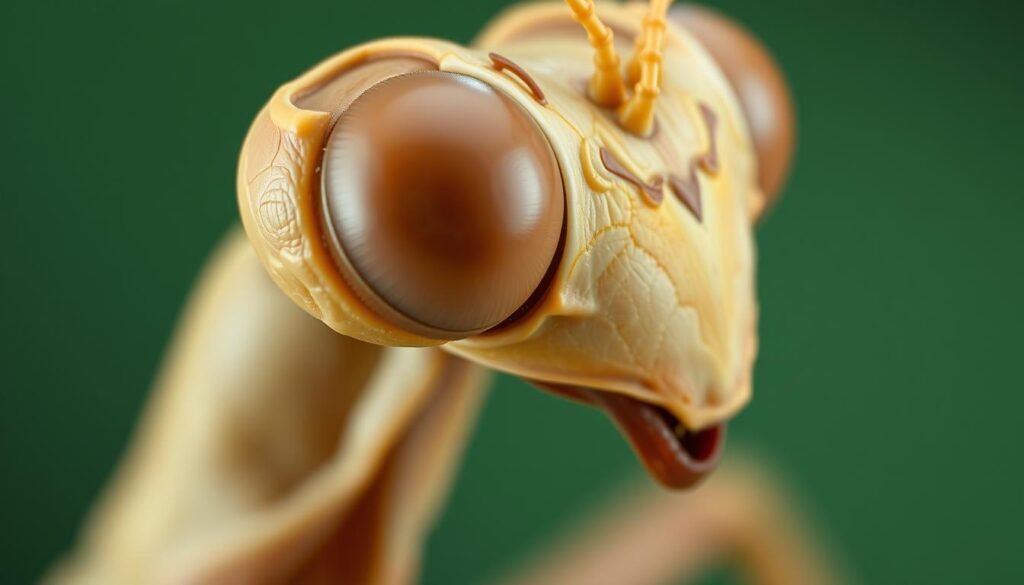
Let’s get something straight—this insect’s neck game is stronger than a yoga instructor’s. While you struggle to check your blind spot while biking, mantises casually scan 180 degrees without moving their bodies. Their secret? A segmented neck with ball-joint mechanics that’d make robot engineers jealous.
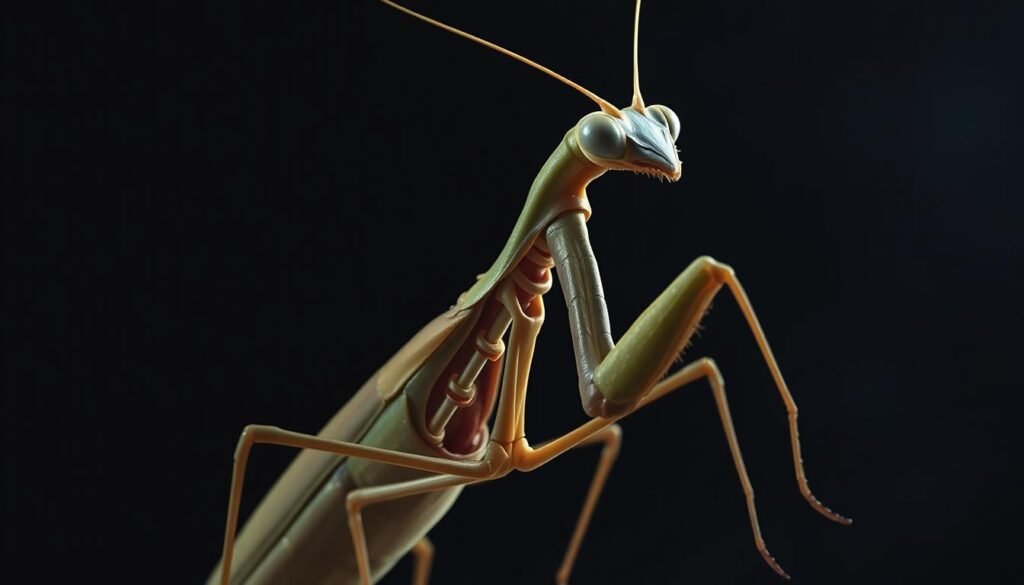
Imagine your head clicking into place like a camera on a tripod. That’s how these predators monitor their surroundings. Five interconnected segments work like a swivel chair, letting them track prey or spot danger mid-meal. I’ve always marveled at how evolution crafted such precise movement from such tiny parts.
Mechanics Behind a 180-Degree Turn
Here’s the breakdown: their neck structure isn’t one solid piece. It’s a chain of flexible plates connected by rubbery tissue. This setup allows rotation most vertebrates can’t match. Picture turning your head backward to see who’s sneaking up—except mantises do it while eating lunch.
This adaptation isn’t just for show. Ambush hunters rely on stealth, and full head rotation lets them stay statue-still while scanning. No sudden body movements to scare off dinner. I once watched a mantis snatch a moth behind itself without twitching its legs. Talk about multitasking!
Nature’s engineering here is pure genius. Those jointed segments absorb shock, too—like built-in suspension for sudden strikes. Next time you see a mantis, try walking around it. Bet it follows you like a security cam… with way better reflexes.
Mastering Camouflage with Clever Mimicry
Ever played hide-and-seek so well you became invisible? Meet nature’s ultimate stealth artist. These insects don’t just blend in—they transform into living props. Their secret? A toolbox of tricks that would make Hollywood special effects teams jealous.
Flower and Leaf Imitation in Action
After shedding their exoskeleton, some species actually change color to match their surroundings. Imagine waking up from a nap with green skin because you slept in grass! The Orchid Mantis takes it further—its body mimics flower petals down to the veiny textures. I’ve watched them sway like blossoms in the breeze, then snap up unsuspecting bees.
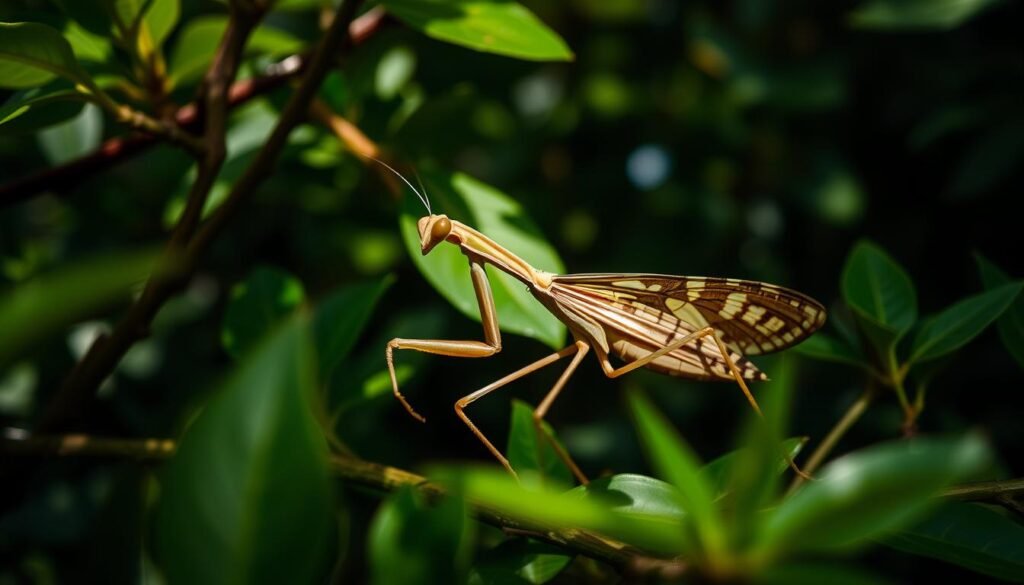
Leaf mimicry? Even cooler. Certain varieties develop jagged edges and brown spots, becoming near-perfect copies of dead leaves. They’ll freeze mid-crawl if a bird flies overhead, becoming part of the forest floor. It’s like playing statue… with life-or-death stakes.
This isn’t just about hiding. Camouflage lets them ambush prey from inches away. Why chase meals when lunch comes to you? Next time you’re outdoors, try spotting shapes that don’t quite belong. That “twig” with legs might be watching you right now.
No Lungs? Embracing Unique Breathing Methods
Time for a biology pop quiz! How do insects breathe without lungs? Spoiler: They’ve got a hack that’ll make you rethink biology class. These predators use tiny air tubes called tracheae—think drinking straws under their skin—to fuel their ninja moves.
Here’s the scoop: Oxygen seeps in through valves called spiracles along their body. Ten pairs dot the thorax and abdomen like microscopic airlocks. Once inside, gas zips through branching tubes directly to muscles and organs. No blood required—nature’s ultimate express delivery!
Check this out:
Feature
Insects (Mantis)
Humans
Oxygen Intake
Spiracles + Tracheae
Lungs
Gas Transport
Direct diffusion
Bloodstream
Active Areas
High-activity tissues
Entire body
I’ve always found it mind-blowing: Their system works best for small bodies. That’s why you won’t see horse-sized mantises—they’d suffocate! These wild adaptations prove evolution’s creativity. While we’re stuck with diaphragms, they’re rocking 24/7 air vents.
Next time you see one frozen in place, remember: Those side holes aren’t just decoration. They’re breathing ports powering a lethal predator. Makes you wonder—what other genius hacks is nature hiding in plain sight?
Raptorial Front Legs and Prey Capture Tactics
Here’s the weapon upgrade evolution nailed 80 million years ago. These insects rock front legs that snap shut faster than a mousetrap—except they’re barbed, flexible, and controlled by a tiny assassin’s brain. I’ve watched slow-mo footage where mantises snatch dragonflies mid-flight. Spoiler: The dragonflies never saw it coming.
Spiked Leg Functions in Real Time
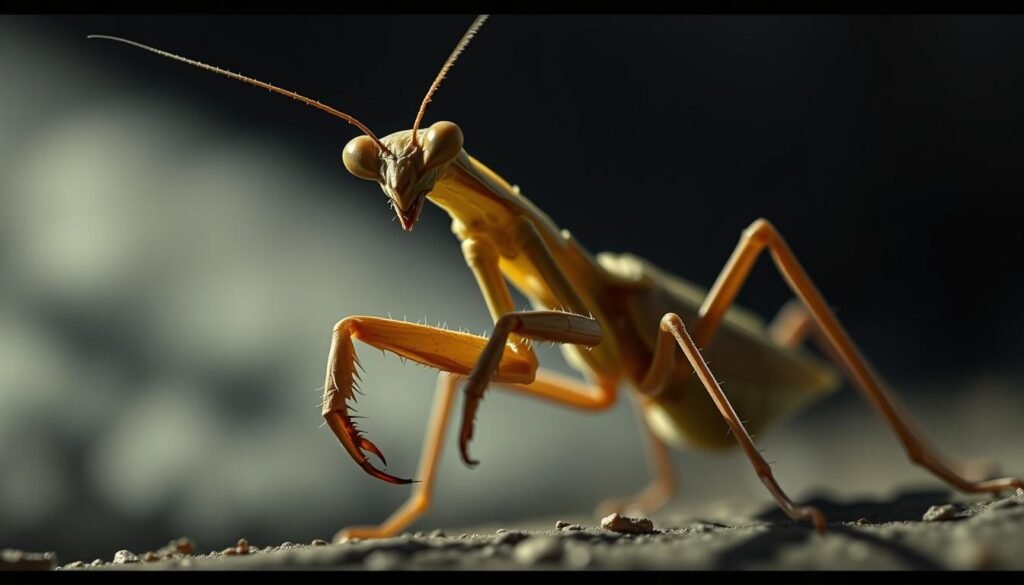
Those folded arms aren’t just for praying. The inner edges sport rows of spikes—like nature’s Velcro. When prey brushes past, the legs whip out and clamp down. Spikes pierce the victim’s exoskeleton, locking it in a death grip. I’ve seen beetles struggle for minutes. No escape. Zero mercy.
How fast? Their strike clocks 1/20th of a second—faster than you blink. Muscles in the thorax act like coiled springs. When released, the front legs extend at 400 Gs of acceleration. That’s fighter pilot territory. Researchers use high-speed cameras just to catch the action.
Check this ambush play-by-play:
Mantis freezes as grasshopper approaches
Neck rotates 90 degrees—target locked
Legs fire forward, spikes deploy on contact
Boom—dinner served
This isn’t random violence. Every movement is calculated. Their legs evolved to minimize energy use—why chase when you can ambush? Next time you see one perched motionless, know this: It’s not meditating. It’s running a lethal trap.
Short but Intense Lives: Lifespan and Survival
Ever wonder why some bugs live fast and die young? These predators pack entire lifetimes into months—but not all species play by the same rules. Let’s crack open their biological clocks.
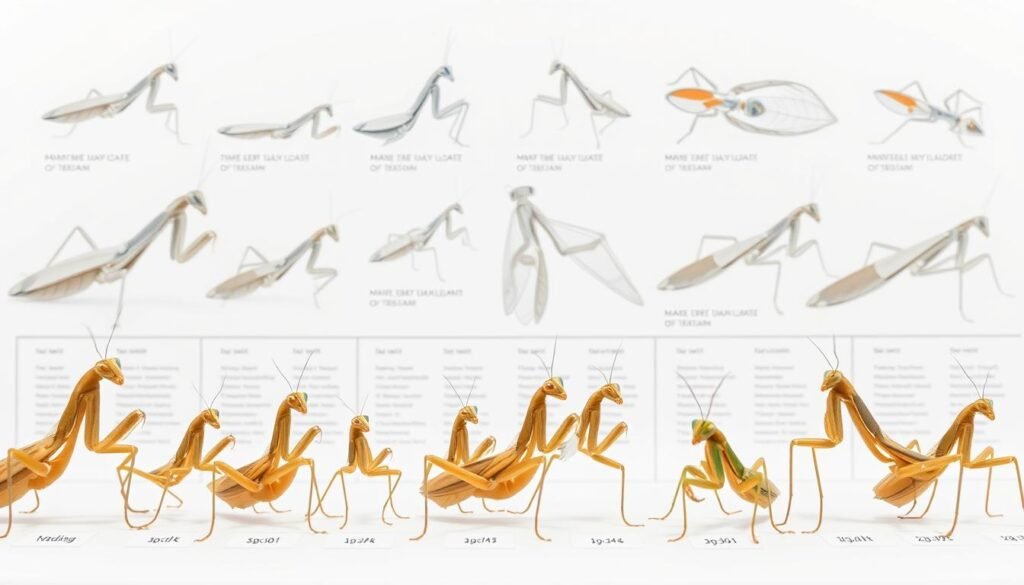
Species Variability and Life Expectancy
Take the European variety. They typically last 6-8 months. But their Chinese cousins? They push 10-12 months in warm climates. Temperature matters—colder regions shorten their timelines like expired coupons.
Females outlive male counterparts almost everywhere. Why? After mating, males often become snacks. Survival rates drop faster than a dropped ice cream cone. Females focus energy on laying eggs—up to 300 per foam-like ootheca case. That’s like packing a kindergarten class into a walnut shell!
Species
Lifespan
Eggs per Ootheca
Key Survival Trait
European
6-8 months
100-200
Camouflage mastery
Chinese
10-12 months
200-300
Cold tolerance
Orchid
5-6 months
50-100
Floral mimicry
Check the ootheca’s genius design. The foam casing hardens into a weatherproof bunker. Inside, eggs wait out winter like tiny astronauts in cryosleep. Come spring? Baby ninjas erupt in synchronized chaos.
Here’s the kicker: Their entire existence balances speed and precision. They don’t need decades—just enough time to hunt, grow, and launch the next generation. Makes you rethink what “living fully” really means, huh?
Green “Blood” and Internal Chemistry
What if I told you bugs have their own version of antifreeze? These insects ditch red blood for something wilder—a neon-green fluid called hemolymph. This isn’t just weird coloring; it’s evolution’s answer to keeping tissues oxygenated without veins or arteries.
Hemolymph and Its Surprising Properties
Forget blood cells—their system works like a Slip ‘N Slide. Hemolymph sloshes freely through body cavities, bathing organs directly. No heart pumps needed. But here’s the kicker: it carries hemocyanin, a copper-based molecule that grabs oxygen 10x better than our iron-based hemoglobin. That’s why their “blood” looks like glowstick juice!
Feature
Praying Mantises
Humans
Circulatory Type
Open system
Closed system
Oxygen Transport
Hemocyanin in hemolymph
Hemoglobin in blood
Fluid Color
Green
Red
Special Perk
Works in cold temps
Rapid nutrient delivery
This setup lets mantis species thrive where frogs freeze. Their green goo acts like biological antifreeze, keeping limbs mobile during chilly hunts. I once watched one stalk prey at 50°F—its movements stayed smooth as butter. Try that with human blood!
The chemistry gets cooler. Hemolymph’s pH stays neutral even during digestion. Ours? One cheeseburger away from acidity overload. These internal tricks make them walking science labs—no lab coat required.
Wings and Flight: Brief Forays into the Air
Ready for takeoff? Let’s zoom into how these insects conquer the skies with built-in flight gear. Their wings aren’t just fancy accessories—they’re survival tools fine-tuned by evolution. Think fighter jets with foldable wings and instant launch capabilities.
Wing Structure and Aerodynamic Insights
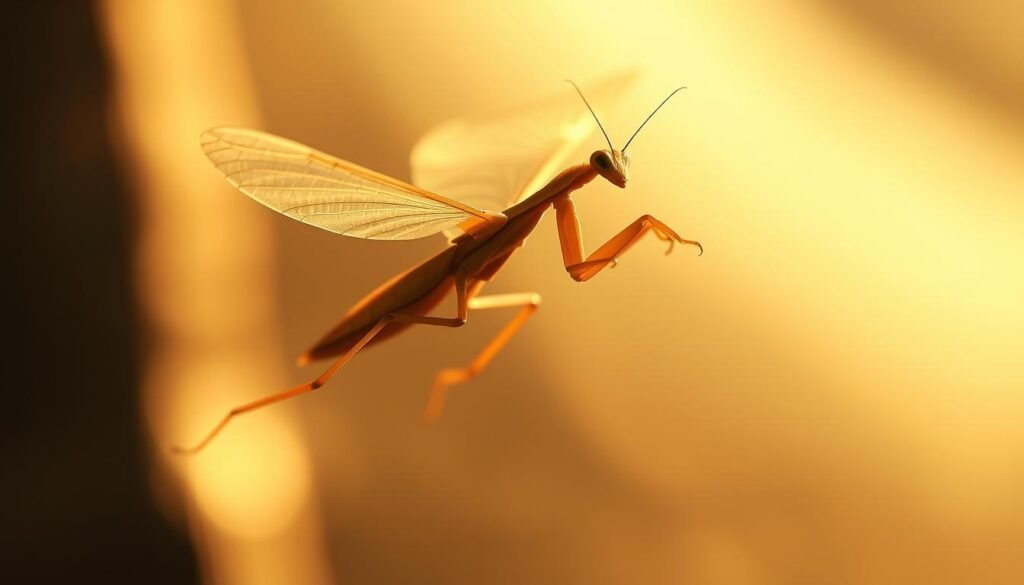
Check their dual-wing system. The front pair—called tegmina—acts like armored cockpit canopies. These leathery shields protect the delicate hindwings beneath. When danger approaches (looking at you, birds and lizards), they snap open like switchblades.
Here’s the magic: Hindwings unfurl into broad, veined sails. They catch air like parachutes, allowing sudden lifts and sharp turns. I’ve clocked their flight bursts at 3 body lengths per second—not bad for part-time flyers!
Tegmina: Reinforced shields against scratches
Hindwings: Silk-thin membranes for agile maneuvers
Thorax muscles: Power boosters for rapid takeoffs
Their field vision plays pilot. While airborne, they spot landing zones and locate prey mid-glide. Ever seen one snatch a moth mid-flight? It’s like watching a helicopter grab a speeding taxi.
Flight Differences Between the Sexes
Males? They’re the frequent flyers. Lighter bodies and longer wings let them cruise like crop dusters. Why risk flight? To dodge bats at night or find mates across fields. Females? More grounded. Their stockier builds favor ambush tactics over aerial chases.
Trait
Male
Female
Wing Length
Longer
Shorter
Flight Frequency
Daily
Rarely
Primary Use
Mating/Escape
Short Hops
Watch a male evade a bat: He’ll tuck wings and drop like a stone. Females? They’ll flatten against bark, trusting camouflage over speed. Both strategies work—proof that evolution loves multiple right answers.
Next time you see one flutter by, remember: Those brief flights pack centuries of engineering genius. Not bad for insects that mostly prefer walking!
Praying Mantis Facts for Kids: A Step-by-Step Tutorial
Ready to become a mantis detective? Let’s turn your backyard into a bug lab. I’ll walk you through three field-tested methods to study these hunters safely—no PhD required.
Practical Tips and Real-World Examples
Step 1: The Spy Kit
Grab a clear jar, magnifier, and notebook. I’ve found mantids love perching on sunlit plants. Gently place the jar over them—no touching! Watch how they track your movements with those swiveling heads.
Step 2: Ootheca Watch
Spot a foamy egg case on a twig? That’s an ootheca. Mark the location with colored tape. Check weekly for tiny cracks—hatchlings emerge like popcorn bursts. Pro tip: Mist nearby leaves. Babies need water droplets to drink.
Tool
Purpose
Mantis Reaction
Soft paintbrush
Guiding movement
Steps on bristles calmly
Red flashlight
Night observation
Ignores red light
Feeding tweezers
Offering crickets
Strikes within 0.5 seconds
Step 3: Habitat Hacks
Raise nymphs in mesh cages with vertical sticks—they molt better climbing upward. I’ve noticed misting their enclosure at dawn mimics dew. Avoid lettuce; flightless fruit flies work best for tiny jaws.
Teachers love using these methods for science fairs. One student tracked an ootheca’s 43-day development, charting temperature effects. Her project proved warmer rooms speed up hatching. Your turn—what will you discover?
Final Wrap-Up: Celebrating Mantis Marvels With a Chuckle
Think you’ve seen it all? These head-spinning hunters laugh at ordinary insect rules. Their 180-degree necks out-rotate owls. Five-eyed vision spots lunch from three directions. Breathing through body vents? Just another Tuesday for nature’s tiny Terminators.
I’ve watched mantises rewrite biology textbooks. Their spiked legs strike faster than TikTok trends. One species mimics orchids so perfectly, bees propose marriage. Another hears bat sonar through its butt—talk about awkward superpowers!
Here’s the kicker: Their green blood isn’t even the weirdest part. These predators breathe through 20 tiny holes while snatching dragonflies mid-air. Try chewing gum and walking? Pathetic.
You’ve seen how they outsmart lizards, dodge bats, and turn mating into extreme sports. But here’s what matters: Every backyard holds alien superpowers. Grab a jar. Watch. Learn. Just don’t challenge them to staring contests—they’ve had 80 million years of practice.