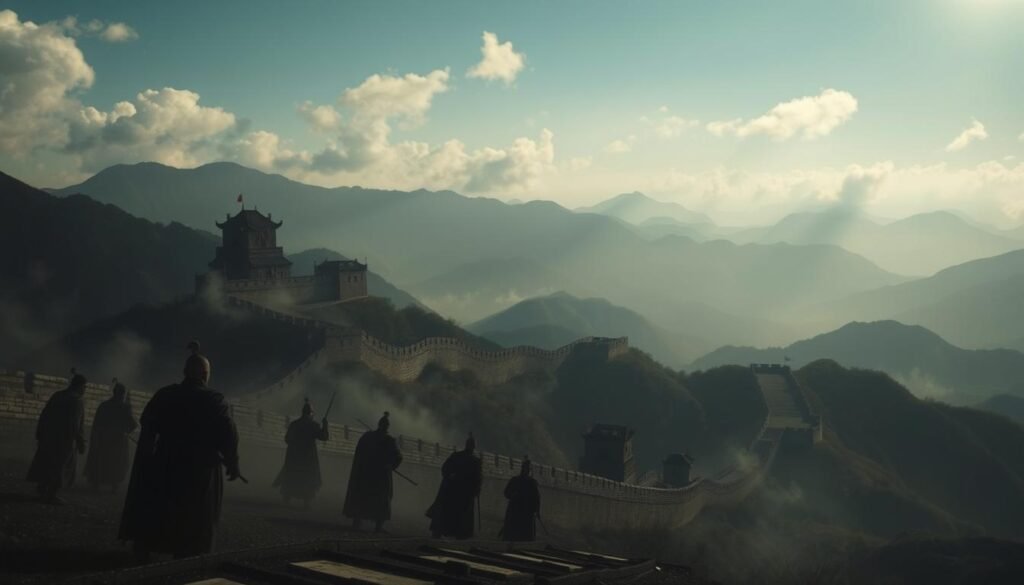
Can you spot a 2,300-year-old brick snake from orbit? Turns out, even NASA astronauts disagree about whether China’s iconic structure truly stands out in space. Let me unpack this cosmic debate while sharing wild details about the world’s most famous fortification.
Imagine a barrier so long, it could wrap around Texas six times. This 13,171-mile marvel isn’t just one wall – it’s a patchwork of rammed earth, bricks, and sheer stubbornness built across dynasties. The Ming Dynasty sections you see in photos? Those are merely the “new” 600-year-old parts.
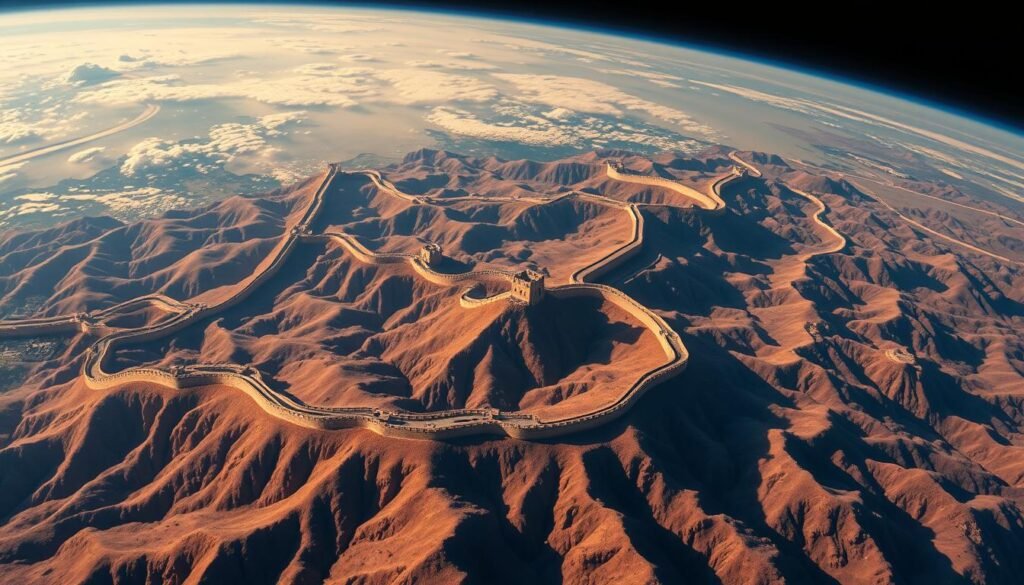
Here’s the kicker: Apollo astronauts claimed they couldn’t see it from the moon, but shuttle crews argue some sections pop if you know where to look. Think spotting a single noodle from a helicopter – possible, but hardly obvious.
Why should kids care? Because hidden in those watchtowers are stories of ice cream-sticky silk traders, Mongol-dodging alarm systems, and enough construction material to build 30 Empire State Buildings. And we haven’t even discussed how workers used sticky rice mortar – yes, actual lunch leftovers – as ancient superglue.
History and Origins of the Great Wall
Ever wonder how a 2,000-mile security system gets built without cranes or computers? Let’s rewind to when rival kingdoms stacked dirt mounds to keep out horseback raiders. Fast-forward to 221 BCE: Emperor Qin Shi Huang, fresh off unifying China, orders these scrappy barriers linked into one mega-fortification. Think of it like turning random LEGO walls into a castle spanning entire states.
Early Wall Beginnings and Qin Dynasty
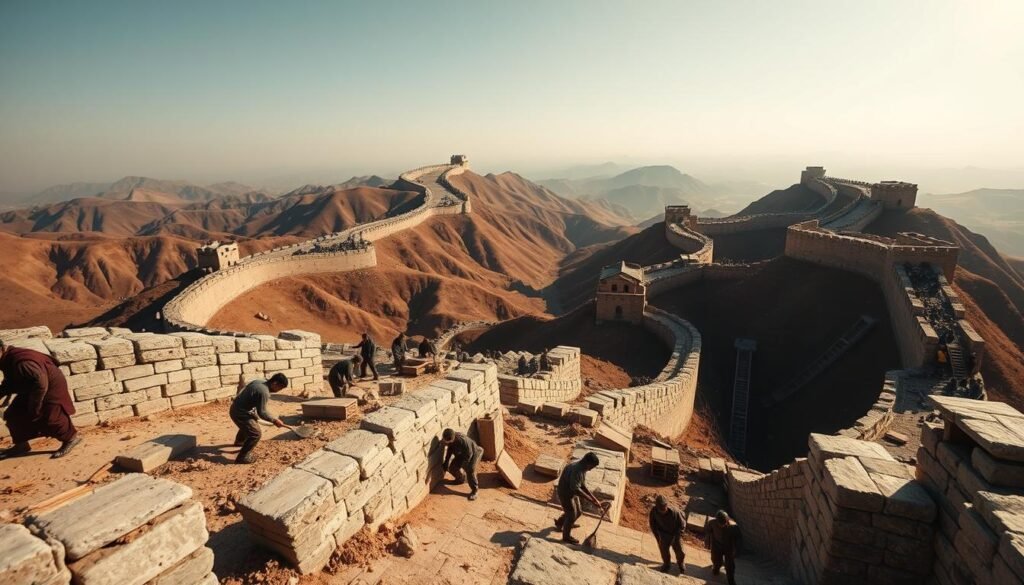
Workers under Qin didn’t have it easy. Picture millions hauling compacted earth and stone across mountains. Historical records mention soldiers, peasants, and even prisoners sweating through this project. The result? A 3,000-mile beast (roughly Boston to LA) built in just 10 years. Not bad for a crew using ropes and wooden sleds.
Dynastic Transformations Over the Centuries
Later rulers kept upgrading like gamers modding a fortress. Han Dynasty emperors stretched it westward using sun-baked clay. Ming engineers? They swapped dirt for bricks and mortar during the 1300s. Each dynasty left its fingerprint: watchtowers here, horse-blocking trenches there. By the 1600s, this patchwork shield had more layers than a dragon’s birthday cake.
Construction Techniques and Materials Used
Imagine constructing a barrier longer than the distance from New York to Sydney – without trucks or power tools. Early builders treated the landscape like a giant recipe book, using whatever “ingredients” they found nearby. Let’s break down their genius hacks across different eras.
Dirt Cheap Solutions (Literally)
Qin Dynasty workers played extreme recycling. Hillside soil became rammed earth layers. River stones transformed into rubble foundations. They even mixed in willow branches as natural rebar! This “use what’s underfoot” approach let crews build fast – some sections rose 18 feet in weeks.
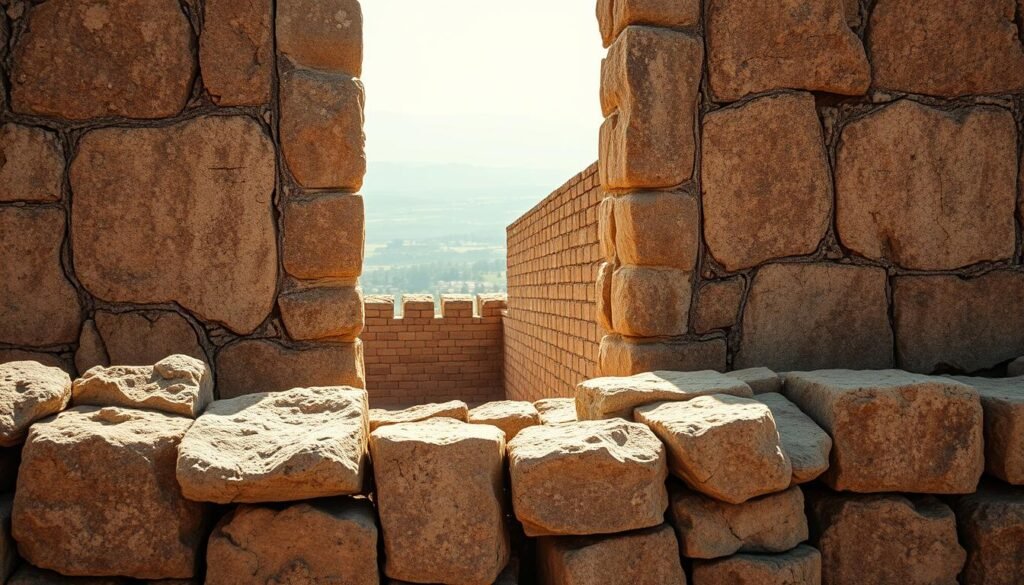
Ming engineers upgraded to bricks like smartphone makers switching to touchscreens. Kiln-fired blocks allowed curvier walls and taller watchtowers. But here’s the kicker: their mortar contained sticky rice flour. This glutenous mix hardened better than regular cement – and probably smelled like lunch.
Rock & Roll Engineering
Mountainous areas got clever treatment. Builders carved stone slabs onsite rather than hauling materials uphill. Steep slopes used “trapezoid” bases – wider bottoms for stability. In deserts? They layered earth with red willow twigs, creating flexible sections that swayed during earthquakes.
From dirt pancakes to rice glue, every choice solved specific problems. Next time you struggle with LEGO, remember: these crews built earthquake-proof walls across 15 states’ worth of terrain using zero electricity. Now that’s #constructiongoals.
Military Significance and Watchtowers Function
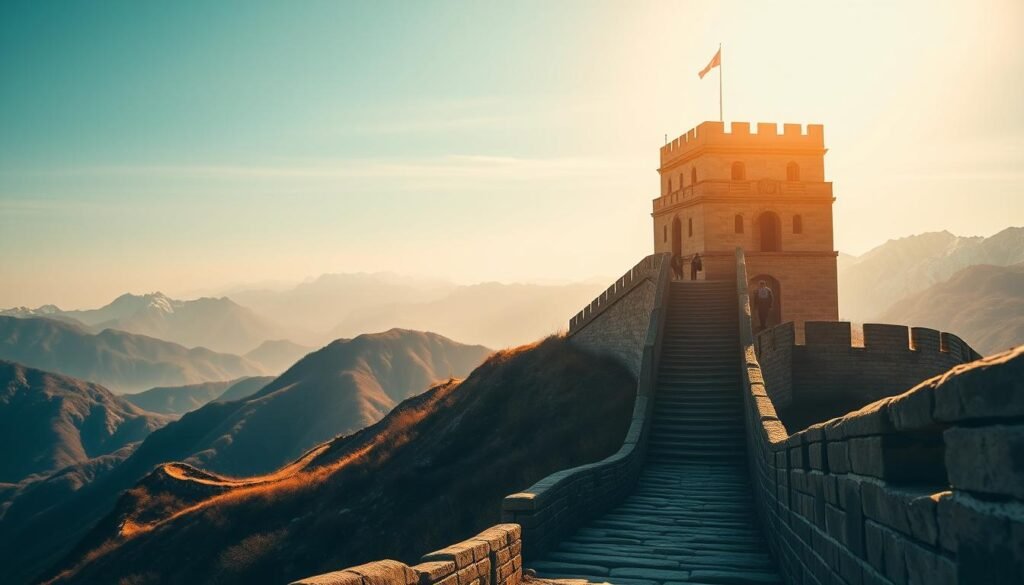
Think of this stone giant as the world’s first military social network. With over 7,000 watchtowers dotting the landscape, soldiers could relay messages faster than TikTok trends. These weren’t just lookout posts – they were ancient cell towers keeping invaders at bay.
Strategic Fortifications and Signal Towers
Here’s how it worked: Guards in each tower scanned the horizon 24/7. Spot trouble? Light a beacon fire or bang a drum. The next tower would repeat the signal, creating a smoke-and-sound chain that raced across provinces. Messages traveled 300+ miles in a day – faster than Mongol horses!
Three genius features made these towers unbeatable:
Spacing science: Built exactly 2 arrow shots apart (about 650 feet) for overlapping defense
Encrypted comms: Different smoke puffs meant specific threats – like emoji for warriors
Let’s get real – patrolling 13,000+ miles sounds impossible. But soldiers used the wall’s curves to their advantage. Steep slopes forced attackers into kill zones where defenders could rain arrows. Those iconic crenellated battlements? Human-sized chess pieces letting guards duck and shoot.
Fun fact: Some towers had secret escape routes disguised as brick walls. Because when 10,000 horsemen charge your position, you want an exit strategy that doesn’t involve becoming a human pincushion.
Great Wall of China Facts for Kids – The Fun Breakdown
Ready to crunch numbers that’ll make your calculator blush? Let’s peel back the curtain on this ancient landmark’s modern-day fame. Spoiler: it involves more selfies than you’d expect from a 600-year-old brick structure.
Amazing Visitor Stats and Real-World Numbers
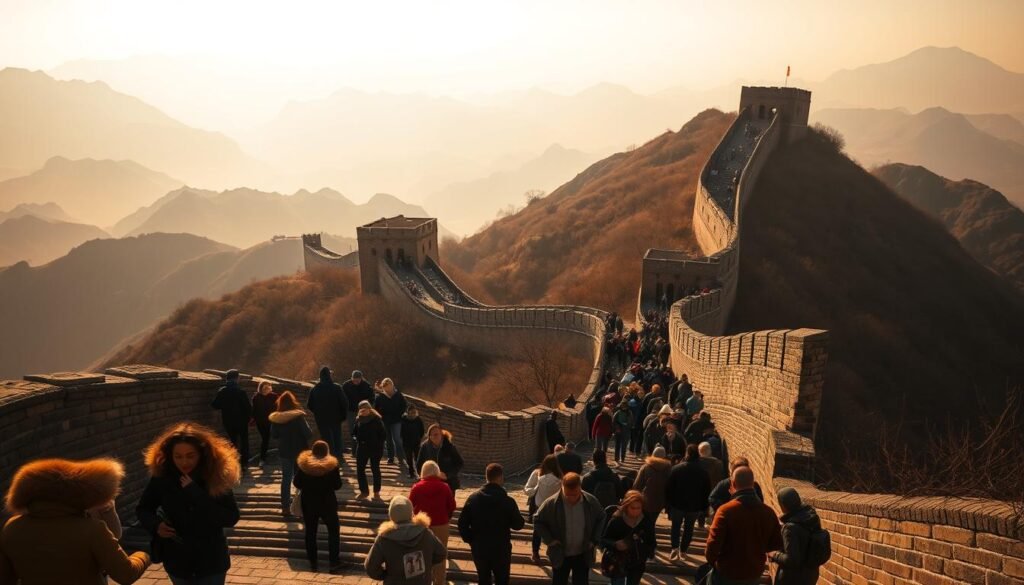
Badaling – the wall’s most Instagrammable section – sees more foot traffic than Disneyland. We’re talking 10 million visitors annually, enough to fill 140,000 school buses. Check these jaw-dropping comparisons:
Combined, these sections draw nearly 50 million tourists yearly. That’s like every Texan visiting twice – with 10 million friends tagging along.
Kid-Friendly Nuggets and Surprising Tidbits
Here’s where history gets weirdly awesome:
Some watchtowers served as ancient post offices – think texting with smoke signals
The Mutianyu toboggan? A 1,500-foot stainless steel slide winding through towers
Workers left secret graffiti – 500-year-old brick carvings of animals and poems
Pro tip: Visit in winter. You’ll dodge crowds and might spot frozen waterfalls clinging to the ramparts like nature’s glitter glue. Just don’t challenge locals to wall-running contests – they’ve had centuries of practice.
The Great Wall’s Changing Landscape and Erosion
Time and footsteps are reshaping this ancient wonder. While 13,000+ miles survived wars and weather, modern visitors now leave their mark. Every selfie-seeking tourist and rainstorm chips away at the structure – but without tourism dollars, conservation stalls. It’s a rock-and-hard-place scenario playing out across crumbling watchtowers.
Tourism Impact and Conservation Challenges
Popular sections like Badaling show the dilemma. Millions walk its bricks yearly, funding repairs but wearing down original stones. Meanwhile, remote wild wall areas crumble silently. Chinese researchers estimate 30% of Ming-era structures have vanished since the 1980s – some from storms, others from souvenir hunters.
Today’s preservation teams use tech the original builders couldn’t imagine:
Region
Old Methods
Modern Fixes
Gubeikou
Mud bricks
3D mapping + lime mortar injections
Jiankou
Stone stacking
Steel supports hidden inside walls
Huanghuacheng
Willow reinforcements
Erosion-resistant polymer coatings
Here’s the twist: some conservation rules limit repairs. Why? Over-restoration erases historical clues. Workers now leave “weathering zones” to study natural decay patterns. It’s like doctors monitoring a patient’s vitals before prescribing medicine.
But challenges remain. At lesser-known parts, unofficial trails carved by hikers accelerate erosion. One 2022 study found foot traffic erodes slopes 400% faster than rain alone. Balancing access with protection might be the greatest wall challenge yet – no rice glue required.
Visibility from Space: Debunking Misconceptions
Let’s cut through the cosmic rumors. You’ve probably heard the “fact” that this ancient barrier is the only human-made structure visible from orbit. Spoiler: It’s about as true as moon cheese. I’ve dug through astronaut logs and satellite data to separate stardust from reality.
Neil Armstrong famously said he couldn’t spot the wall from the moon. But shuttle astronaut William R. Pogue later claimed he saw sections “with binoculars” from low Earth orbit. Here’s the catch: at 250 miles up, you’d need perfect conditions – snow-covered ramparts at dawn, zero pollution. Even then, it’s like trying to see a shoelace on a football field.
Scientific Evidence Versus Popular Myths
Modern satellites? Sure. Human eyes? Not so much. The structure’s width works against it – most parts are narrower than a highway lane. Our retinas simply can’t process such slim, earth-toned lines against vast landscapes. NASA confirms: urban areas show up clearer due to color contrast.
Visibility Factor
Human Eye Reality
Camera Truth
Color Contrast
Blends with terrain
Infrared sensors detect differences
Width Perception
~20 feet seems microscopic
Zoom lenses reveal textures
Atmospheric Interference
Haze obscures details
Satellites use spectral imaging
So why does the myth persist? Blame 1930s textbooks and our love for epic superlatives. The real marvel? This wall stretches across deserts and peaks that are visible from space – if you know how to read the land’s wrinkles.
Next time someone claims they’ve spotted it from their space camp telescope, smile. Then hit them with cold, hard facts: even at 17,500 mph, the International Space Station crew needs camera gear to pick out specific parts. Not impossible. Just wildly overstated.
Mind-blowing Architectural Feats and Engineering
What if I told you this ancient wonder was built like a giant stone sandwich? Engineers across dynasties crafted a structure so stable, it laughs at earthquakes and scoffs at landslides. Let’s peel back the layers of their genius.
Trapeze Design for Unmatched Stability
Picture a circus acrobat’s swing – wide at the base, narrow at the top. That’s exactly how builders shaped steep mountain sections. At Jiayu Pass, walls flare out to 20 feet wide at ground level, tapering to 16 feet up top. This “stone pyramid” approach distributed weight perfectly. Even today, these slopes handle 7.0 quakes better than modern highways.
Section
Base Width
Top Width
Material
Jiayu Pass
20 feet
16 feet
Compacted earth + gravel
Mutianyu
25 feet
19 feet
Granite blocks
Shanhai Pass
18 feet
14 feet
Limestone + clay
Robust Fortress Gateways and Watchtowers
The wall’s gates weren’t just doors – they were death traps for invaders. At Gubeikou, a series of four staggered gates forced enemies into tight corridors. Archers in overhead watchtowers could pick them off like ducks in a shooting gallery. Clever? Absolutely. Friendly? Not so much.
Adaptive Construction Methods Through Time
Builders constantly upgraded their playbook. Early sections used rammed earth mixed with pine resin. Ming-era crews switched to kiln-fired bricks held together with that famous sticky rice mortar. In deserts? They wove willow branches into walls like basketwork. This wasn’t just construction – it was eco-engineering centuries before the term existed.
From trapezoid foundations to self-healing mortar, every choice had purpose. Next time you see a modern skyscraper, remember: its DNA traces back to this 13,000-mile masterclass in construction greatness.
Legends, Myths, and Historical Anecdotes
Ever heard a story so sad it made stones weep? Let me take you through the tear-stained legends that turned this engineering marvel into a cultural touchstone. These tales reveal more about the people behind the bricks than any history book.
During the Qin Dynasty, newlywed farmer Wan Xiliang got snatched by soldiers to work on the wall. His wife Meng Jiangnu walked 700 miles through snow to bring him winter clothes. When she arrived? Workers told her he’d died – his body buried in the ramparts.
Her wails shook heaven itself. For three days, she cried until a 300-foot section collapsed, revealing bones. As legend goes, blood dripped from one skeleton – proof it was Wan. Today, a temple near Beijing honors her devotion.
Dragons in the Stonework
Many dynasties wove serpent myths into the wall’s story. Builders claimed its winding shape mirrored a sleeping dragon’s spine. Some Ming-era sections even have carved scales! Locals still whisper that:
Storm clouds gather where dragon spirits guard hidden treasure
Certain watchtowers mark spots where celestial dragons landed
Cracked stones mean angry dragons shifted underground
Legend
Dynasty
Cultural Impact
Meng’s Lament
Qin
Symbolizes workers’ sacrifices
Stone Dragons
Ming
Explains wall’s winding path
Ghost Soldiers
Han
Used to deter nighttime thieves
These stories did more than entertain. They gave workers hope during backbreaking labor and united the country through shared myths. Next time you see a weathered brick, remember – it might be hiding 500 years of dragon gossip.
Wrapping Up the Ancient Wonder
What if history class smelled like sticky rice? That’s the lingering truth behind this 13,000+ mile marvel – a mix of rammed earth, sweat, and lunchbox ingredients. Across 23 centuries, countless hands shaped a living timeline that still whispers secrets through crumbling watchtowers.
Think bigger than bricks. Every foot of its length represents choices – willow branches woven into desert walls, rice glue defying earthquakes, soldiers banging drums across mountain passes. Modern engineers marvel at how workers without blueprints outbuilt skyscrapers using dirt and grit.
Today’s preservation teams face their own puzzle: protect the past without freezing it in time. Some sections get polymer armor, others are left to weather naturally. It’s a reminder that even stone giants evolve – surviving not through perfection, but adaptation.
So next time you see its winding silhouette, remember: you’re glimpsing dynasties of problem-solving. From horseback alarms to tourist selfies, this isn’t just a wall. It’s humanity’s scrapbook – pages still being written, one repaired brick at a time…