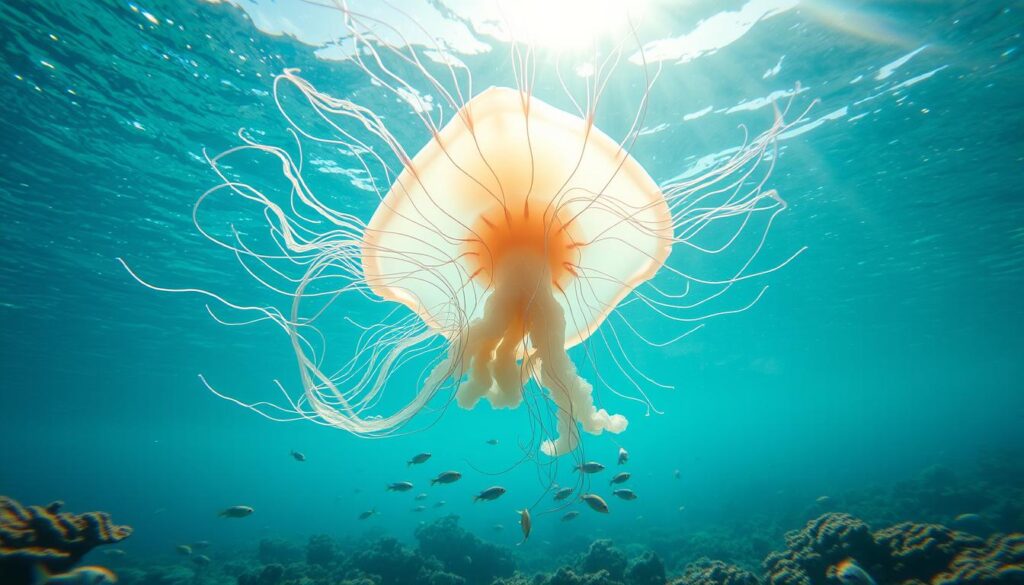
Box jellyfish are among the deadliest sea creatures. They have a sting that can be deadly. This makes them very dangerous in the ocean.
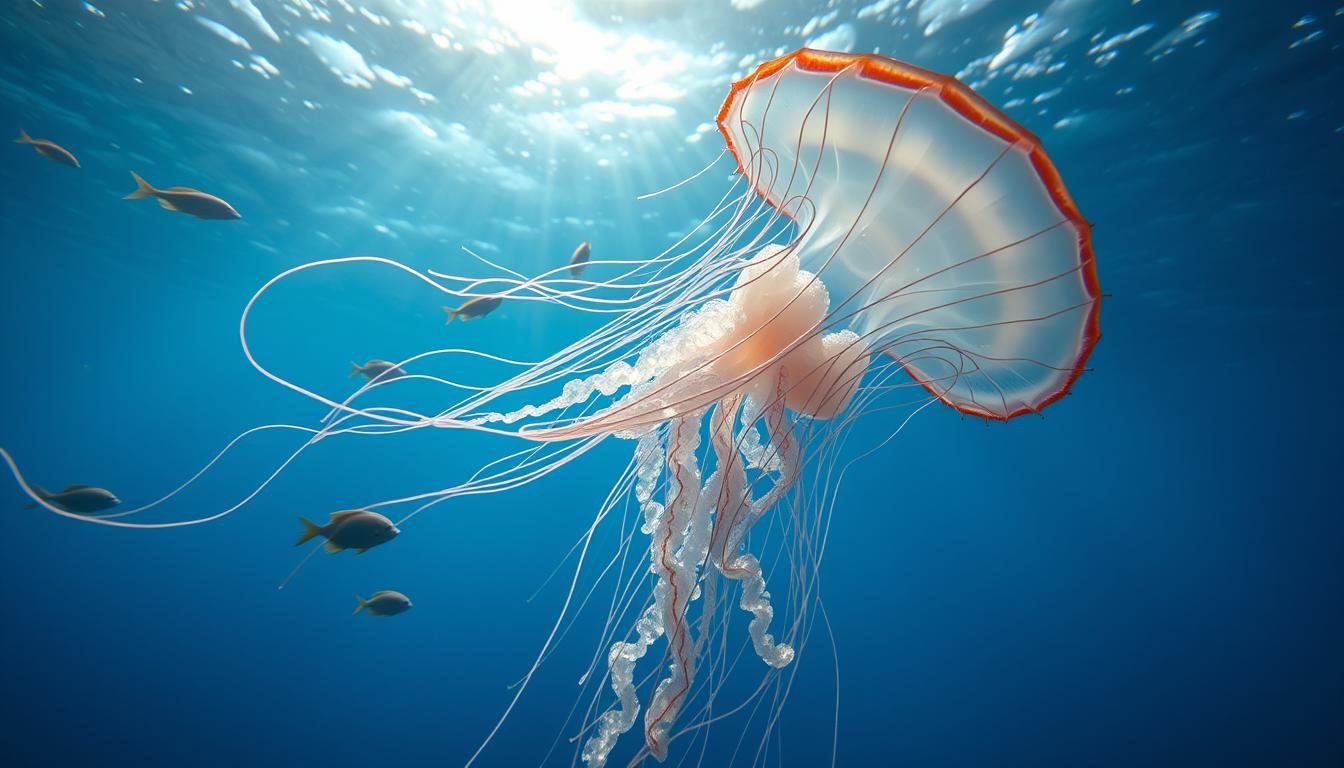
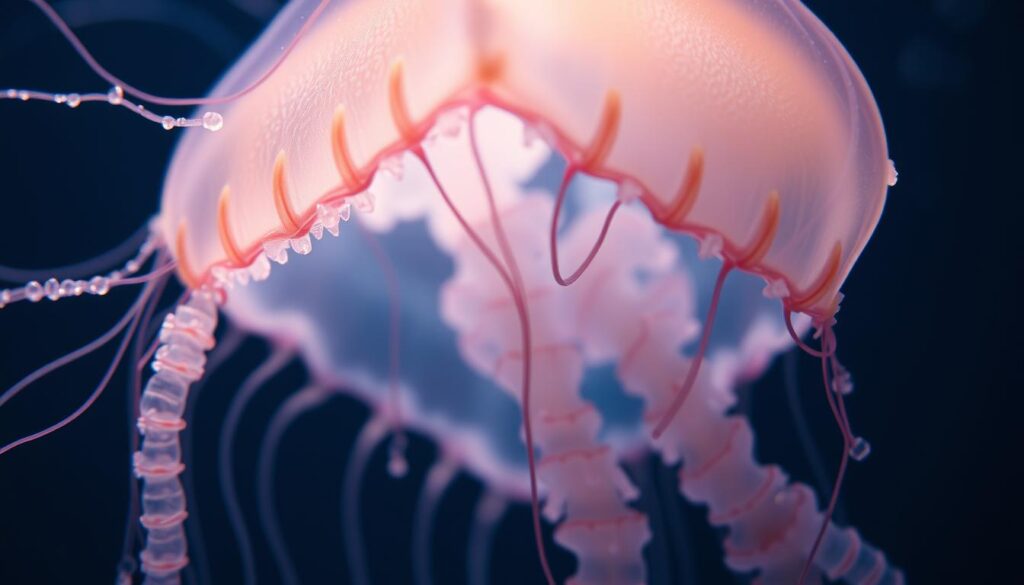
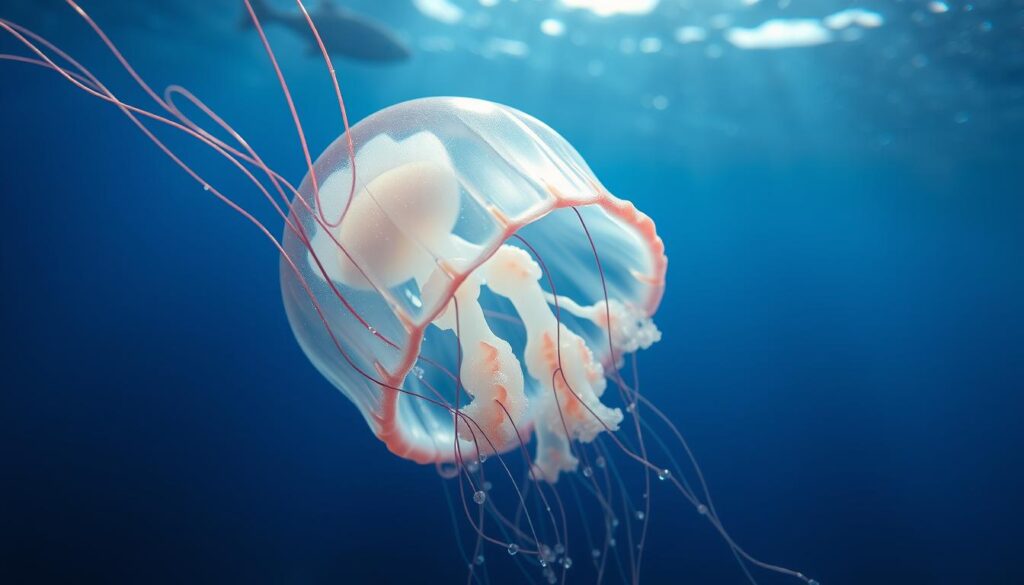
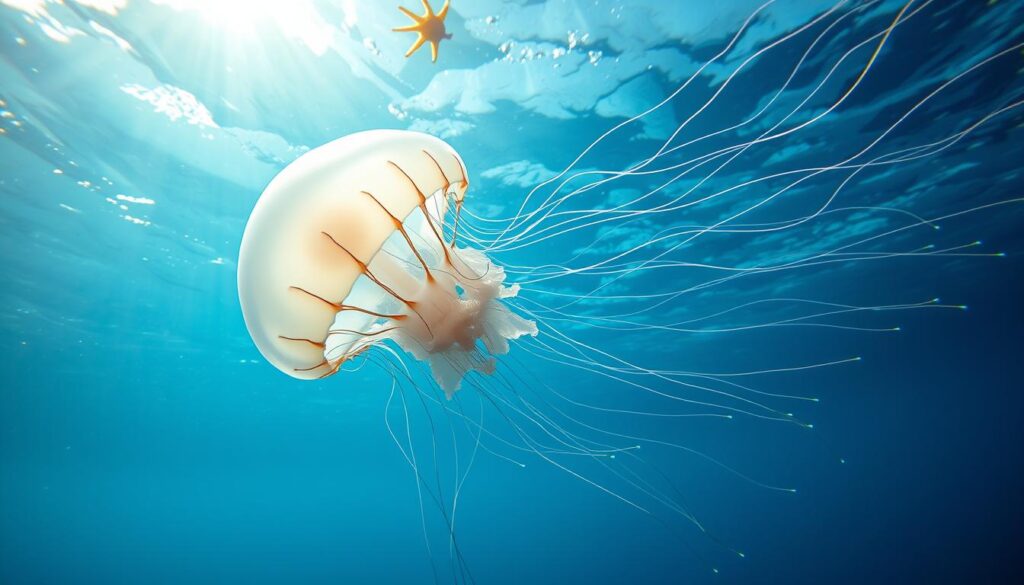
These sea animals are called cnidarian invertebrates. They have a box-like body. Their clear bodies help them hide in the water, making them hard to see.
Box jellyfish are different from other jellyfish. They can swim fast and catch prey easily. Their swimming skills make them top predators in the sea.
Kids who love the sea will find box jellyfish fascinating. They have amazing ways to see and hunt. These creatures are truly amazing in the ocean.
Their clear bodies are not just for hiding. They are a special feature that helps them live in different sea places. Learning about these creatures helps us understand the ocean better.
What Makes Box Jellyfish Unique in the Ocean World
The ocean is full of mysteries, and the box jellyfish is one of them. Their unique features make them stand out in the underwater world.
Transparent jellyfish are common, but box jellyfish are different. Their bodies are so clear, they’re called the “ghosts of the sea”.
Physical Features of Box Jellyfish
Box jellyfish don’t look like other jellyfish. They have:
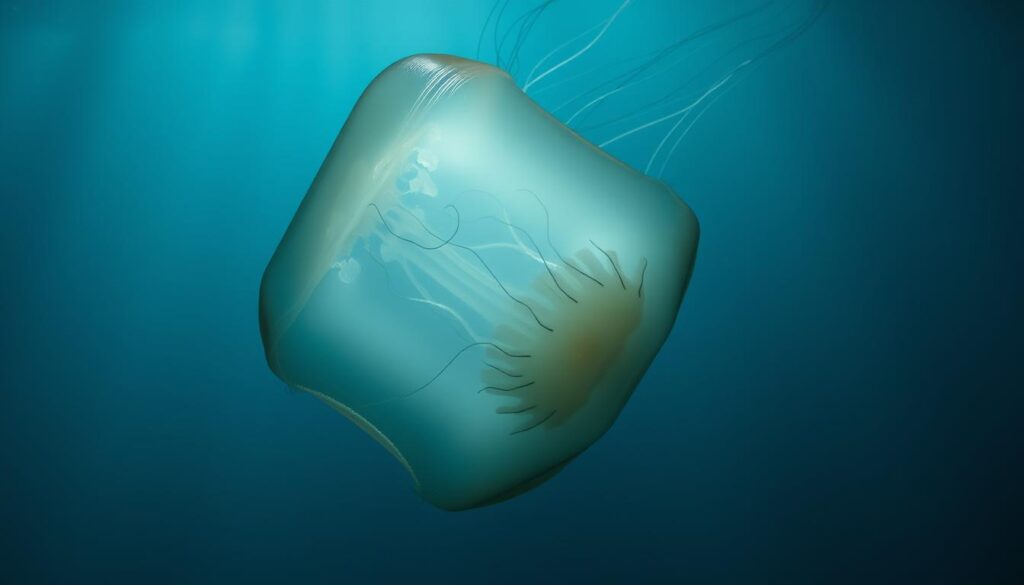
Perfectly square-shaped bell
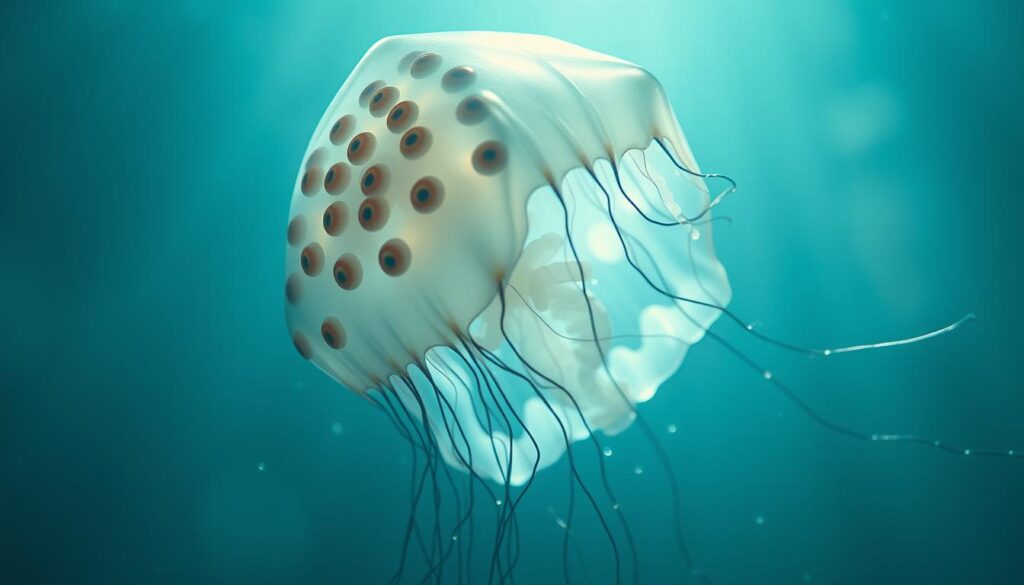
Extremely clear, glass-like body
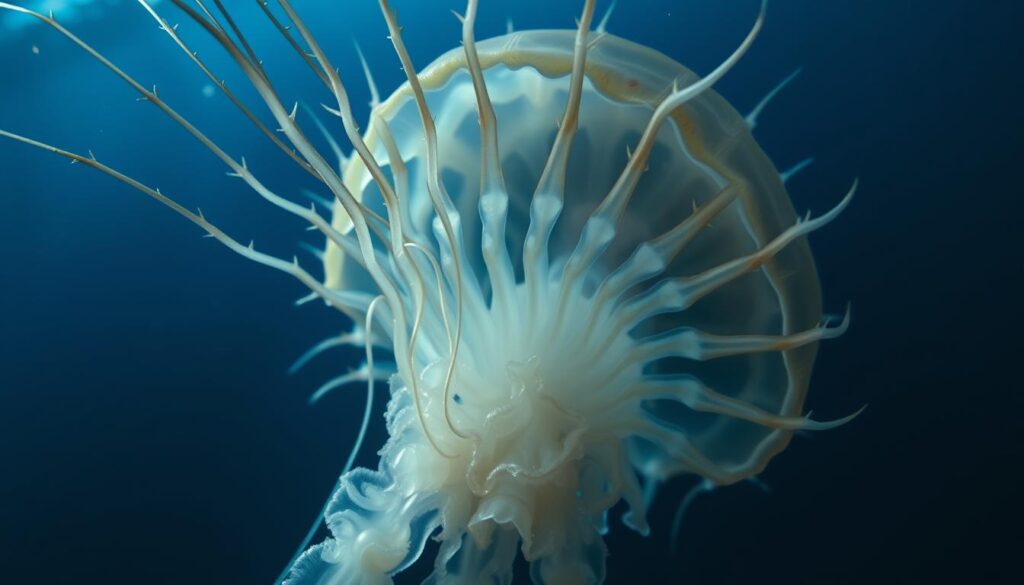
Multiple tentacles extending from each corner
Incredibly sophisticated visual system
Why They’re Called ‘Glass’ Creatures
The term glass jellyfish comes from their transparency. You can see right through them, making them blend into the water.
The Box-Shaped Bell Structure
Their bell is a marvel of marine engineering. It lets them swim better than most other jellyfish.
Feature
Box Jellyfish Characteristic
Shape
Perfect cube-like structure
Transparency
Nearly 100% see-through
Tentacle Arrangement
One at each corner of the bell
Movement
More precise and faster than typical jellyfish
Box Jellyfish Facts for Kids: Amazing Things to Know
Get ready to learn about box jellyfish in a way that will amaze you! These sea creatures have abilities that seem almost magical. They are truly incredible marine animals.
Here are some mind-blowing facts about box jellyfish that kids will love:
Box jellyfish have an astonishing 24 eyes spread across their body
They can swim at incredible speeds up to 4 knots – faster than most other jellyfish
Their transparent body looks like living glass, making them nearly invisible in water
They have a unique cube-shaped bell that helps them navigate precisely
Here are more amazing details about box jellyfish:
Unique Feature
Incredible Fact
Vision
24 eyes with 4 separate retinal groups
Speed
Can move up to 4 knots (4.6 mph)
Body Structure
Cube-shaped transparent body
Swimming Ability
Active swimmers unlike most jellyfish
Imagine a creature that looks like living glass, can see in multiple directions, and swims faster than you might expect! Box jellyfish are nature’s underwater superheroes. Their abilities are like something from a science fiction movie.
The Powerful Swimming Champions of the Sea
Box jellyfish are amazing sea creatures with incredible swimming skills. They move through the water in a way that’s unique among sea animals. This makes them some of the most impressive swimmers in the ocean.
Box jellyfish are different from other jellyfish because they swim actively. They can swim up to 1.5 to 2 metres per second. This is very fast for something as soft as a jellyfish.
Exploring Box Jellyfish Swimming Mechanics
The way box jellyfish swim is quite complex. They use a pulsing motion to move through the water. This motion is what makes them so agile and fast.
Powerful bell-shaped body provides rapid propulsion
Synchronized muscle contractions enable directional control
Ability to move quickly helps with hunting and survival
Speed Comparison in Marine Environments
Marine Creature
Swimming Speed
Box Jellyfish
1.5-2 m/second
Sea Turtle
0.5-1 m/second
Typical Jellyfish
0.1-0.3 m/second
Box jellyfish are truly remarkable predators in the sea. Their speed and precision let them move through the water with ease. This makes them very efficient in their underwater world.
Box jellyfish have an amazing vision system. They have 24 eyes, more than most sea creatures. Their eyes are not simple light sensors but complex organs for navigation.
Scientists found that box jellyfish have different eye types. Some of their eyes can form images, a rare ability in marine animals. These image-forming lens eyes work like tiny cameras, helping them understand their underwater world.
24 total eyes spread across their body
4 special eyes called “rhopalia” with lens and cornea
Some eyes can detect light and dark
Other eyes can recognize complex visual details
The vision of box jellyfish is so advanced. They can detect obstacles, navigate reefs, and even distinguish between environments. Unlike many jellyfish, they actively move and hunt with great accuracy.
Researchers think their unique vision system evolved for survival. With multiple eye types, they can quickly adapt to changes in their underwater world. This makes them one of the most visually adapted creatures in the ocean.
Inside the Box Jellyfish’s Body
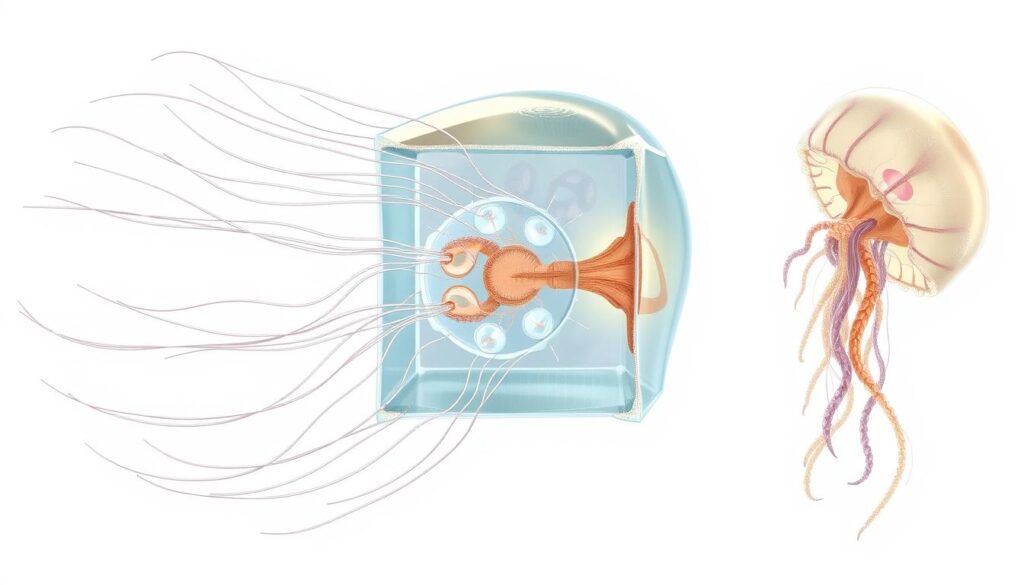
Dive into the fascinating world of jellyfish anatomy and explore the incredible marine biology of box jellyfish. These remarkable creatures have a unique body structure that sets them apart from other marine organisms.
Box jellyfish have a surprisingly complex internal system. This makes them true marvels of the ocean. Unlike typical jellyfish, their body design is more advanced and detailed.
Key Structural Components
Bell (Body): A transparent, cube-shaped structure that gives them their distinctive name
Tentacles: Four clusters of powerful, venom-laden tentacles
Digestive System: A central cavity that processes food quickly
Sensory Structures: Unique eyes that help them navigate marine environments
Revolutionary Nervous System
Marine biology for kids reveals that box jellyfish have an extraordinary nervous system. Unlike other jellyfish with simple nerve nets, box jellyfish feature a more sophisticated network of nerves. This allows for complex behaviors.
Their nervous system acts like a sophisticated biological computer. It enables rapid responses to environmental stimuli. This advanced neural network helps them hunt, avoid predators, and navigate through water with remarkable precision.
The intricacy of jellyfish anatomy in box jellyfish continues to fascinate marine biologists. It showcases nature’s incredible design and adaptability in the underwater world.
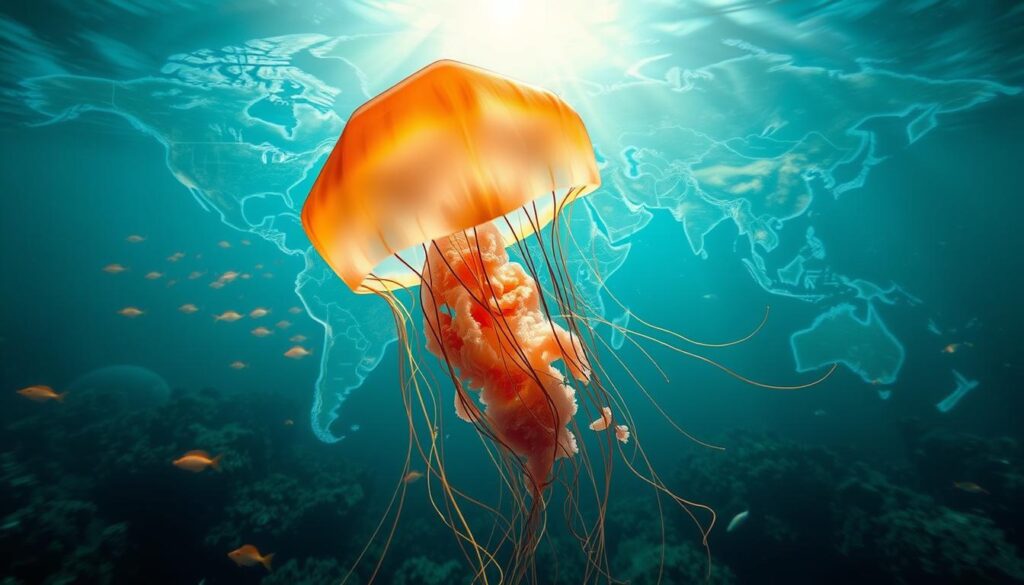
Box jellyfish are fascinating creatures found in tropical and subtropical oceans. They live between 42° North and 42° South latitudes. This range creates a unique marine ecosystem that scientists and ocean lovers find intriguing.
These remarkable creatures mainly live in warm ocean waters. They are found in large numbers in:
Northern Australia’s coastal regions
Southeast Asian maritime zones
Caribbean Sea ecosystems
Hawaiian marine environments
The marine ecosystems where box jellyfish thrive have specific temperature ranges and water conditions. Warm tropical waters provide the ideal environment for these unique creatures.
Region
Typical Water Temperature
Box Jellyfish Presence
Great Barrier Reef
24-30°C
High concentration
Gulf of Mexico
22-28°C
Moderate presence
Philippines
26-32°C
Significant population
Ocean temperatures are key in defining where box jellyfish live. They prefer waters above 22°C. This is why they are found in tropical and subtropical marine ecosystems worldwide.
The Hunting Skills of Box Jellyfish
Box jellyfish are fascinating predators in the marine food chain. Unlike many other jellyfish species that passively drift, these creatures are active hunters with remarkable hunting strategies. Their advanced hunting skills set them apart in the underwater world.
These marine predators have developed unique techniques to catch their prey with incredible precision. Their hunting approach is both sophisticated and efficient, making them formidable jellyfish predators in their ecosystem.
How They Catch Their Prey
Box jellyfish use their powerful tentacles as primary hunting tools. These tentacles are equipped with specialized stinging cells called nematocysts that work like tiny harpoons. When a prey comes near, the jellyfish quickly:
Detect movement using their advanced vision system
Rapidly deploy venomous tentacles
Immobilize prey within seconds
Pull the captured food toward their central body
What Box Jellyfish Eat
Their diet mainly includes small marine creatures that live in their underwater world. Typical prey includes:
Small fish
Tiny crustaceans
Marine worms
Microscopic zooplankton
By eating these organisms, box jellyfish help keep the marine food chain balanced. Their hunting skills make them efficient predators in their underwater home.
Box Jellyfish Size and Growth
Box jellyfish are amazing creatures with unique growth patterns. They come in various sizes, making them stand out in the ocean. A full-grown box jellyfish can be as big as a coffee mug, measuring up to 20 cm on each side.
Knowing about marine animal sizes helps us see the ocean’s incredible variety. Box jellyfish vary in size, from small to large. Some are as small as a golf ball, while others are quite big.
Smallest box jellyfish: Around 5 cm in diameter
Largest box jellyfish: Up to 20 cm per side
Average weight: Approximately 100-200 grams
Their growth is quite interesting. Young box jellyfish start as tiny polyps on underwater surfaces. They grow into the box-shaped adults we know through a process called strobilation.
Life Stage
Size Range
Growth Characteristics
Polyp Stage
1-3 mm
Stationary, attached to surfaces
Juvenile Stage
5-10 cm
Developing bell and tentacles
Adult Stage
10-20 cm
Full swimming capabilities
Their size affects their hunting skills. Bigger box jellyfish can catch more prey and swim better in the ocean. This shows how important size is for survival in the sea.
The Life Cycle of Box Jellyfish
Box jellyfish have a unique life cycle that shows nature’s complexity. Their reproduction cycle includes several special transformations. These set them apart from other sea creatures.
The jellyfish reproduction starts with tiny eggs released into the ocean. These eggs quickly turn into tiny larvae called planula. These larvae can survive and attach to rocks or coral reefs, beginning their journey.
Egg Stage: Microscopic eggs released in marine environments
Planula Stage: Larvae attach to underwater surfaces
Polyp Stage: Develop into stationary organisms
Medusa Stage: Transform into free-swimming jellyfish
In the polyp stage, box jellyfish go through strobilation. This amazing change happens when the polyp splits into many segments. Each segment turns into a tiny jellyfish, called ephyrae. These young jellyfish grow and mature over time.
Life Stage
Duration
Key Characteristics
Egg
Few days
Microscopic, free-floating
Planula
1-2 weeks
Attach to surfaces
Polyp
Months
Stationary, reproducing asexually
Medusa
Several months
Free-swimming, sexually mature
When their bell is about 5 millimeters wide, box jellyfish become sexually mature. At this size, they can reproduce and finish their life cycle in the sea.
Box Jellyfish Venom and Stings
Box jellyfish have an amazing defense system. They are transparent and have very strong venom. This makes them very dangerous to others in the ocean.
Box jellyfish use their venom to survive. Their tentacles are not just for swimming. They are also weapons for hunting and protecting themselves.
Why Their Stings Are Dangerous
The venom of box jellyfish is very complex and works fast. It can cause severe reactions right away. Their venom has:
Powerful neurotoxins that attack the nervous system
Cardiotoxic compounds that impact heart function
Dermatonecrotic agents that destroy skin tissue
How They Use Their Tentacles
Box jellyfish use their tentacles very carefully. These tentacles can grow up to 10 feet long. They have thousands of tiny stinging cells called nematocysts.
Tentacle Function
Purpose
Mechanism
Hunting
Capture prey
Instant venom injection
Defense
Protect against predators
Rapid stinging response
Navigation
Sense environmental changes
Chemical and light detection
The venom of box jellyfish works very fast. It can cause immediate cardiac arrest in small prey. It also causes a lot of pain in bigger animals, including humans.
Staying Safe Around Box Jellyfish
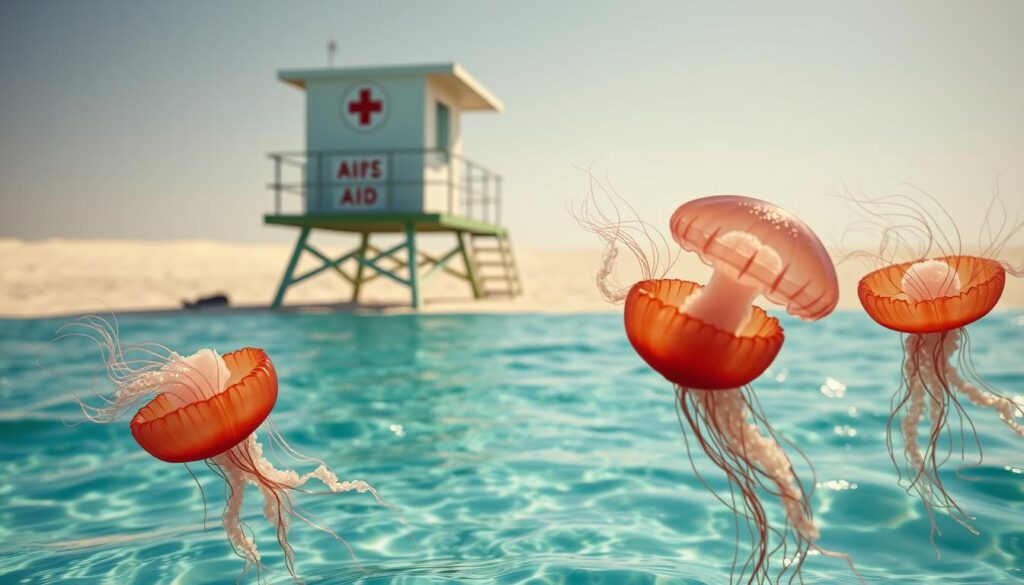
Ocean safety is key when you’re near box jellyfish. These creatures live in tropical waters and need careful attention. Knowing how to prevent jellyfish stings can save your life.
There are many ways to stay safe in the ocean:
Wear full-body stinger suits in tropical waters
Use protective gear like swimming caps and water shoes
Check local beach warnings before entering the water
Swim only in safe areas with lifeguards
If you get stung, act fast. Vinegar is the best treatment for box jellyfish venom. Rinse the area with vinegar for 30 seconds to stop the venom.
Experts say to always be prepared:
Swim with a buddy
Carry a first aid kit with vinegar
Learn how to treat jellyfish stings
Stay updated on local marine conditions
Knowing about box jellyfish can help you stay safe. By understanding their habits, you can enjoy the ocean while avoiding dangers.
Natural Predators of Box Jellyfish
In the complex marine food web, box jellyfish have natural predators. These predators keep their numbers in balance. Box jellyfish, despite their dangerous venom, are not invincible.
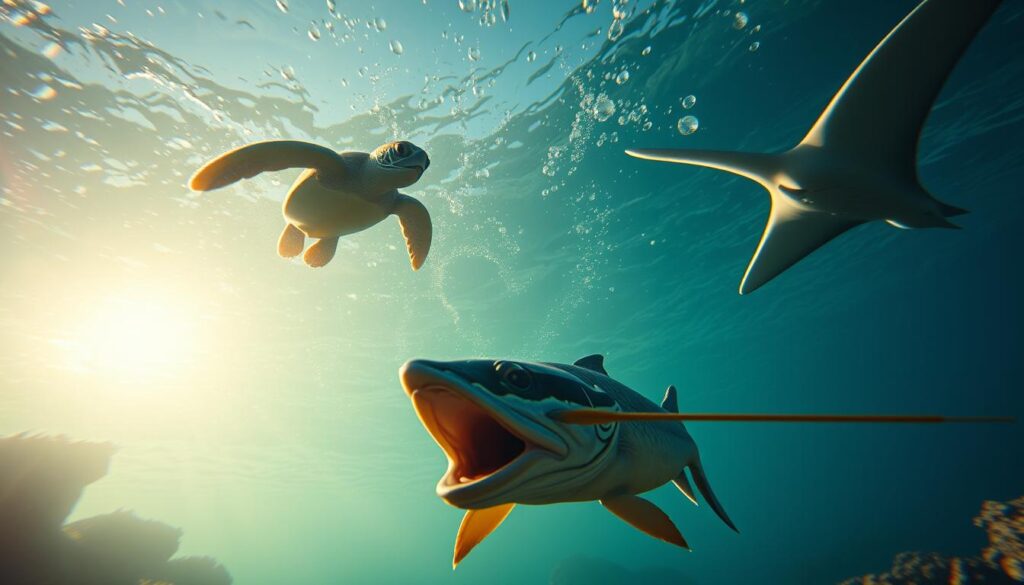
Sea turtles are the most impressive jellyfish predators. Their thick skin protects them from box jellyfish stings. Leatherback sea turtles, in particular, can eat jellyfish without harm.
Sea turtles consume up to 70% of their diet as jellyfish
Some turtle species can eat box jellyfish without suffering from their toxic stings
Predators help maintain balance in marine ecosystems
Other predators include certain fish and marine birds. They are key in controlling jellyfish numbers. This helps keep the ocean’s ecosystem balanced.
Predator
Interaction with Box Jellyfish
Leatherback Sea Turtle
Primary consumer, immune to venom
Sunfish
Occasional jellyfish hunter
Sea Birds
Opportunistic feeders
Studying these predator-prey relationships is important. It helps scientists understand marine food webs. This knowledge is key to keeping our oceans healthy.
How Scientists Study Box Jellyfish
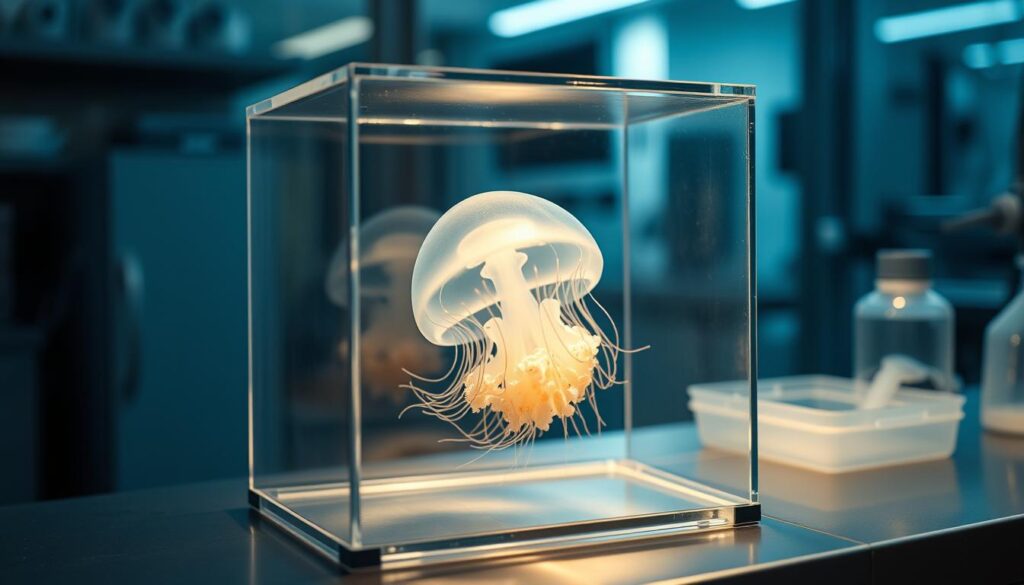
Studying box jellyfish in the ocean is a big challenge. Marine biology uses special methods to learn about these creatures.
Scientists use many ways to study box jellyfish in their home. They mix new technology with careful watching.
Underwater Video Tracking: Researchers use high-resolution cameras to capture detailed movements
Specialized Sampling Nets: Designed to collect specimens without causing damage
Environmental DNA Analysis: Detecting genetic traces in water samples
The coolest part of studying box jellyfish is using environmental DNA. This new way lets scientists find genetic info without catching the jellyfish.
Research Method
Purpose
Effectiveness
Underwater Cameras
Observe Behavior
High
eDNA Sampling
Genetic Analysis
Medium-High
Specialized Nets
Physical Specimen Collection
Medium
New ocean exploration tools are making studying box jellyfish better. Young scientists will see even more cool ways to do research soon.
Conservation and Environmental Impact
Box jellyfish are key to protecting our oceans. They act as both hunters and food for other sea creatures. Scientists say their numbers change with the environment, like water temperature and acidity.
Efforts to save our oceans affect where box jellyfish live. Warmer temperatures can mess with their breeding and where they go. This could upset the balance of sea life. Studies show climate change might let box jellyfish spread, posing new threats to sea diversity.
Kids can really help protect the oceans where box jellyfish live. By cutting down on plastic, joining beach clean-ups, and learning about ocean protection, they can make a big difference. Every little bit helps keep our oceans and their amazing creatures healthy.
Learning about box jellyfish shows us how connected sea life is. Their well-being shows us how healthy the ocean is. By supporting ocean-saving efforts, we can protect these amazing creatures and their homes.