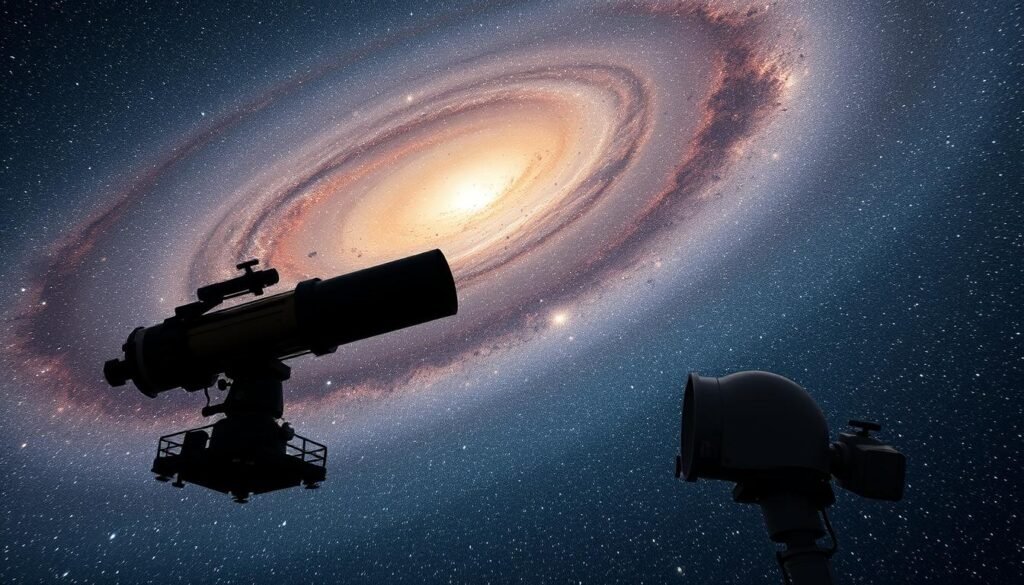
Welcome to the most epic cosmic adventure in our universe! The Milky Way is our incredible home galaxy. It’s filled with billions of stars and secrets waiting to be discovered by curious young space explorers.
Imagine a massive cosmic neighborhood stretching across 100,000 light-years. Each star has its own story. These galaxy facts for kids will change how you see the night sky forever!
Our Milky Way isn’t just a random collection of stars. It’s a spinning spiral of stellar excitement. Gravitational forces hold everything together like a gigantic cosmic dance. Picture a galactic disk so enormous that if you could drive across it at highway speed, you’d need millions of years to reach the edge.
Scientists estimate our galaxy contains between 100-400 billion stars. That’s more stars than there are grains of sand on every beach on Earth combined! Each of these stars has its own planetary system, making the Milky Way a treasure trove of wonders.
From supermassive black holes at our galaxy’s center to mysterious dark matter, the Milky Way is a playground of scientific mysteries. Buckle up for an interstellar journey that’ll make your imagination soar beyond the stars!
The Tasty Truth: Our Galaxy Smells Like Raspberries and Rum
Get ready for a cosmic adventure that changes how you see space smells! The Milky Way is more than stars and dust. It’s a huge chemical playground with amazing smells.
Imagine flying through space and smelling something like a fruity cocktail. Sounds crazy? Not in our galaxy! Scientists have found out how space smells so wild.
Chemical Compounds in Space
Astronomers found a huge cloud at the galaxy’s heart. It contains ethyl formate, a molecule that smells like raspberries and rum.
Creates a raspberry-like fragrance
Carries hints of rum’s distinctive smell
Exists in a gigantic space cloud near the galaxy’s center
The Sweet-Scented Space Cloud
This space cloud is not just a random find. It shows how complex space smells can be. It proves that molecules can make familiar smells from millions of light-years away.
Space Alcohol Adventures
But there’s more! Nearby areas have lots of ethyl alcohol. It’s enough to keep Earth “buzzed” for billions of years. But don’t expect to drink it anytime soon. These clouds also have bad stuff like carbon monoxide.
Space keeps surprising us with its complex and unexpected traits. It shows the universe is much more interesting than we thought.
Size Matters: How Big is the Milky Way?
Imagine a cosmic pizza so massive that it would make every earthly measurement look microscopic! The Milky Way’s galaxy dimensions are mind-blowingly enormous. Stretching approximately 100,000 light-years in diameter, our home galaxy is a celestial giant that dwarfs human comprehension.
Let’s break down the milky way size in a way that’ll make your brain spin:
If our galaxy were the size of the United States, our entire Solar System would be smaller than a quarter in Washington D.C.
Light takes 100,000 years to travel from one side of the Milky Way to the other
The galaxy contains between 100-400 billion stars
To put this cosmic magnitude into perspective, if you could travel at the speed of light, you’d need 100,000 years to cross our galactic neighborhood. That’s longer than human civilization has existed!
Our Milky Way isn’t just big – it’s a spiral powerhouse spinning through space. It carries billions of stars, planets, and countless mysteries within its vast dimensions. Each light-year represents roughly 6 trillion miles, making the total span of our galaxy an absolutely mind-bending distance.
Star Power: Our Sun’s Cosmic Family
The Milky Way is a stunning neighborhood filled with stars of all kinds. Our Sun is part of a huge family of stars, each with its own story. Scientists think our galaxy has between 100 to 400 billion stars, each with its own tale.
Types of Stars in Our Galaxy
Stars are incredibly diverse, with each type having its own features. The galaxy is home to:
Red Dwarfs: The most common stars, small and cool
Blue Giants: Massive, hot stars burning incredibly bright
Yellow Stars: Medium-sized stars like our Sun
White Dwarfs: Compact, dense stellar remnants
Star Colors and Their Meanings
Star colors tell us a lot about their temperature and what they’re made of. Red stars are cooler, while blue and white stars are hotter. Our yellow Sun is right in the middle.
The Life Cycle of Stars
The life of a star is an amazing journey from dust to shining star. Stars start as dense clouds, then collapse and start burning. They live for a long time, ending in dramatic ways like supernovas or planetary nebulas.
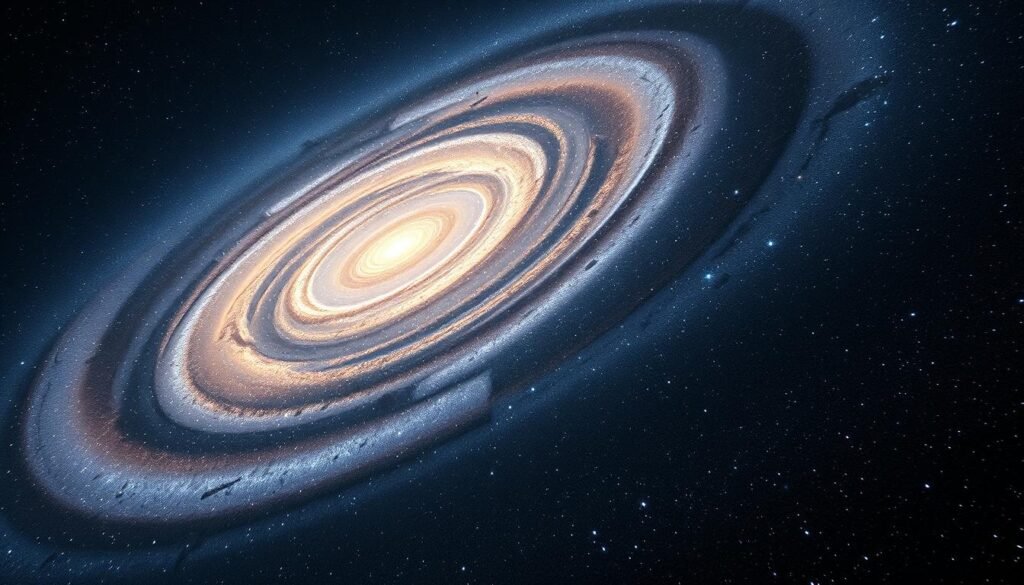
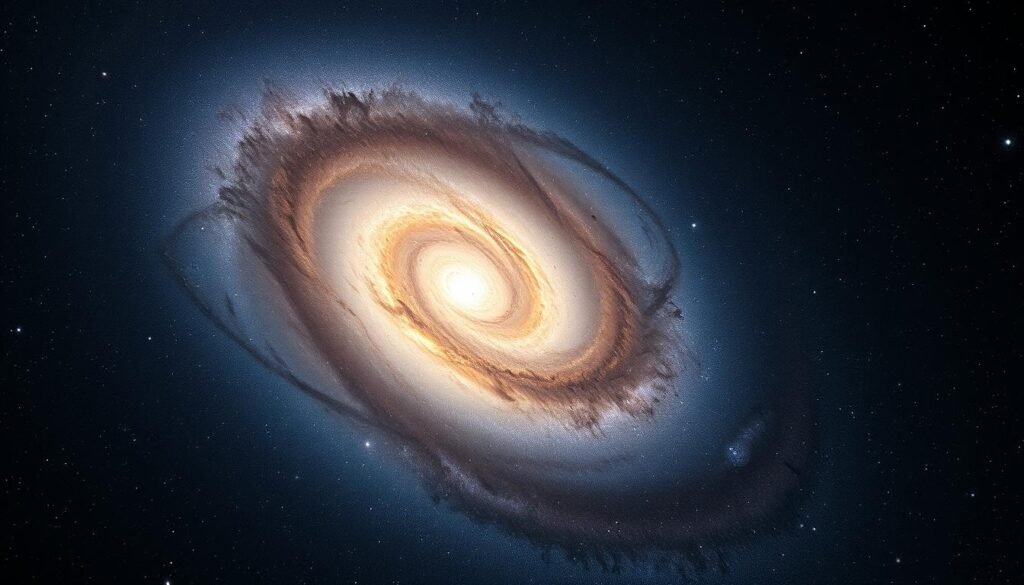
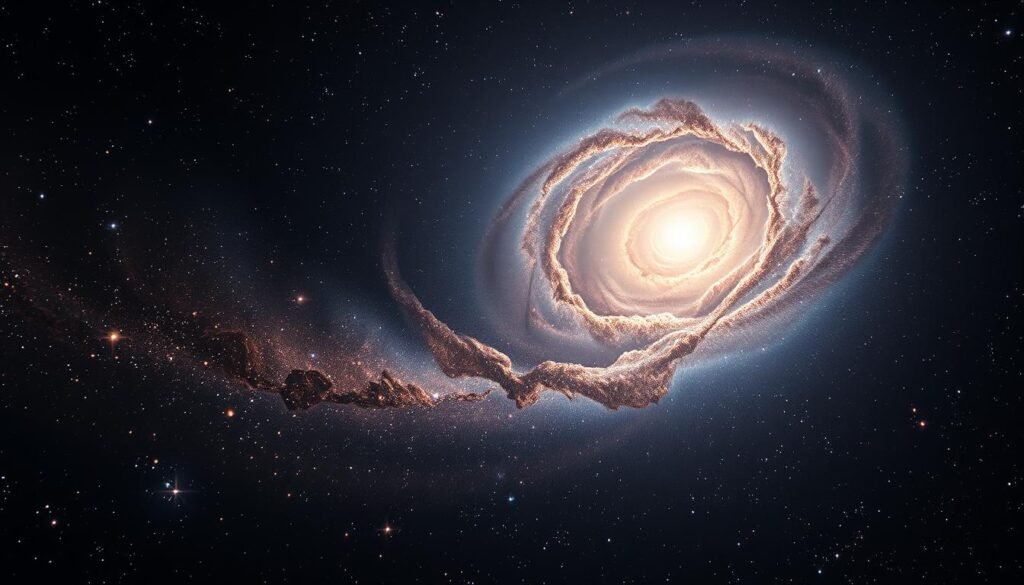
Imagine our Milky Way as a cosmic pinwheel spinning through space. This spectacular spiral galaxy is a breathtaking celestial design that captures astronomers’ imaginations. The Milky Way structure isn’t just random – it’s a carefully choreographed dance of stars, gas, and dust.
Our galaxy features a unique design that sets it apart from other cosmic neighborhoods. As a barred spiral galaxy, the Milky Way has a distinctive central bar-shaped region from which spiral arms extend outward. Think of it like a cosmic highway system where stars travel along these magnificent arms.
Central bar length: Approximately 27,000 light-years
Total galaxy diameter: Around 100,000 light-years
Number of primary spiral arms: 4
The spiral galaxy’s arms are star-forming powerhouses. Stellar nurseries populate these regions, where dense gas clouds give birth to new stars. Our Solar System sits in a smaller arm called the Orion Arm – basically the galactic suburbs of this massive cosmic metropolis.
Astronomers have mapped the Milky Way’s structure using advanced telescopes and space missions. Each observation reveals more about our galactic home’s complex and dynamic nature. From the dense galactic core to the sprawling spiral arms, our galaxy is a marvel of cosmic engineering.
Cosmic Neighbors: Planets and Stars Near Us
Our galaxy is filled with nearby stars and interesting exoplanets. Beyond our solar system, there’s a world of wonders waiting to be explored. Scientists have found amazing objects that change how we see planets.
The Local Star Group
The closest star system to Earth is Alpha Centauri, just 4.37 light-years away. This system has three stars:
Alpha Centauri A: A star like our sun
Alpha Centauri B: A bit smaller and cooler
Proxima Centauri: A tiny red dwarf star
Nearest Exoplanets
Discoveries of nearby exoplanets have changed how we see life beyond Earth. Proxima b, around Proxima Centauri, is a major find.
Exoplanet
Star System
Distance from Earth
Potential Habitability
Proxima b
Proxima Centauri
4.2 light-years
Possible liquid water zone
TRAPPIST-1e
TRAPPIST-1 System
39 light-years
Within habitable region
These stars and planets near us give us a peek into the diversity of the universe. Each find brings us closer to understanding our place in the cosmos.
Space Speed: Racing Through the Galaxy
Imagine our solar system as the ultimate cosmic roller coaster, moving at incredible speeds. The motion of our solar system is truly mind-blowing. We’re not just sitting there – we’re racing around the Milky Way’s center at 220 kilometers per second!
To understand this speed, let’s look at some big numbers:
One complete orbit around the galaxy takes 225-250 million years.
Our speed is like traveling 792,000 kilometers per hour.
We’re moving faster than the fastest human-made spacecraft.
Stars near the galactic center are even more extreme. Some cosmic speedsters zip around at over 1,000 kilometers per second. This makes our solar system seem slow!
Location
Speed (km/s)
Orbit Time
Solar System Center
220
225-250 million years
Galactic Center
1,000+
Varies
Next time you feel like you’re standing in one place, remember: you’re actually on a high-speed cosmic journey through the universe!
Milky Way Facts for Kids: Amazing Galaxy Discoveries
Get ready for an amazing journey through space! We’re about to explore the incredible facts of the Milky Way. These discoveries will make you see the universe in a whole new way.
Our galaxy is full of amazing facts that will make your imagination run wild. Scientists have found some incredible statistics. These show just how amazing our galaxy is.
Cool Space Statistics
The Milky Way contains an estimated 100 billion planets
Light takes approximately 100,000 years to cross from one end of the galaxy to the other
Our galaxy hosts more stars than there are grains of sand on all of Earth’s beaches
Mind-Blowing Numbers
Now, let’s look at some incredible facts that will blow your mind:
The Milky Way spans roughly 100,000 light-years in diameter
Our galaxy contains between 100-400 billion stars
The galaxy rotates at an incredible speed of 220 kilometers per second
Imagine a huge cosmic playground where even light takes thousands of years to travel. These statistics show that our galaxy is more than just stars. It’s a huge, dynamic system waiting to be explored.
Black Holes: The Galaxy’s Vacuum Cleaners
At the heart of our Milky Way lies a cosmic monster that defies imagination. The supermassive black hole called Sagittarius A* sits quietly at the galactic center. It wields incredible gravitational power that shapes our entire galaxy.
This extraordinary cosmic phenomenon packs an astounding punch. Weighing approximately 4 million times the mass of our Sun, Sagittarius A* acts like a celestial vacuum cleaner. It pulls in nearby stars, gas, and cosmic debris with mind-blowing intensity.
Location: Center of the Milky Way
Mass: 4 million solar masses
Distance from Earth: 26,000 light-years
Black holes aren’t just destructive giants. They play a key role in galactic evolution. They influence star formation and maintain the delicate balance of our cosmic neighborhood.
Black Hole Characteristic
Details
Name
Sagittarius A*
Type
Supermassive Black Hole
Gravitational Influence
Controls galactic structure
Despite its immense power, you can breathe easy. Earth remains safely orbiting in the galactic suburbs, far from this cosmic whirlpool’s grasp. Scientists continue to study Sagittarius A*, unraveling the mysteries of these fascinating celestial objects that anchor entire galaxies.
Cosmic Colors: Why Space Isn’t Just Black
Space isn’t just a dark void. It’s a vibrant canvas filled with amazing colors. These colors tell us about the universe’s light and stars.
Our eyes can only see a small part of the light spectrum. What looks black to us is actually full of invisible light. This light holds secrets of the cosmos.
Different Wavelengths of Light
Stars shine in many colors, creating a stunning cosmic palette. Each color shows the star’s energy and temperature:
Red stars: Cooler temperatures around 3,000°C
Blue stars: Extremely hot, reaching 30,000°C
White stars: Medium-temperature stellar objects
Space Rainbow Science
Scientists use special telescopes to see all cosmic light. These tools help us understand space colors better.
Wavelength Type
Color Representation
Temperature Range
Radio Waves
Invisible
Extremely Low
Infrared
Reddish
Warm
Visible Light
Rainbow Spectrum
Moderate
X-Rays
Blue-White
Very High
Gamma Rays
Invisible
Extremely Hot
Every wavelength has its own story about stars. Next time you look at the sky, think of it as a cosmic light show. It’s much more than what we see.
Mysterious Dark Matter: The Invisible Space Glue
Imagine a cosmic ninja controlling the universe’s biggest dance party. Dark matter is like that – an invisible force shaping our galaxy. Scientists say it makes up 85% of the universe’s matter, but we can’t see it.
Dark matter acts like invisible scaffolding for galaxies. It gives them the gravity they need to stay together. Without it, stars would spin wildly and galaxies would fall apart.
Comprises 85% of universal matter
Cannot be directly observed
Influences galactic structure through gravity
Prevents galaxies from falling apart
Scientists use clever methods to find dark matter. They measure how it affects visible matter. It’s like tracking an invisible elephant by its footprints.
Dark Matter Characteristic
Scientific Understanding
Composition
Unknown subatomic particles
Interaction with Visible Matter
Gravitational influence only
Percentage in Universe
Approximately 85%
Our Milky Way needs dark matter to stay stable. It’s like a superhero’s secret power. Next time you look at the stars, remember: what you can’t see is just as important as what you can!
Space Weather in Our Galaxy
The Milky Way is not just a calm place in space. It’s a lively area filled with strong weather that tests our space tech. Imagine a world where solar winds and cosmic rays mix in a dance of energy and particles.
Galactic weather is a complex mix of solar events and space around us. The Sun sends out charged particles that move through space. This is called solar wind.
Solar Storms and Their Effects
Solar storms are big events in our space. They can:
Disrupt satellite communications
Create stunning auroral displays
Generate electromagnetic interference
Cosmic Ray Protection
Cosmic rays are fast, high-energy particles that hit our galaxy. Earth’s magnetic field protects us, keeping most of these harmful rays away.
Cosmic Phenomenon
Speed
Potential Impact
Solar Wind
400 km/s
Minor satellite interference
Solar Storm
2000 km/s
Significant communication disruption
Cosmic Rays
299,792 km/s
Potential radiation exposure
Knowing about galactic weather helps us plan better for space travel. It also helps protect our tech from space dangers.
Stellar Nurseries: Where Baby Stars Are Born
Imagine a cosmic playground where stars take their first breath. Stellar nurseries are the galaxy’s most fascinating birth centers. Here, star formation transforms massive clouds of gas and dust into brilliant celestial objects. These nebulae act like cosmic incubators, nurturing the beginnings of stellar life.
Inside these remarkable stellar nurseries, gravity performs a magical dance. Enormous clouds of molecular hydrogen begin to collapse. This creates dense regions that eventually spark the birth of new stars. The process of star formation is slow and intricately complex, taking millions of years to complete.
Nebulae can span hundreds of light-years across
Temperatures inside these regions can reach thousands of degrees
Some nebulae produce multiple stars simultaneously
The Orion Nebula stands as a prime example of an active stellar nursery. Located approximately 1,344 light-years from Earth, this cosmic maternity ward continues to fascinate astronomers. Young stars emerge from these dense regions, radiating incredible energy and light that illuminates the surrounding space.
Stellar nurseries represent more than just star creation. They are cosmic recycling centers, transforming the remnants of expired stars into new celestial bodies. Each star born in these nebulae carries the chemical legacy of previous stellar generations.
Galaxy Growth: How the Milky Way Gets Bigger
Our galaxy is not standing idle; it’s growing in space. This growth is part of a bigger story of how galaxies change and grow. It’s a journey that fills space fans with wonder.
Galaxy mergers are key to this growth. Imagine our galaxy as a cosmic collector. It slowly adds smaller star systems to its family. These additions are not sudden crashes but slow, beautiful dances that last for millions of years.
Smaller galaxies get pulled into the Milky Way’s gravitational embrace
Star clusters are gently integrated into our galactic structure
Gas and dust from neighboring systems get incorporated
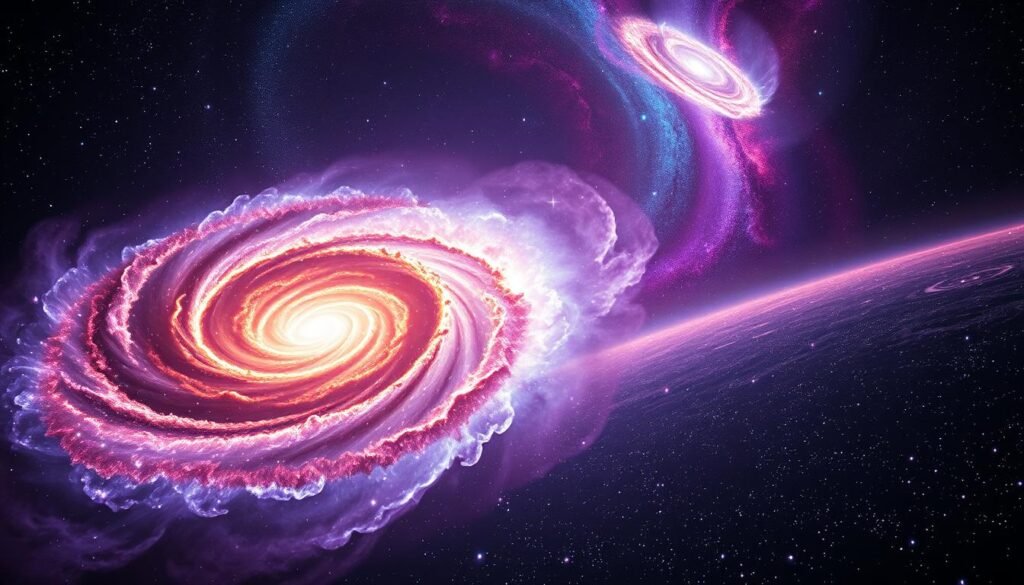
In about 4.5 billion years, the Milky Way will merge with Andromeda. This will create a new, massive galaxy. This event will change our galaxy’s shape, blending two galaxies into one big elliptical one.
Scientists use telescopes and computers to study this growth. They learn about the universe by watching how galaxies grow and meet. This helps us understand the universe’s complex structure.
Space Technology: How We Study Our Galaxy
Exploring the vast Milky Way needs top-notch technology and amazing scientific ideas. Galactic research has changed how we see space with incredible tools. These tools look deep into the cosmic world. Scientists use advanced space telescopes and smart research tools to solve the mysteries of our galaxy.
Space telescopes are at the forefront of space discovery. They take stunning pictures and gather important data on distant stars, planets, and cosmic events. Unlike telescopes on Earth, space telescopes don’t get distorted by the atmosphere. This gives us clear views of the universe.
Telescopes and Tools
Modern galactic research depends on several groundbreaking instruments:
Hubble Space Telescope: Captures high-resolution images of deep space
Spitzer Space Telescope: Studies infrared emissions from celestial objects
James Webb Space Telescope: Explores distant galaxies with unprecedented clarity
Space Missions
Dedicated space missions expand our cosmic knowledge. Special satellites and probes gather key data on star formations, planets, and galaxy structures. Missions like Gaia have made detailed 3D maps of our galaxy. These maps show how stars move and the layout of the cosmos.
By using advanced space telescopes and smart research methods, scientists keep uncovering the deep secrets of our vast Milky Way galaxy.
Future of Our Galaxy: The Andromeda Collision
Get ready for the ultimate cosmic journey! In about 4.5 billion years, the Milky Way will collide with Andromeda. This won’t be a quick space encounter. It’s more like a slow dance that will change our galaxy’s shape.
Scientists say this collision will be a cosmic show. Stars won’t crash into each other. Instead, they’ll move in a way that will light up the sky. This will create a new galaxy, called Milkomeda, with the best of both worlds.
Humans won’t see this amazing event. But future civilizations might be amazed by the new galaxy. This collision shows how our universe is always changing. It’s like a cosmic remix of two galaxies into one.
This event shows that space is always changing. The Milkomeda merger shows the power of our universe. It’s a reminder that change is constant, even on a galactic scale. It’s nature’s way of creating a new cosmic masterpiece.