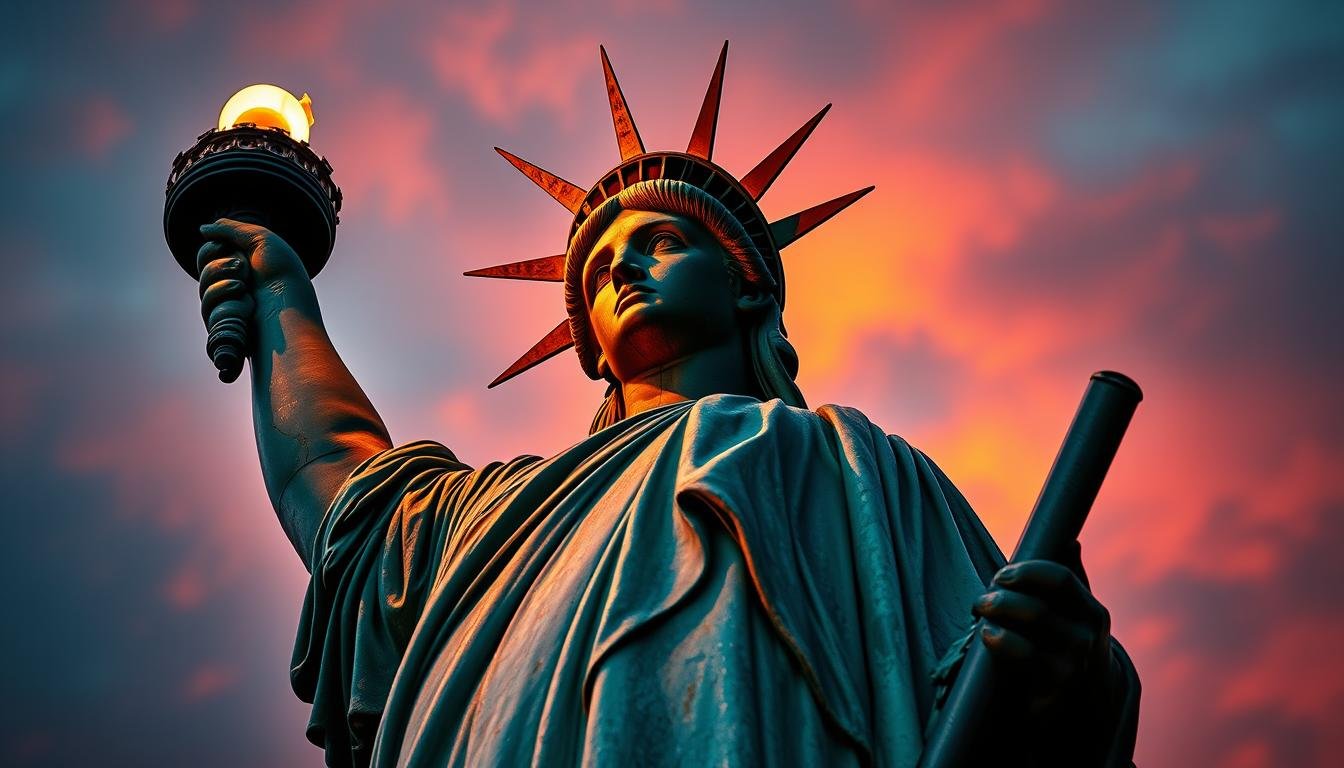
You’d never guess this green giant started life as a shiny copper penny! Back in 1886, Lady Liberty wasn’t just a gift from France—she was a metallic masterpiece that blushed green after 30 years of New York’s salty air and rain. Picture a 151-foot-tall copper figure turning colors like mood jewelry, and you’ve got America’s most famous science experiment.
Let me blow your mind: the statue’s skin is thinner than two stacked pennies (just 0.094 inches!), yet it survived hurricanes, tourists, and 134 years of bad weather. Sculptor Frédéric Bartholdi designed her folds to literally breathe—those ripples in her robe? Genius airflow vents disguised as art.
Here’s the kicker: France spent a decade building this copper giant, then shipped her in 350 pieces like the world’s heaviest IKEA project. When she first stood in New York Harbor, sailors probably thought a giant had dropped a lucky penny. Now her green patina acts like nature’s sunscreen—no touch-ups needed!
Want to know how she went from “brand new penny” to “oxidized avocado”? Stick around. We’re diving into rust chemistry, sneaky engineering tricks, and why this French-American icon keeps surprising us.
From Copper to Green: The Visual Evolution
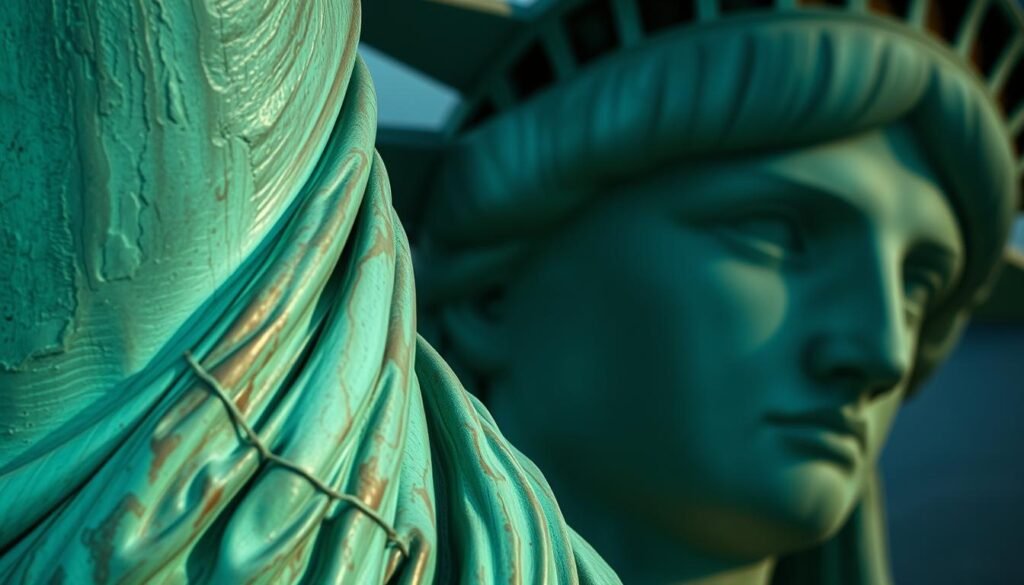
Imagine a colossal penny standing tall in New York Harbor, slowly transforming into an emerald icon. That’s exactly what happened here—Mother Nature became the ultimate makeup artist. When copper meets salty air and rain, it cooks up a chemical recipe called patina. Think of it like rust’s fancier cousin: over 30 years, oxygen and moisture turned her skin into that famous green armor.
Early sailors docking in York Harbor wrote about catching sun glints off her metallic surface—like a giant disco ball greeting ships. But here’s the kicker: that green crust isn’t just pretty. It’s science’s version of sunscreen, shielding the metal underneath. Engineers actually counted on this reaction—they knew the patina would act like a self-healing force field.
I’ll never forget seeing her from a ferry—that green glow against New York’s skyline feels like watching history breathe. What’s wild? No one in 1886 could’ve predicted she’d become a living science project, teaching us about oxidation through her wardrobe change. Turns out, even icons evolve—one molecule at a time.
Gift’s Backstory and Unusual Origins
Ever received a gift so big it needed 350 pieces? France basically said, “Let’s build a copper colossus!” in 1875. Édouard de Laboulaye—a French historian with big ideas—dreamed up this liberty love letter to celebrate America’s centennial. But here’s the twist: it took a decade to finish, and we almost rejected the package.
French Generosity and Revolutionary Hints
The sculptor Frédéric Bartholdi wasn’t messing around. His early blueprints show a wild original torch design—a flaming beacon with gold leaf details. Fun fact: that torch got scrapped twice before landing on the final version. He snuck revolutionary symbolism everywhere, like the tablet engraved “JULY IV MDCCLXXVI” (that’s 1776 for us non-Latin speakers). Subtle? Not exactly. Iconic? Absolutely.
American Pedestal Puzzles and Early Challenges

Meanwhile, America faced its own headache: building a pedestal sturdy enough for this gift. Imagine trying to assemble Ikea furniture without instructions—except it’s 89 feet tall and made of concrete. Funding dried up faster than spilled coffee, until newspaper tycoon Joseph Pulitzer crowdsourced donations. Even kids chipped in pennies! Talk about a DIY project gone epic.
| French Contribution | American Challenge | Symbolic Element |
|---|---|---|
| Copper skin & internal framework | Pedestal funding crisis | Declaration of Independence date |
| Bartholdi’s sculptural vision | Public skepticism | Broken chains at feet |
| Original torch design | Engineering unknowns | Seven-spike crown |
Honestly, this “gift” felt like getting a Lamborghini… but having to build the garage first. Yet somehow, through Franco-American stubbornness and creative problem-solving, Lady Liberty rose—torch included.
Creative Construction Techniques
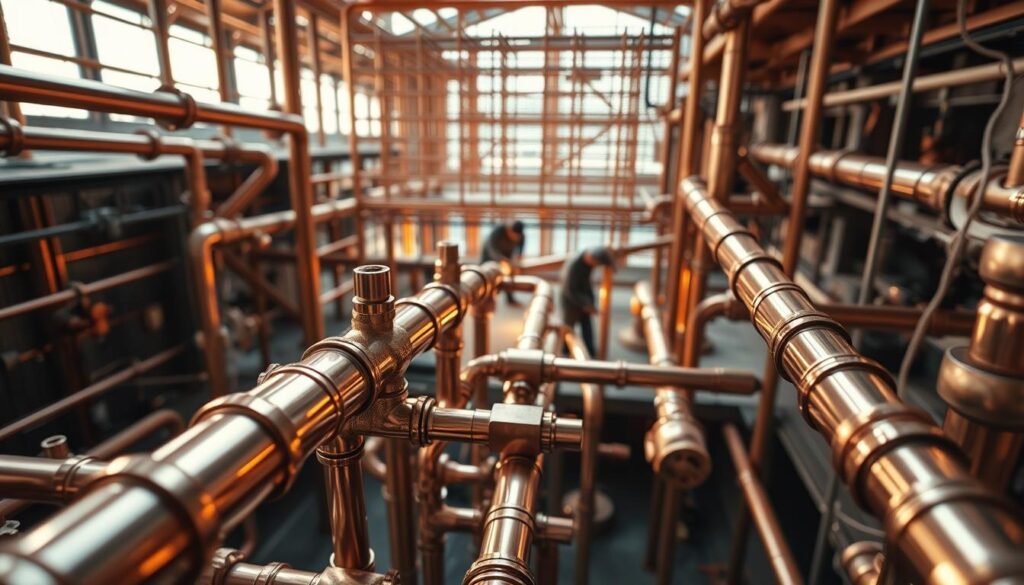
Picture this: French artisans hammering copper sheets thinner than a dime, shaping history one dent at a time. Bartholdi’s team used an ancient technique called repoussé—metal origami for grown-ups—to mold Lady Liberty’s skin. They’d pound heated copper over wooden forms, creating folds that catch light like rippling water. What blows my mind? Each section could flex independently, letting her sway six inches in hurricane winds without cracking.
Repoussé Wonders and Hammered Copper Narratives
This wasn’t just metalwork—it was performance art. Workers shaped 300+ copper pieces using hammers and stakes, turning flat sheets into a 3D masterpiece. The torch alone required 3,600 pounds of material, hammered until it gleamed like liquid fire. I’ve seen modern factories struggle with precision these craftsmen achieved by hand. Their secret? Treating metal like fabric—stretching, folding, and texturing until it breathed.
Eiffel’s Ingenious Steel Frame and Structural Twists
Gustave Eiffel (yes, that Eiffel) engineered her spine—a construction marvel hiding beneath the copper. His iron skeleton acted like a shock absorber, letting the outer skin expand and contract with temperature swings. The torch’s flame? A clever disguise for ventilation ducts preventing pressure buildup. It’s wild—every “decorative” element solved an engineering puzzle. Today’s architects still study this hybrid of art and infrastructure.
Standing beneath her last year, I marveled at how 19th-century minds built something tougher than most modern stadiums. That torch isn’t just a symbol—it’s a time capsule of industrial ingenuity, blazing brighter with every passing century.
Addressing Challenges of Funding
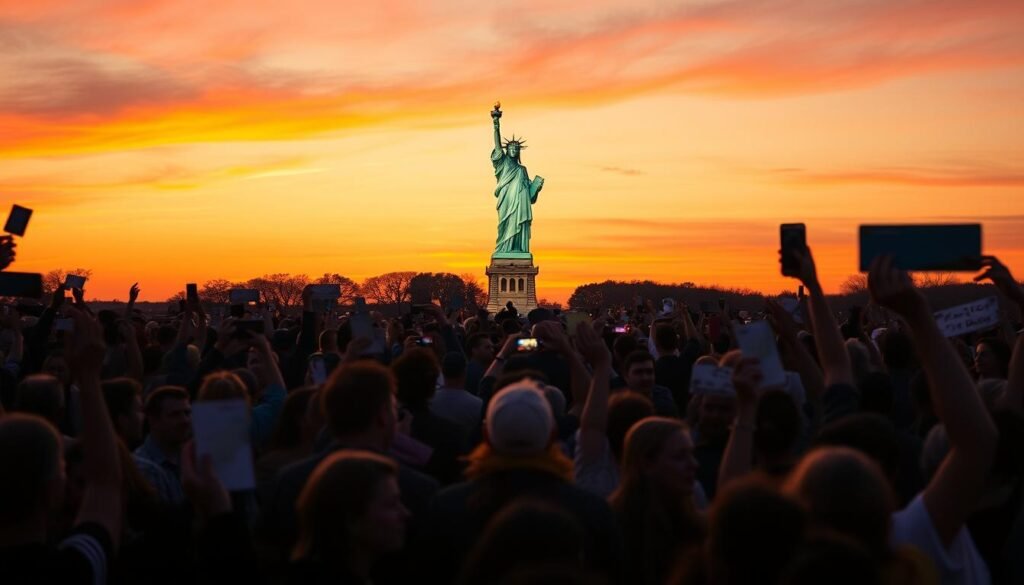
Ever tried crowdfunding a coffee machine? Multiply that by 151 feet of copper. France built the gift, but America needed $250,000 (about $7 million today) just for the pedestal. Cue the world’s first transatlantic fundraising marathon—a 10-year hustle involving bake sales, rich folks, and a newspaper mogul’s wild publicity stunt.
Crowdsourcing Chronicles in Two Continents
Over in France, people paid to see Bartholdi’s workshop—like a 19th-century Patreon tier. Artists auctioned paintings; theaters hosted benefit shows. Meanwhile, America’s fundraising flopped harder than a soggy croissant. Enter Joseph Pulitzer: his New York World newspaper shamed millionaires and printed every donor’s name, even kids who sent pennies. One Brooklyn school class raised $1.35 (enough for 300 pretzels back then).
I love this story because it’s pure people power. Rich donors wrote checks, but 80% came from middle-class wallets. For years, folks mailed coins wrapped in notes like “From factory workers who believe in liberty.” By 1885, they’d scraped together $102,000—enough to pour concrete for Lady Liberty’s shoes.

Here’s the kicker: France and America spent years arguing over who’d pay for what. At one point, Philadelphia almost stole the statue by offering to fund it! But persistence won. When you see her today, remember: every rivet represents someone’s two cents—literally.
Statue of Liberty Facts for Kids: Symbolism & Surprises
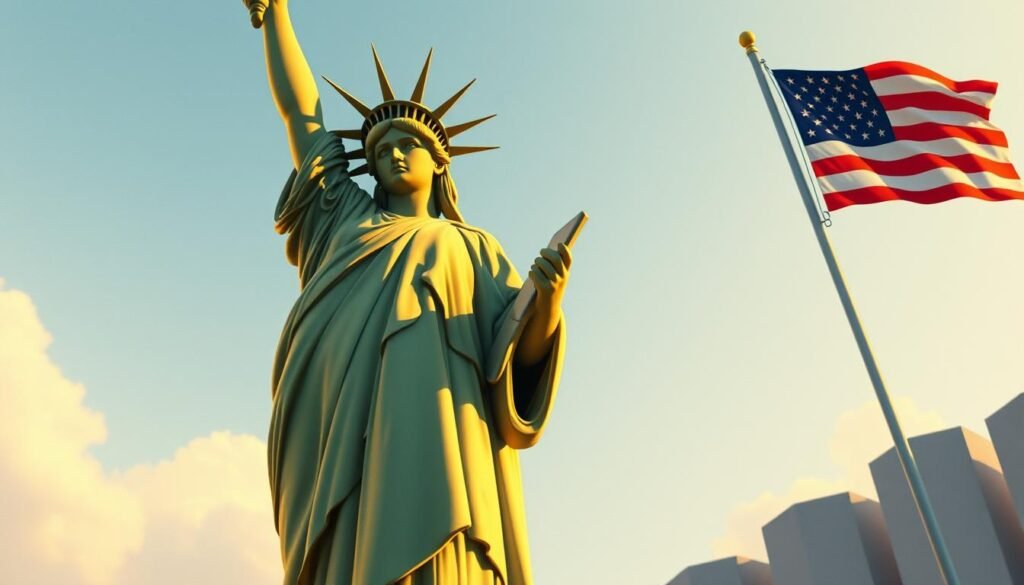
Bet you didn’t know Lady Liberty’s sandals are crushing broken chains—a sneaky symbol of freedom from oppression. That’s right, her Roman-style footwear hides rebellious details most visitors miss. The seven spikes on her crown? Not just decor—they represent Earth’s seven continents and seas, shouting “Liberty for all!” without saying a word.
Here’s the cool part: that massive tablet she’s holding isn’t a random prop. Engraved with “JULY IV MDCCLXXVI,” it’s basically America’s birthday certificate. I once watched a kid gasp realizing it’s literally our Declaration of Independence date. Talk about history hiding in plain sight!
- Torch = Enlightenment (literally lighting the way)
- Robe folds = Flowing freedom, not just fabric wrinkles
- 25 windows in crown = Gemstones symbolizing natural wealth
What blows my mind? How immigrants in the 1900s saw her torch as a giant “Welcome” sign. A Polish teen in 1906 reportedly cried, “She’s holding the light just for us!” That’s the magic of symbols—they morph to fit our stories. Your family might see hope in her gaze, while mine spots engineering genius.
Next time you spot her in movies or memes, remember: every inch whispers facts about liberty’s price and promise. Even her left foot’s lifted, frozen mid-stride toward progress. Not bad for a 150-year-old metal lady, huh?
Pedestal, Torches, and Illumination Mix-Up
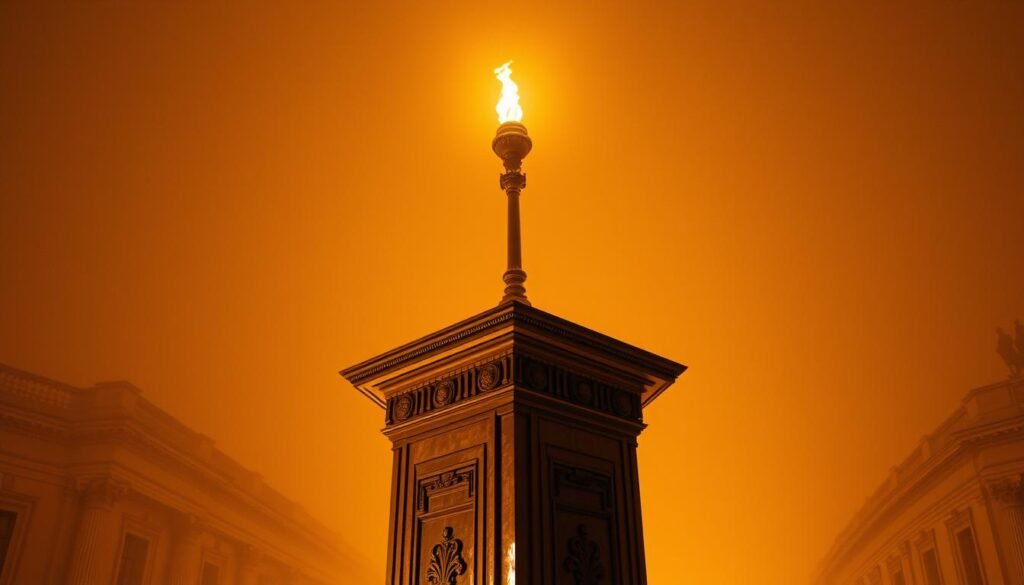
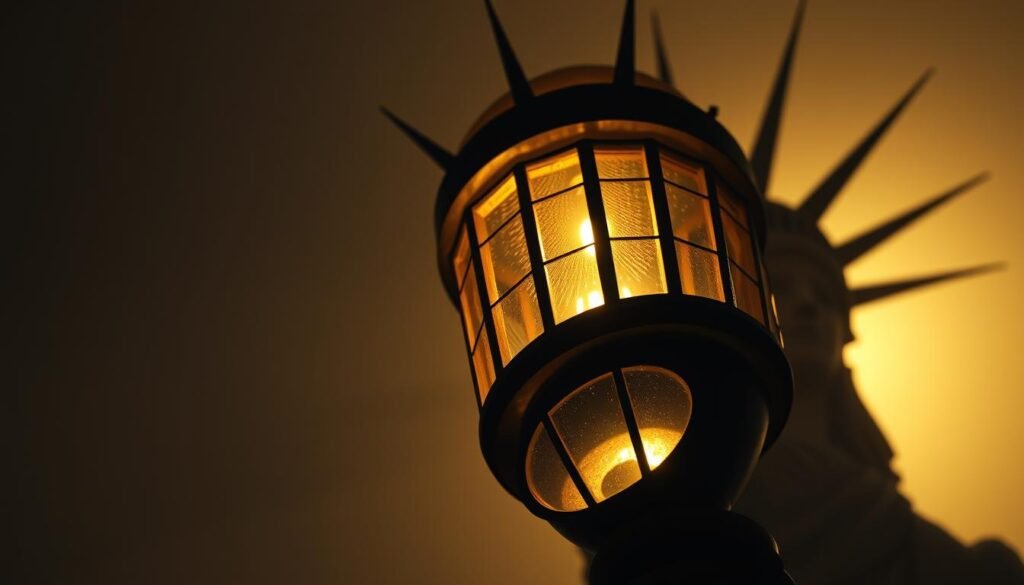
Let’s talk about America’s most famous lamp—that torch wasn’t always camera-ready. The original 1886 flame looked like a giant copper colander, leaking rainwater onto visitors below. Engineers scrambled to fix it, adding glass panes that made the torch resemble a stained-glass beehive. Spoiler: it failed spectacularly.
Original Torch Tinkering and Modern Adjustments
By 1916, workers stripped the torch’s copper skin and replaced it with 250 glowing amber glass panels. Bad news: it still leaked. Worse news: they coated the flame in 24-karat gold leaf, creating a disco-ball effect that blinded harbor pilots. Today’s replica torch (added in 1986) uses museum-grade materials—no more accidental lighthouse impersonations.
Down below, the pedestal hides secrets better than a magician’s sleeve. Climb its 154 steps, and you’ll find exhibits showcasing the original torch’s skeletal remains. My favorite? A scale model of Lady Liberty’s pinky toe—bigger than your couch.
What cracks me up? The pedestal’s original blueprints called for a moat (!) to deter vandals. Instead, we got a museum celebrating immigrant stories. Talk about a glow-up: from soggy torch fixes to gold-plated upgrades, this icon proves even national treasures need occasional makeovers.
Historical Reorganizations and Nods to Immigrants

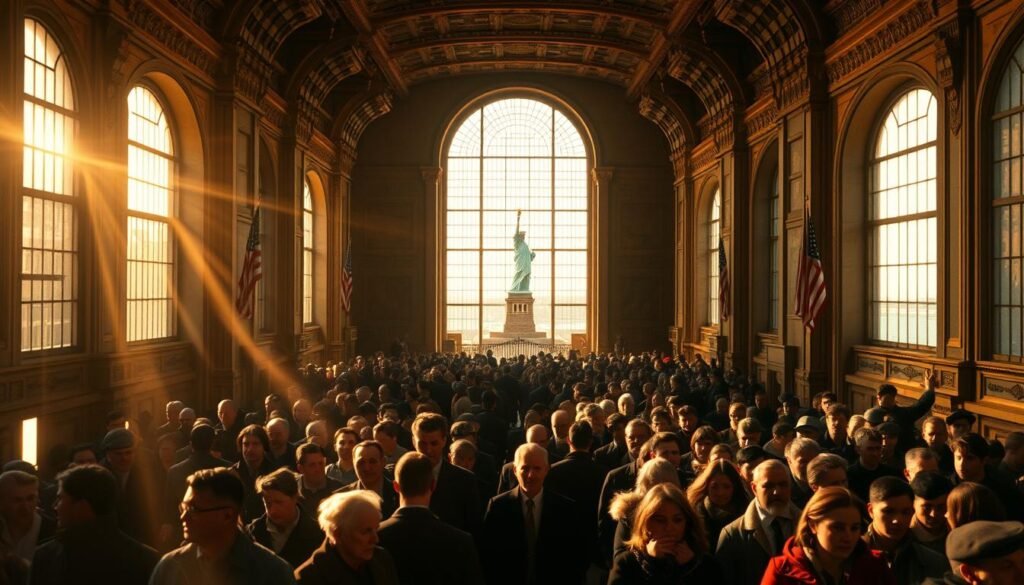
Standing in New York Harbor, she wasn’t just a monument—she was the first hello for millions. Between 1892 and 1954, over 12 million people sailed past her torch to Ellis Island, clutching hope like a life preserver. I’ve held replicas of those ship tickets—thin paper that held entire futures.
Picture a Sicilian family in 1907: salt-crusted faces pressed against railings, spotting her crown through fog. That moment became America’s origin story for countless families. The United States didn’t just gain citizens—it absorbed dreams, recipes, and resilience from every docked steamship.
Here’s what moves me: immigration records show kids as young as five listed occupations like “farmhand” or “seamstress.” Their first view of freedom? A green giant holding light steady through storms. Even today, descendants visit Ellis Island’s registry room, tracing fingers over ancestors’ handwritten entries.
I once met a woman whose grandmother arrived in 1911, reciting Lady Liberty’s poem: “Give me your tired, your poor…” That’s the magic—she wasn’t just steel and copper. She became a mirror reflecting our collective hunger for new beginnings.
Modern ceremonies still honor this legacy. Every naturalization oath taken on Ellis Island echoes those early arrivals’ whispers. The statue’s secret power? Making “American” less about geography, more about courage to start over.
Behind the Design: Sculptural Secrets
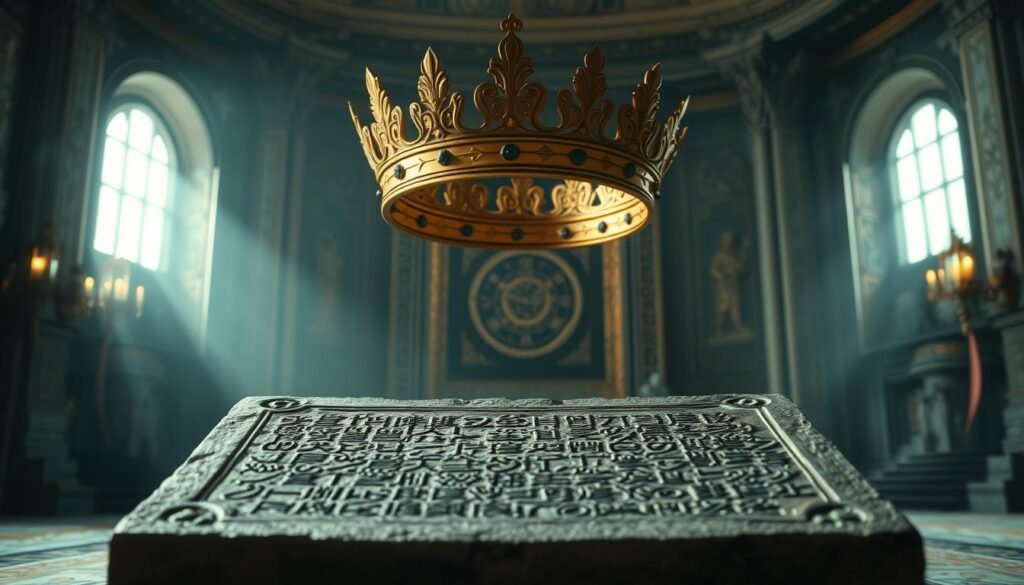
What if I told you every curve on Lady Liberty was a hidden message? Frédéric Bartholdi didn’t just sculpt metal—he encoded revolutions into her posture. That raised arm? A deliberate echo of ancient Roman goddess Libertas. The name says it all: “Liberty Enlightening the World” wasn’t just a title—it was a manifesto chiseled in copper.
Bartholdi’s Bold Brushstrokes in History
Digging through Bartholdi’s sketches, I found wild ideas that never made it—like giving her a pileus (freed slave’s hat) instead of the crown. His final choice? Seven spikes radiating like sunbeams, symbolizing light reaching all seven continents. Genius move: the diadem doubles as a solar halo, making her look celestial from ships below.
Detailing the Tablet and Inscription Choices
That tablet in her left arm? It’s thicker than a dictionary for a reason. Bartholdi wanted it to feel monumental, literally grounding her in America’s founding moment. The “JULY IV MDCCLXXVI” engraving? He insisted on Roman numerals to connect to Europe’s classical past—a bridge between old and new worlds.
Here’s a nugget most miss: the crown’s 25 windows represent gemstones, but also natural resources offered to newcomers. And get this—Bartholdi nearly named her “Liberty Lighting the Way” before settling on “Liberty Enlightening the World”. Rolls off the tongue better, right?
Standing beneath her last fall, I realized something: great design outlives its creator. Those crown spikes still catch dawn light like they did in 1886, proving Bartholdi’s vision was timeless. Want to blow a kid’s mind? Tell them her pinky finger’s longer than most adults—now that’s a statue liberty fact worth remembering.
Unexpected Turns in Structure Adjustments

What do you get when France mails a 225-ton jigsaw puzzle? A shipment of chaos! In 1885, 350 copper pieces arrived in New York Harbor—each part numbered like giant Lego blocks. But here’s the twist: workers spent four months reassembling her while the government argued over bills. Imagine building Ikea furniture blindfolded, except missing screws could topple a national icon.
The first shock came when the ship unloaded crate #1: Lady Liberty’s torch arm. It sat exposed on Bedloe’s Island for a year while America scrambled for pedestal funds. I’ve seen photos—that lone arm looked like a toddler’s tower block experiment. When the government finally approved cash, engineers faced another nightmare: matching French measurements to American tools. Spoiler: they didn’t.
Three critical parts needed last-minute fixes:
- The head’s copper skin gaps (fixed with decorative rivets)
- Torch ventilation issues (added secret airflow channels)
- Pedestal anchor misalignment (solved with 300,000 pounds of concrete)
By 1886, workers were bolting sections in pouring rain—time crunch pressure turned every lunch break into a engineering huddle. What fascinates me? Original blueprints show 40% of the framework was redesigned mid-build. The government nearly canceled the project twice, but public demand (and Pulitzer’s newspaper crusade) kept the dream alive.
Here’s the kicker: that iconic crown wasn’t fully assembled until three days before the unveiling. Talk about cutting it close! Every time I visit, I spot those hasty rivet patches—silent witnesses to history’s greatest DIY challenge.
Real-Life Anecdotes from New York Harbor
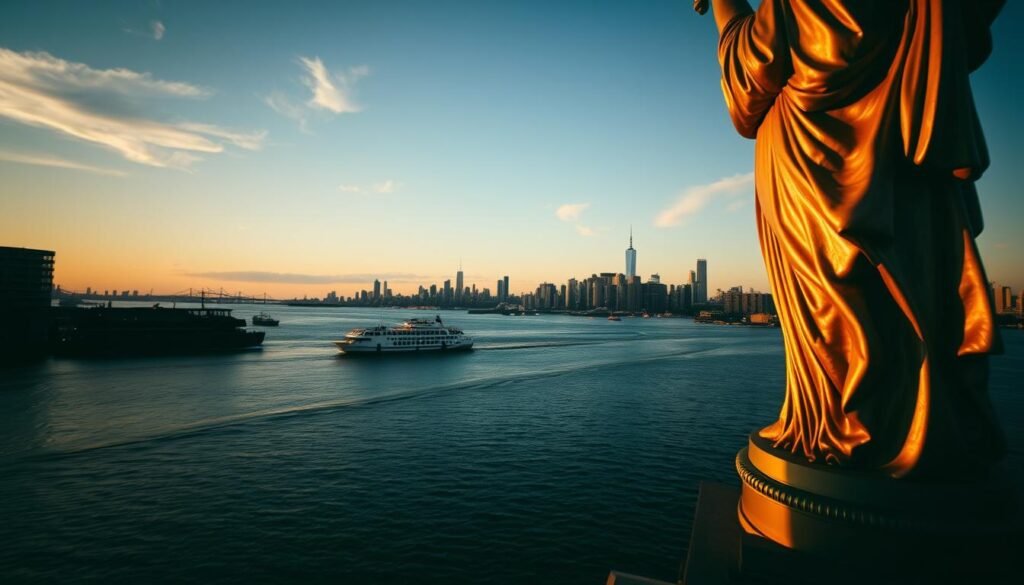
The first time I sailed past Bedloe Island at dawn, fog clung to the statue’s crown like cotton candy. A German tourist beside me whispered, “She’s wearing the weather,” as sunlight pierced the mist. That’s New York Bay magic—where history and human wonder collide daily.
New York Bay Snapshots and Pedestal Moments
In 1936, a Brooklyn dockworker snapped the most stolen postcard image: two boys gaping at the monument from a tugboat. Their awestruck faces mirror today’s TikTokers leaning off New York City ferries. Last summer, I watched a toddler point and shout, “Big lady has a flaming lollipop!”—proof some first impressions never change.
Climbing the pedestal last fall, I found 1942 graffiti etched near the entrance: “Giuseppe + Rosa ♡ Liberty.” Imagine carving love notes into a national treasure! Rangers told me couples still propose there, chasing that Bedloe Island romance. One groom even arrived by Jet Ski, ring tucked in his wetsuit.
New York City’s skyline may sprout glass towers, but the harbor keeps its time-capsule charm. A park ranger once showed me 1920s visitor logs—entries like “Anastasia Petrova, 14, from Minsk: Saw Lady’s torch first.” Today’s kids scribble similar excitement in junior ranger booklets, bridging generations through shared awe.
My favorite moment? Watching dawn light hit the pedestal as a street musician played “America the Beautiful” on harmonica. Tourists from five continents hummed along—New York Bay becoming the world’s living room for three minutes. That’s the statue’s secret power: turning strangers into storytellers.
Interweaving Facts with Edgy Commentary
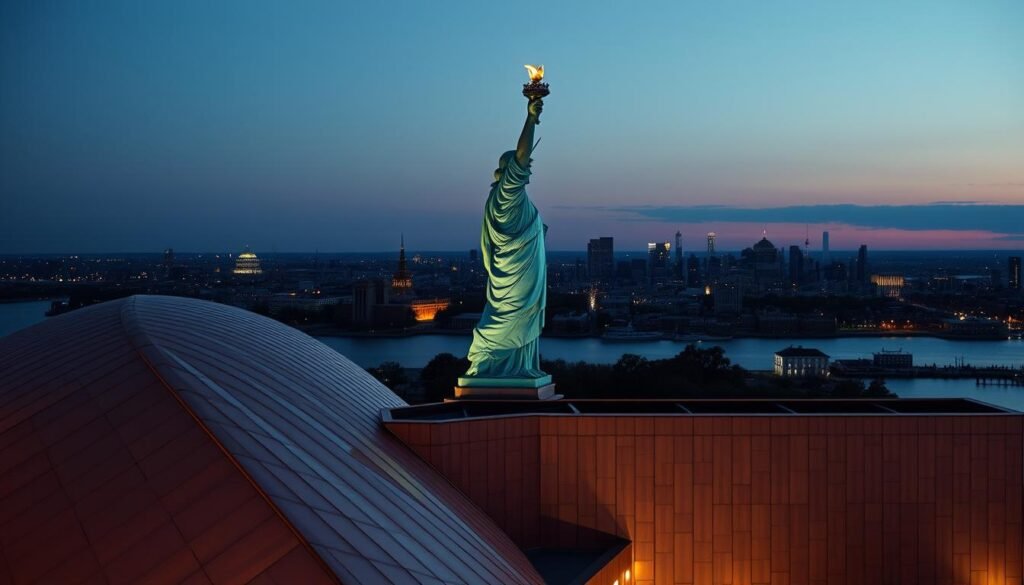
Ever wonder how a 305-foot monument becomes a time capsule? The statue liberty museum tucked inside her pedestal does the heavy lifting. I’m talking original torch fragments that look like sci-fi props and scale models revealing engineering secrets. It’s history class meets treasure hunt—if Indiana Jones curated exhibits.
Pedestal Puzzles that Stir the Imagination
That concrete base isn’t just a footstool—it’s a mad scientist’s blueprint. Architects left cryptic notes about ventilation shafts disguised as decorative grooves. Why? To prevent moisture buildup that could’ve turned Lady Liberty into a copper pancake. The park service still debates whether some design choices were genius or happy accidents.
Here’s the kicker: workers poured the pedestal’s foundation using 24,000 tons of rubble—including Civil War-era cannons. Talk about recycling before it was cool. Climb those 154 steps today, and you’re literally walking on history’s leftovers.
Iconic Inscription Insights with a Twist
Bartholdi’s “JULY IV MDCCLXXVI” tablet isn’t just a date—it’s a national monument mic drop. But guess what? Early sketches show Roman numerals sized for ants. The final version? Each character stands 16 inches tall—because subtlety’s overrated when you’re shouting revolution across an ocean.
The park service once found graffiti from 1903: “Giuseppe + Maria ♡ Liberty.” Turns out love notes outlast empires. Now protective glass shields the stone, proving even freedom symbols need babysitters.
Next time you visit this national monument, ask yourself: Who decides which stories get spotlighted? The park service juggles preservation with progress—like a DJ remixing history’s greatest hits. Spoiler: they’re killing it.
Engaging Fundraising Tactics That Worked Despite Odds
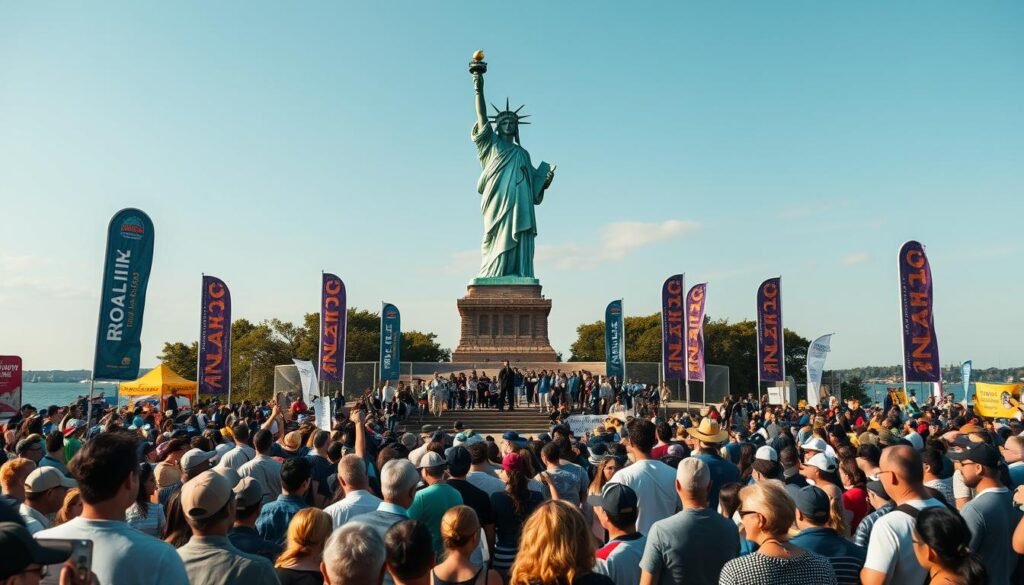
Who knew pennies could build an icon? When Liberty Island’s pedestal funds dried up in 1885, Joseph Pulitzer turned his newspaper into a megaphone. His New York World blasted front-page pleas like “We Must Not Wait for Millionaires!”—and America listened. Schoolkids mailed nickels wrapped in crayon drawings, while waitresses donated a day’s tips. One farmer even sent a chicken (valued at 25¢).
Pulitzer’s Paper Push and Donor Surprises
This wasn’t just fundraising—it was storytelling. Pulitzer printed every donor’s name, turning givers into local celebrities. A Brooklyn teacher’s class raised $1.35 (about $40 today), while a Civil War vet sent his last dollar. The campaign’s genius? Framing the statue as “Liberty Enlightening the World”—a shared mission, not a handout.
- 120,000+ donors in six months
- 80% of contributions under $1
- Fundraising total: $102,000 (≈ $3 million today)
Walking through the national park today, I spot plaques honoring those “penny patriots.” Their legacy? Proving crowdsourcing works—no TikTok required. What’s wild? France’s copper gift almost toppled over because America couldn’t afford the base. Thanks to Pulitzer’s hustle, we got history’s most democratic pedestal instead.
That enlightening world slogan still resonates. Every ferry ride to Liberty Island feels like joining those 19th-century donors—ordinary people banking on an extraordinary symbol. Turns out, hope makes better glue than concrete.
Timelines, Repairs, and Flashy Makeovers
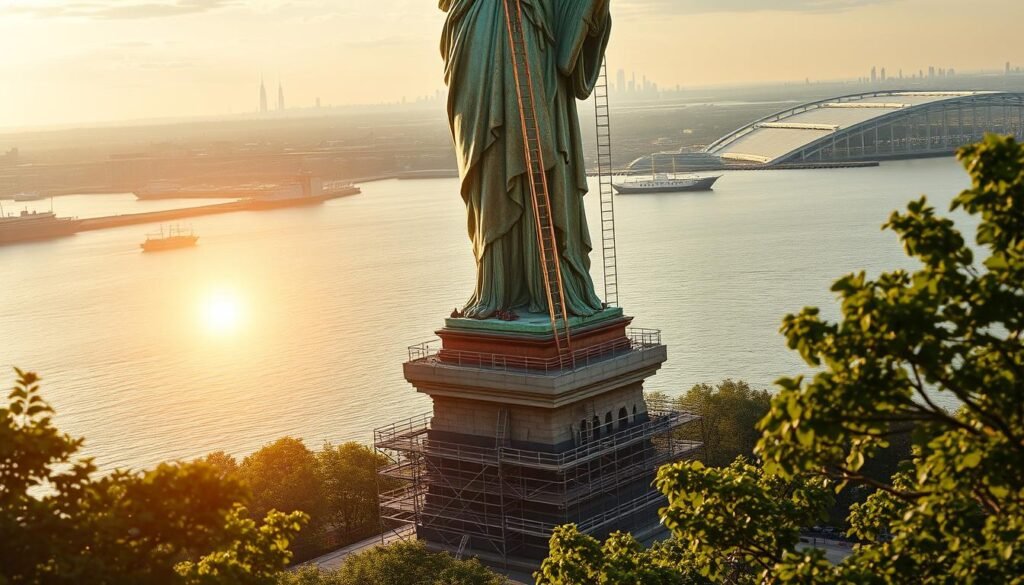
Maintaining a 305-foot icon isn’t for the faint-hearted—ask the daredevils who replaced her torch mid-air in 1986. The national park service once dangled engineers from harnesses to fix corroded rivets, turning preservation into extreme sports. I’ve seen photos of workers zip-lining copper panels like rock climbers redecorating Everest.
Let’s timeline this drama: after surviving 98 years of salt spray, Lady Liberty got a “spa day” in 1984. Crews stripped 1,500 rusted iron bars, swapping them with stainless steel that wouldn’t bleed green onto her skin. The world heritage site status? It forced restorers to balance modern tech with historical accuracy—like using 19th-century tools for 30% of repairs.
Here’s the kicker: during the ’80s makeover, they discovered her original torch had been leaking since 1916. The national park service opted not to restore it, instead displaying the skeletal relic in the pedestal museum. Smart move—now visitors gawk at its decayed grandeur while the new torch gleams with 24-karat gold leaf.
Climbing her crown last year, I spotted laser-etched markers from the 1986 team—ghost signatures of those who’ve touched history. The statue liberty island crew still battles epic challenges: micro-cracks from tourist foot traffic, pigeon-proofing the crown spikes, and scrubbing graffiti without harming patina. Each fix becomes a national park service masterclass in creative problem-solving.
What blows my mind? This world heritage site now uses drones for inspections—a far cry from 1937’s rope-and-pulley audits. Yet some traditions endure: every October, workers reapply 300 pounds of protective wax, keeping America’s favorite copper lady camera-ready for her next close-up.
Wrapping It Up With a Salute to Liberty
Here’s the wild part—her story isn’t finished. Every chip in her patina whispers liberty facts we’re still decoding. I’m still picking my jaw off the floor over how copper + seawater = accidental genius. What secrets still hide in her copper folds? Maybe tomorrow’s engineers will find clues we missed.
That’s the magic—she’s not just metal. She’s a mirror reflecting how the world sees freedom. I’ve watched tourists from every continent tear up at her feet, each finding their own story in her gaze. Does her torch shine brighter now than in 1886? Depends who you ask—immigrants, artists, or kids spotting her crown from ferries.
Think about it: Bartholdi’s team built a world icon using hammers and hope. Today, she’s still teaching us chemistry, history, and why stubborn dreams matter. Those broken chains at her feet? They’re not relics—they’re reminders that liberty’s always a work in progress.
So here’s my unofficial salute: keep questioning her mysteries. That green glow? Just the start. Her real power lives in the conversations she sparks across the world. Catch you on the next ferry—who knows what we’ll uncover? 🗽